Key Takeaways About Scrumban
- Hybrid Nature and Continuous Flow: Scrumban is not a simple informal middle ground; it is a structured methodological framework that combines the predictability and ceremonies of Scrum with Kanban’s pull system and continuous delivery.
- Elimination of Administrative Waste: It replaces complex story point estimation and fixed-scope sprints with Just-in-Time planning triggered by visual reorder thresholds.
- Visual Control and Bottleneck Resolution: Strictly enforcing Work-in-Progress (WIP) limits and visual impediment indicators drives team swarming (focused collaboration), reducing blocked task durations by up to 55% (GALP case study).
- Objective Metrics vs. Estimations: Team performance is evaluated via Little’s Law using Lead Time, Cycle Time, Throughput, and Cumulative Flow Diagrams (CFD), replacing traditional sprint velocity with empirical data on real capacity.
- Proven Cross-Industry Versatility: Its success is empirically documented across diverse sectors: from data engineering and hardware/software projects (INDT) to civil construction, Global Software Development (GSD), and academic simulation environments (UniFOA).
- Discipline as the Decisive Factor: Scrumban fails when adopted as an excuse to operate without structure (a “Frankenstein Model”). Its effectiveness critically depends on visual board hygiene, adherence to WIP limits, and clear semantic alignment of work states.
If your team seeks a balance between the functional rigidity of Scrum sprints and the continuous flexibility of Kanban, a middle ground exists. Scrumban is the hybrid framework that integrates the best of both worlds: Scrum’s strategic cadence with Kanban’s continuous workflow and visual management. However, what does this approach truly entail, how does it operate in practice, and why does it divide opinions within the agile community regarding its status as a formal methodology?
In this comprehensive guide, we will analyze the true origin of the term, the discrepancies among agile coaches regarding its legitimacy, and the key metrics that distinguish a rigorous Scrumban process from an improvised implementation. Furthermore, we will explore its operational advantages and disadvantages, evaluate whether it aligns with your management goals, and define clear criteria to determine when adopting this solution is appropriate.
What is Scrumban? Definition of the Hybrid Framework
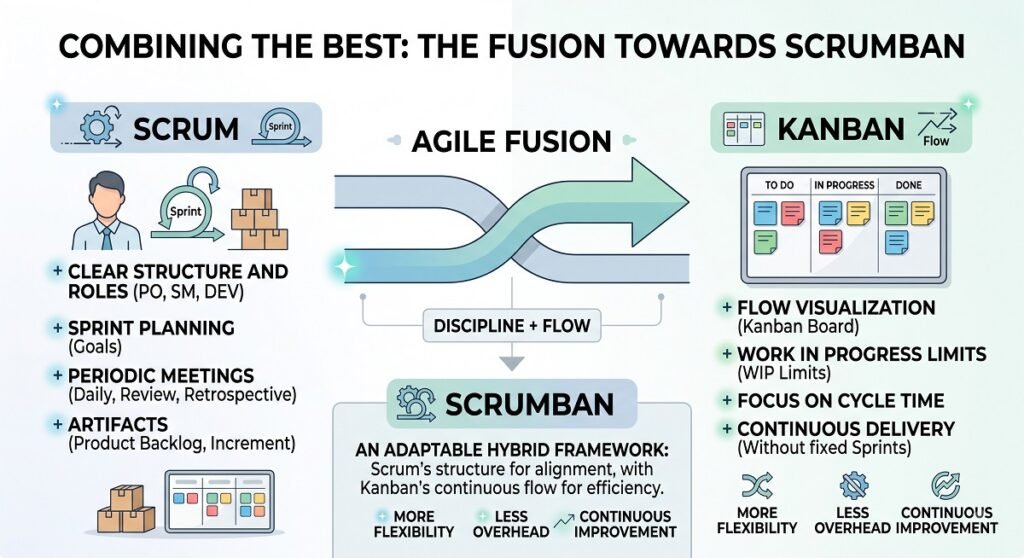
Scrumban is a hybrid agile framework that integrates Scrum‘s planning structure with Kanban‘s visual management and continuous flow. In practice, a Scrumban team manages its work on a visual board with Work-in-Progress (WIP) limits while retaining key Scrum events—such as planning sessions, reviews, and retrospectives—tailored to its specific needs.
Originally conceived as a transition method to guide development teams from Scrum toward more advanced continuous flow models (Fuentes Del Burgo & Sebastián, 2022; Meireles et al., 2025), Scrumban has now established itself as a highly stable operating model ideal for environments with highly variable demands (Benoliel, 2025).
Its core premise is clear: adopt Scrum’s discipline without its operational rigidity, and leverage Kanban’s fluidity without losing strategic direction. Unlike Scrum, Scrumban does not require packaging deliverables into fixed-length sprints; work is managed via a pull system as capacity becomes available. Likewise, unlike pure Kanban, it establishes deliberate prioritization intervals.
This dynamic makes it an ideal approach for teams with continuous, unpredictable workloads—such as support, maintenance, operations, or marketing—where setting static goals is unfeasible. Consequently, those seeking to understand the Scrumban method are usually looking to resolve a recurring challenge: an excess of unplanned tasks interrupting traditional planning.
The Origin of Scrumban: A Destination or a Stepping Stone?
The term was coined in 2008 by Corey Ladas in his work Scrumban: Essays on Kanban Systems for Lean Software Development. Ladas, a prominent figure in Agile and Lean development, did not conceive Scrumban as a permanent hybrid framework—a “50% Scrum and 50% Kanban” model—intended to be a team’s final state.
On the contrary, he designed it as a transition method: a progressive pathway for Scrum-based teams to integrate Lean and Kanban principles until evolving into a mature continuous flow system. From its author’s perspective, Scrumban was a strategic stepping stone toward a superior operating model, rather than a definitive goal.
However, over time, numerous organizations discovered that this middle ground delivered optimal performance in its own right and chose to adopt it permanently, solidifying popular perception of Scrumban as a standalone framework. This historical nuance is essential: while its creator envisioned it as a temporary bridge, much of the industry embraced it as a final destination.
In this regard, Fuentes Del Burgo and Sebastián (2022) note that transitioning board usage—from Scrum to Kanban, and ultimately to Scrumban—aims to establish a continuous workflow, facilitate early detection of bottlenecks, and drive continuous improvement strategies.
Scrum + Kanban = Scrumban
To understand how Scrumban strategically merges both frameworks—leveraging Scrum’s discipline and Kanban’s flexibility—the following table details the integration and operational mechanics of each adapted element:
Table 1. Integration of Scrum and Kanban elements within the Scrumban framework.
| Origin Methodology | Adapted Element | Details and Operation in Scrumban |
| Scrum | Structure and roles | Retains key roles such as Product Owner, Scrum Master, and development team, adapting them flexibly to project context (Fuentes Del Burgo & Sebastián, 2022). This preserves self-organization and a strong sense of shared accountability (Benoliel, 2025). |
| Scrum | Rites and ceremonies | Maintains essential alignment events, such as Daily Stand-ups to identify blockers, Reviews to gather direct feedback, and Retrospectives for continuous process improvement (Paul & Rahman, 2018; Meireles et al., 2025). |
| Kanban | Visual board | Utilizes a dynamic board with columns and cards to transparently map the end-to-end workflow, enabling rapid detection of bottlenecks and interdependencies (Fuentes Del Burgo & Sebastián, 2022). |
| Kanban | Work-in-Progress (WIP) Limits | Establishes a numerical cap on concurrently active tasks per column (Paul & Rahman, 2018; Benoliel, 2025). This safeguards the team from overload and prevents the accumulation of unfinished work (Fuentes Del Burgo & Sebastián, 2022). |
| Kanban | Pull system | Tasks enter the workflow only when active capacity becomes available, replacing rigid batch allocation with a continuous delivery model (Paul & Rahman, 2018). |
This hybrid convergence allows teams to minimize operational waste and reduce planning overhead while retaining a structured framework for continuous collaboration and optimization.
The Debate in the Agile Community: Is Scrumban a Real Methodology?
The status of Scrumban sparks considerable skepticism in various professional agile forums, where its validity as an independent framework is a matter of constant discussion.
The Skeptical Perspective
Several coaches and practitioners contend that Scrumban is ‘not a real framework,’ but rather a convenient label for teams that failed to implement Scrum or Kanban properly. From this critical standpoint, the model is perceived as a justification for cherry-picking—arbitrarily selecting convenient rules while discarding uncomfortable elements that provide true discipline.
The underlying risk is high: by eliminating demanding aspects of Scrum, such as sprint commitments, transparent retrospectives, or capacity limits, without understanding their purpose, the team risks reverting to a disguised waterfall model characterized by high volume of parallel work, loss of focus, lack of continuous improvement, and the erosion of empirical control.
The Hybrid Defense
Conversely, advocates of the model argue that Scrum and Kanban are deeply complementary. While Scrum provides empiricism and continuous feedback loops, Kanban optimizes workflow and operational visibility. When integrated with rigorous metrics, both approaches enhance rather than dilute each other.
The practical conclusion is unequivocal: Scrumban thrives when backed by data and discipline; it fails when used to evade commitment. The difference lies not in the name, but in the team’s ability to measure its flow (lead time, throughput, WIP) and drive evidence-based improvements.
Ultimately, Scrumban stands as a legitimate, formally documented, and widely adopted framework in both academic research and industry practice (Dantas et al., 2025). As Thorne (2025) notes, it is not an informal workaround, but a mature hybrid approach within Hybrid Project Management.
Scrum vs. Kanban vs. Scrumban: A Comparative Overview
One of the most frequent searches in agile management is “Kanban vs. Scrum vs. Scrumban.” The clearest way to address this comparison is to evaluate their key differences in roles, planning, estimation, cadence, and delivery pace:
Table 2. Comparison between Scrum, Kanban, and Scrumban.
| Criterion | Scrum | Kanban | Scrumban |
| Roles | Fixed: Product Owner, Scrum Master, and development team | No prescribed roles | Flexible: Scrum Master not mandatory; adapted to project needs |
| Cadence / Iterations | Fixed-length sprints (1 to 4 weeks) | Continuous flow, no fixed iterations | Continuous flow with on-demand planning |
| Planning | At the beginning of each sprint (Sprint Planning) | Continuous, capacity-driven | Triggered by reorder points, not calendar-driven |
| Estimation | Story points, Planning Poker | Optional; focuses on item size and time | Average task size, lead time, and minimum backlog |
| Work Limits (WIP) | Implicit (based on sprint capacity) | Explicit per board column | Explicit per column (core element of the framework) |
| Deliveries | At the end of the sprint | Continuous (just-in-time) | Continuous (just-in-time) |
| In-flight Changes | Discouraged during the sprint | Allowed at any time | Allowed based on active capacity and priority |
| Key Metrics | Velocity, burndown chart | Lead time, cycle time, throughput, CFD | Lead time, throughput, WIP, Little’s Law |
| Ideal Use Case | Products with regular learning goals | Continuous, unpredictable operations | Transitioning teams or hybrid environments |
Quick takeaway: Scrum offers high predictability but lower flexibility; Kanban provides maximum adaptability but requires self-discipline; Scrumban balances both approaches to optimize value delivery.
Editor’s note: You can find a comparative analysis of Scrum vs Kanban.
How Scrumban Works Step-by-Step: From Theory to Practice
If you are looking to understand the operational mechanics of Scrumban or how to execute its implementation, this is the key section. The methodology is structured around five essential phases or mechanisms that you can deploy incrementally:
Phase 1: Create the Visual Board (Scrumban Board)
Everything starts with the board. Define columns that reflect your actual workflow and avoid using generic templates. A representative schema for software development is:
Request → Selection → Analysis → Development → Testing → Done.
Each card represents a task moving from left to right. The key lies in detailing your process through the intermediate states that effectively occur (such as ‘On Hold’ or ‘Blocked’).
- In Theory: The Scrum board—which resets at the end of each sprint—is replaced with a persistent Kanban board (Stoica et al., 2016; Fuentes Del Burgo & Sebastián, 2022). Columns are designed to represent every real stage a task undergoes until completion, serving as a continuous information radiator (Fuentes Del Burgo & Sebastián, 2022).
- In Practice: According to Benoliel (2025), digital tools like Jira are configured with specific columns such as Open, In Progress, Ready for Quality, Ready for Approval, and Done. In multidisciplinary hybrid environments where hardware and software engineers collaborate, internal workflows are customized within a single Jira board to reflect the technical nuances of each area without losing visibility of global dependencies (Meireles et al., 2025).
Phase 2: Establish Work-in-Progress (WIP) Limits and a Pull System
This is the operational core of Scrumban. Each board column defines a maximum number of concurrent tasks—a practical rule of thumb to start is ‘one task per person,’ ensuring no team member works on more than one item at a time. Work-in-Progress (WIP) limits prevent operational overload and make bottlenecks visible: if a column hits its maximum capacity and stalls the flow, the disruption becomes immediately obvious rather than staying hidden.
- In Theory: Work-in-Progress (WIP) limits are enforced at each stage to prevent multitasking and operational congestion (Paul & Rahman, 2018; Fuentes Del Burgo & Sebastián, 2022). The team operates through a pull system: developers are not assigned tasks top-down, but instead pull a new task from the preceding column only when they have active capacity, respecting the established limits.
- In Practice: Enforcing strict limits acts as a self-regulating and resolution mechanism that prioritizes clearing bottlenecks before starting new work streams, directly combating systematic delay known as ‘student syndrome’ (Thorne, 2025). At GALP, the rigorous application of these limits significantly reduced the duration of tasks remaining blocked in the workflow (Benoliel, 2025).
Phase 3: On-Demand Planning
Instead of scheduling meetings on fixed calendar dates, Scrumban uses a planning trigger called an order point. This mechanism functions similarly to inventory replenishment: when the number of tasks ready for execution in the backlog falls below an established threshold (for example, two items), a session is automatically triggered to replenish the queue with new priorities. This approach enables planning only when necessary, eliminating redundant meetings and preventing the accumulation of an oversized backlog that would not be addressed for weeks.
- In Theory: Scrumban eliminates the lengthy planning sessions characteristic of Scrum, which can consume between 10% and 15% of development time (Thorne, 2025). Instead, a planning trigger is set on the Backlog or Ready column (Fuentes Del Burgo & Sebastián, 2022). When the volume of available tasks drops below the minimum limit, a brief replenishment meeting is automatically triggered.
- In Practice: According to Benoliel (2025), requirement refinement is decentralized to maximize agility. For instance, at GALP, Data Product Owners (DPOs) estimate and specify business and non-technical requirements, while Technical Points of Contact (TPOCs) independently evaluate architecture and infrastructure. Both roles meet weekly solely to resolve discrepancies and prioritize flow, drastically reducing operational bureaucracy.
Phase 4: Daily Execution and Flow Synchronization (Daily Swarming)
Daily management in Scrumban prioritizes work continuity over individual accountability. To ensure tasks progress smoothly, the team synchronizes its efforts daily by reviewing board status, identifying bottlenecks, and collaboratively resolving blockers immediately.
- In Theory: The daily meeting (Daily Stand-up) characteristic of Scrum is retained (Paul & Rahman, 2018). However, the discussion shifts from individual activity reporting to focusing strictly on board flow health, analyzing blocked tasks and aging items (Benoliel, 2025).
- In Practice: When a card becomes stuck or an impediment is flagged during the daily stand-up, an explicit visual indicator is added to the board (Fuentes Del Burgo & Sebastián, 2022; Benoliel, 2025). According to Thorne (2025), team members with available capacity immediately execute a swarm—a temporary, focused collaboration to resolve the dependency or technical defect. In GALP’s operational experience, this adaptive dynamic in daily sessions reduced the average duration of blockers by 54% to 55% (Benoliel, 2025).
Phase 5: Concurrent Quality Control (Shift-Left)
In Scrumban, work validation is not deferred to the end of the process. Through a concurrent quality control (Shift-Left) approach, technical testing and requirements verification are integrated into the early stages of the workflow, ensuring that every deliverable meets the required standards before advancing to the next phase.
- In Theory: The lifecycle of each increment incorporates Quality Assurance (QA) activities and constant customer feedback iteratively, rather than relegating them to a massive final phase (Paul & Rahman, 2018).
- In Practice: The board workflow requires cards to progress transparently through continuous testing. For instance, Benoliel (2025) highlights that at GALP, Data Quality (DQ) analysts accompany development by validating cards in a pre-production (PRE) environment before coordinating final customer acceptance and authorizing their secure deployment to the production (PRD) environment.
Phase 6: Monitoring and Optimization Through Flow Metrics
In a Scrumban environment, performance evaluation shifts from subjective estimates to objective, data-driven metrics. By replacing rigid sprint cadences with continuous flow, team success is measured by actual delivery speed, process stability, and the ability to eliminate operational friction in real time.
- In Theory: As fixed-length iterations become optional in favor of continuous flow, traditional complex estimations (such as story points) lose priority (Stoica et al., 2016). Instead, performance is measured empirically using Cycle Time (the duration to complete an active task) and Lead Time (the total time from request initiation to final delivery) (Stoica et al., 2016; Fuentes Del Burgo & Sebastián, 2022).
- In Practice: Automated data extraction from Jira into analytical repositories (Data Lakes) enables management to monitor real capacity and performance indicators. Benoliel (2025) reports that at GALP, adopting this continuous workflow reduced average lead time for data projects by 51% within six months, providing the necessary resilience to absorb unexpected demand spikes and urgent requests without disrupting the team.
Phase 7: Closing Ceremonies and Feedback Loops (Kaizen)
The Scrumban cycle concludes by evaluating both the delivered outputs and the team’s operational performance. Through regular review and reflection mechanisms, a culture of continuous improvement (Kaizen) is fostered, allowing processes and working policies to adapt as project needs evolve.
- In Theory: Product Reviews and Retrospectives characteristic of Scrum are retained (Paul & Rahman, 2018; Fuentes Del Burgo & Sebastián, 2022). The goal is to examine the product alongside stakeholders and make progressive adjustments to process policies, such as modifying WIP limits, adding columns, or refining quality criteria.
- In Practice: During monthly retrospectives, developers use interactive boards to categorize identified issues, vote on the most critical bottlenecks, and structure targeted action plans (Benoliel, 2025). This dynamic enables the organization’s Scrumban framework to mature and optimize autonomously over time.
The Science of Flow: Advanced Metrics
In Scrumban, unlike traditional Scrum—which relies heavily on effort estimations such as story points or sprint velocity (Paul & Rahman, 2018)—the primary focus shifts toward continuous flow metrics and process efficiency (Benoliel, 2025). As Thorne (2025) notes, eliminating rigid, closed-scope sprints in favor of a pull model allows Scrumban metrics to accurately evaluate the speed, stability, and quality of value delivery (Benoliel, 2025).
The primary metrics used in Scrumban are divided into four fundamental categories:
Flow & Capacity Metrics
These metrics evaluate the pace, stability, and efficiency with which work moves through the various stages of the board:
- Lead Time: Measures the total elapsed time from when a request enters the backlog or input queue until its final delivery. Reducing both average lead time and its variability is essential to ensuring customer predictability.
- Cycle Time: Represents the duration a task remains in an active state of execution, from the moment the team begins development until completion.
- Throughput: Indicates the number of tasks or product increments successfully completed per unit of time. In a mature Scrumban model, throughput tends to stabilize, generating a steady stream of deliverables.
- Work in Progress (WIP): Counts the number of concurrently active tasks on the board. Enforcing strict WIP limits is critical to preventing bottlenecks and minimizing multitasking.
- Work Item Age: Evaluates the time elapsed for items that have started execution but remain in progress, enabling the detection of stalled tasks before they compromise overall lead time.
- Response Time: Measures the time a requirement sits waiting in the queue before being pulled into the active workflow by a developer.
Product Quality Metrics
These metrics ensure that the operational agility gained by relaxing sprint cadences does not compromise technical stability in production environments:
- Defect Leakage: Measures the proportion of technical errors that slip past early Quality Assurance stages—such as testing or pre-production environments—and reach end users in production.
- Patches per Deployment: Tracks the average number of hotfixes or urgent patches required per released version or feature. An uptick in this metric signals that development velocity is degrading code quality.
- Patch Lead Time: Evaluates the speed with which the team resolves a critical failure or technical incident, from initial reporting to live production deployment.
Blockage and Dependency Metrics
In Scrumban, internal and external impediments are made directly visible on the board, allowing their impact to be measured to optimize the team’s sociotechnical interactions:
- Time to Unblock: Measures the business days a task remains halted in a ‘Blocked’ state due to an internal impediment. By using an explicit visual channel during daily stand-ups, teams aim to minimize this indicator.
- Time in Dependencies: Evaluates the cumulative time requirements spent waiting for approvals, validations, or inputs from external teams outside the squad (such as database access, business authorizations, or security reviews). In large-scale organizations, this metric often represents the primary bottleneck once internal flow is optimized.
Management & Planning Metrics
These metrics evaluate backlog hygiene and the level of predictability for medium-term commitments:
- Planning Accuracy: Evaluates the variance in business days between the team’s originally projected target date and the actual completion date.
- Time in Backlog: Measures the average number of days tasks remain in an ‘Open’ state before being prioritized and refined for active execution. A low score on this metric reflects a dynamic intake and prioritization process.
- Schedule Performance Index (SPI): In traditional sectors adopting Scrumban—such as civil construction—this classic project management indicator is integrated to objectively measure physical work progress against the planned baseline.
Visual Analytics Tools
To transform these metrics into data-driven decisions, Scrumban teams replace the analysis of isolated numbers with continuous monitoring through two key visual tools:
- Cumulative Flow Diagram (CFD): Measures the cumulative volume of tasks at each process stage over time, enabling immediate bottleneck identification by detecting expanding bands in active work columns.
- Cycle Time Control Chart: Displays cycle time distribution for every completed item, facilitating process variability analysis and realistic probabilistic forecasting.
Advantages and Disadvantages of Scrumban
Adopting the Scrumban hybrid framework provides a strategic balance for managing uncertainty and optimizing workflows; however, it also introduces specific challenges and structural trade-offs that teams must mitigate.
Below is a detailed comparative table of its advantages and disadvantages, structured upon available theoretical and empirical evidence:
Table 3. Advantages and disadvantages of Scrumban implementation.
| Type | Aspect / Impact | Details and Practice-Based Evidence | Sources |
| Advantage | Flow optimization and time reduction | Facilitates highly efficient continuous delivery. In data engineering projects at GALP, its adoption reduced average lead time by 51% in six months and stabilized throughput. Theoretically, Thorne attributes this benefit to WIP limits that eliminate bottlenecks compared to pure Scrum. | Benoliel (2025), Thorne (2025) |
| Advantage | Accelerated task unblocking | Featuring an explicit visual lane and dynamic daily stand-ups focused on the board allows blocked tasks to be surfaced and resolved faster. At GALP, the average duration of “Blocked” tasks dropped by 54% to 55%. | Benoliel (2025) |
| Advantage | Flexibility to change and agile support | Operates under a pull system that eliminates the rigidity of closed sprint planning. It allows teams to respond to and pull critical support requests or urgent bug fixes into the active queue—provided capacity is freed up—without disrupting priority stability. | Thorne (2025), Paul & Rahman (2018) |
| Advantage | Alignment of multidisciplinary teams | Provides a unified visualization of dependencies. Facilitates alignment between software developers and engineers bound by physical constraints (e.g., hybrid hardware/software teams at INDT). | Meireles et al. (2025) |
| Advantage | Success in traditional sectors (construction) | Applying dynamic visualization and WIP limits in single-family housing construction mitigated delays and boosted the Schedule Performance Index (SPI) from 0.81 to 0.87. | Anyosa et al. (2024) |
| Advantage | Global coordination and equity | In Global Software Development (GSD), it reduces communication asymmetries and optimizes resource allocation, aligning geographically distributed teams. | Banijamali et al. (2017) |
| Advantage | Job satisfaction and work climate | Improves the work environment by reducing the bureaucracy of complex estimations and granting greater autonomy. At GALP, an Employee Net Promoter Score (eNPS) of +43 was recorded, reflecting high satisfaction. | Benoliel (2025) |
| Disadvantage | Risk of defect leakage to production | Increased deployment speed can compress validation phases. As delivery volume rises, there is a documented risk of bugs reaching production (PRD) environments, where remediation is significantly more costly. | Benoliel (2025) |
| Disadvantage | Deterioration in planning accuracy | Dynamic, continuous replenishment may encourage accelerated task prioritization without rigorous refinement. Consequently, requirements enter the workflow with vague acceptance criteria, weakening estimation accuracy. | Benoliel (2025) |
| Disadvantage | Incompatibility with rigid cycles | Agile flow directly collides with lengthy, rigid physical component manufacturing cycles, procurement lead times, and external vendor logistics. | Meireles et al. (2025) |
| Disadvantage | Challenge in task granularity | Breaking down complex infrastructure or hardware activities into low-granularity tasks is extremely difficult in practice, hindering visual traceability on the board. | Meireles et al. (2025) |
| Disadvantage | Risk of “misleading visibility” | In highly technical projects, a card may appear “stuck” on the board for days, masking the developer’s actual effort in resolving unmapped issues and producing unrealistic reporting. | Meireles et al. (2025) |
| Disadvantage | Bottleneck shift | As the team streamlines its internal flow, the main impediment shifts to external dependencies (business approvals, data access, or integrations). At GALP, time spent in dependencies surged by 180%. | Benoliel (2025) |
| Disadvantage | Risk of a “Frankenstein Model” | Implemented without a formal conceptual framework or process alignment, there is a danger of hybridizing heavy traditional bureaucracy (Waterfall) with the lack of documentation in agile environments. | Thorne (2025) |
| Disadvantage | Friction in knowledge flow | A primary focus on swift execution often hampers the effectiveness of internal training and systematic technical knowledge transfer among team members. | Benoliel (2025) |
| Disadvantage | Loss of focus on documentation | Prioritizing continuous delivery can result in weak or nonexistent product documentation, compromising long-term sustainability in complex projects. | Stoica et al. (2016) |
Roles, Ceremonies, and the Board: The Structure of Scrumban
Scrumban combines Scrum’s structural discipline with Kanban’s continuous flow optimization (Meireles et al., 2025). According to Benoliel (2025), Scrumban’s architecture relies on three key components that shape daily team management: roles, ceremonies, and the visual board.
Roles in Scrumban
According to Fuentes Del Burgo & Sebastián (2022) and Benoliel (2025), at an operational level, Scrumban inherits Scrum’s responsibility structure, albeit under a considerably more flexible and adaptable approach. Thus, Scrumban does not prescribe strictly mandatory roles:
- Role Flexibility: In Corey Ladas’s classic formulation, rigidly maintaining traditional Scrum roles (Scrum Master, Product Owner, and development team) is not required. Unlike Kanban—which prescribes no native roles—Scrumban empowers the team to determine which functions are needed and when to adopt them based on project dynamics (Stoica et al., 2016). Many teams retain the Product Owner to prioritize the backlog, whereas the Scrum Master becomes optional as process management is distributed collectively. This lightness represents both an advantage (reduced hierarchy) and a challenge (lack of a single accountable individual).
- Preservation of Self-Organization: Collective ownership of work and team members’ self-management capabilities are strengthened.
- Practical Adaptations: In large-scale implementations, traditional roles tend to become specialized (Benoliel, 2025). For instance, in multinational GALP’s data engineering teams, the Product Owner role evolved into Data Product Owner (DPO), the Scrum Master actively managed flow metrics (such as lead time monitoring and WIP limits), and the development team was structured into specialized profiles—Data Quality analysts, Technical Points of Contact (TPOCs), hybrid engineers, and external collaborators—to efficiently manage environmental complexity.
Ceremonies in Scrumban
Ceremonies in Scrumban are designed to sustain strategic team alignment and drive continuous improvement, reducing operational overhead and meeting fatigue typical of traditional frameworks. Only sessions that deliver tangible value are retained and executed on demand rather than on a rigid calendar: planning is triggered by order points, reviews and retrospectives take place based on practical utility, and Daily Stand-ups are preserved for their low time investment and high coordination value.
- Just-in-Time Planning: Unlike Scrum, where work scope is strictly frozen at the start of each sprint (Stoica et al., 2016), Scrumban makes planning dynamic (Thorne, 2025). A replenishment signal (planning trigger) is used in the backlog column; when the volume of tasks ready for execution drops below a minimum threshold, a brief replenishment session is immediately called on the board (Fuentes Del Burgo & Sebastián, 2022).
- Flow-Focused Daily Scrum: The daily 10-to-15-minute synchronization is maintained (Fuentes Del Burgo & Sebastián, 2022), but with a drastic shift in focus. Instead of individual reporting on past activities, the team examines board flow health, concentrating on blocked cards or aging items to rebalance active execution capacity (Benoliel, 2025).
- Decentralized Refinement: Aimed at clarifying requirement details before they enter the active workflow. In industrial practice, to avoid consuming valuable development time, estimations are decentralized—technical specialists evaluate architecture while Product Owners assess business scope—meeting weekly only to reconcile final priorities (Benoliel, 2025).
- Reviews and Retrospectives: Retained to guarantee customer feedback loops and implement continuous improvements (Kaizen) to the process, such as redesigning the board, adjusting policies, or modifying WIP limits (Paul & Rahman, 2018; Benoliel, 2025).
The Scrumban Board
The Scrumban board retains the essence of Kanban—workflow columns with Work-in-Progress (WIP) limits—enriched with Scrum’s planning and prioritization frameworks. It serves as the methodology’s central artifact: the minimum indispensable implementation requires a board with strict WIP limits. As an information radiator and operational backbone, the board features the following hybrid characteristics:
- Board Persistence: Unlike Scrum, where the board resets at the end of each sprint (Stoica et al., 2016), the Scrumban board is persistent and indefinite, ensuring a continuous flow of value delivery (Stoica et al., 2016; Fuentes Del Burgo & Sebastián, 2022).
- Column Structure and Buffers: The board maps the actual sequence of stages tasks undergo (Backlog, Ready, Analysis, Development, Testing, and Done). To streamline the pull system, active columns can be subdivided into ‘In Progress’ and ‘Done’; the latter functions as a handoff buffer, signaling that a task is ready to be pulled into the next stage without overloading capacity (Fuentes Del Burgo & Sebastián, 2022).
- Work-in-Progress (WIP) Limits: Strict numerical caps are set on active work columns (Benoliel, 2025). Upon reaching a WIP cap, no new tasks can enter, highlighting the need to execute a team swarm to resolve the bottleneck before opening new work streams (Fuentes Del Burgo & Sebastián, 2022).
- Explicit Visible Policies: Quality criteria and the Definition of Done (DoD) are explicitly defined at the bottom of each column, guaranteeing a standardized quality threshold before state transitions occur (Benoliel, 2025).
- Visual Planning Signal: A reorder line or marker is integrated into the input column. When available cards fall below this threshold, the system visually alerts the team to trigger replenishment (Fuentes Del Burgo & Sebastián, 2022).
- Visual Impediment Management: Prominent visual tags are applied to cards halted by internal factors or external dependencies, ensuring blockages are addressed immediately during daily synchronization (Fuentes Del Burgo & Sebastián, 2022; Benoliel, 2025).
Scrumban Use Cases and Examples
Paul and Rahman (2018) note that Scrumban has gained increasing adoption across service industries, encompassing both development and maintenance projects. Academic literature and industrial experience reports document Scrumban’s application across multiple sectors and contexts, demonstrating its versatility in resolving coordination and workflow challenges that pure frameworks fail to address. Below are the primary success stories reported in the literature:
Data Engineering and APIs in the Energy Sector (GALP)
Benoliel (2025) reports that the multinational energy company GALP—specifically within its Data & AI Delivery (DAD) department—implemented an adapted Scrumban model to migrate from a traditional Waterfall methodology toward an agile operating environment. Responsible for building complex Extraction, Transformation, and Loading (ETL) data pipelines as well as highly dependent APIs, the area’s teams adapted traditional roles (incorporating figures such as the Data Product Owner and Data Quality analysts) and customized state workflows in Jira.
- Results: Following six months of implementation, the department reduced project lead time by 51% and decreased the duration of tasks in a ‘Blocked’ state by 54% to 55%. Furthermore, the team achieved outstanding internal satisfaction, recording an Employee Net Promoter Score (eNPS) of +43.
Multidisciplinary Hardware and Software Teams (INDT)
Meireles et al. (2025) report that the Instituto de Desenvolvimento Tecnológico (INDT) implemented Scrumban between 2022 and 2024 to coordinate interdependent teams comprising software engineers, mechanical designers, automation engineers, and test specialists. The central challenge lay in synchronizing software iterative cycles with physical and logistical hardware phases subject to component procurement and external vendor delays.
- Results: Scrumban optimized progress visibility and cross-functional alignment using shared Jira boards and synchronization meetings. However, the experience showed that traditional fixed-duration sprints required flexibility for hardware, as physical component purchasing and manufacturing cycles collided with short delivery cadences.
Civil Construction Engineering (Residential Projects)
Anyosa et al. (2024) document the adaptation of Scrumban in the construction industry—a traditionally linear and conservative sector—to optimize value delivery to the end client. Specifically, the study reports its implementation during a single-family housing construction project.
- Results: By implementing dynamic boards and Work-in-Progress (WIP) limits, the team streamlined internal communication and task planning against client requests. This dynamic increased the Schedule Performance Index (SPI) from 0.81 to 0.87 and mitigated significant delays, completing physical project delivery one day ahead of the original baseline schedule.
Global Software Development (Finland and Italy)
Banijamali et al. (2017) evaluated Scrumban’s impact on a software development project distributed across two university software factories in Finland and Italy. In Global Software Development (GSD), distributed teams frequently face communication barriers, cultural differences, and task allocation imbalances across sites.
- Results: The empirical study showed that Scrumban positively balanced task and resource distribution across locations while facilitating cross-cultural communication. However, researchers noted that certain complex technical hurdles still required specialized tools alongside the framework.
Academic Simulation and Role-Playing (UniFOA, Brazil)
In the pedagogical sphere, Centro Universitário de Volta Redonda (UniFOA) in Rio de Janeiro applied Scrumban within its Agile Software Engineering program to provide students with hands-on IT project management experience (Dantas et al., 2025). To help them experience professional roles, workflows, and daily stand-ups firsthand, theatrical role-playing was integrated as an active learning method.
- Results: Students created reference documentation and performed dramatic simulations based on real-world workplace scenarios (such as daily board organization, blocker resolution, and stand-ups). This practical, creative approach fostered high retention of Scrumban principles while strengthening essential communication, collaboration, and problem-solving skills in high demand across the job market.
How to Choose: Should Your Team Adopt Scrumban?
To determine whether your team should transition to Scrumban, you must evaluate the nature of your work, process maturity, and primary day-to-day management bottlenecks. In project management, no single methodology fits all; however, Scrumban serves as a highly powerful framework for structural adaptability. Below is a detailed, evidence-based decision framework to determine if this approach aligns with your organization:
When to Choose Scrumban? Signs of an Ideal Fit
You should lean toward Scrumban if your team resonates with any of the following operational scenarios:
Constantly Interrupted Scrum Sprints
If your team operates in high-volatility environments, technical support, or maintenance—such as DevOps—committing to a fixed scope for two to four weeks often fails (Thorne, 2025). Scrumban provides a fast lane for urgent incidents and a continuous pull model that absorbs shifting priorities on the fly without disrupting workflow momentum (Paul & Rahman, 2018).
Experiencing “Meeting Fatigue” or Excessive Planning Overhead
In pure Scrum, teams can spend between 10% and 15% of their time on complex estimations (such as story points) and planning sessions (Thorne, 2025). If the team perceives these meetings as bureaucratic or inaccurate, Scrumban introduces Just-in-Time planning (Paul & Rahman, 2018; Fuentes Del Burgo & Sebastián, 2022). The work queue is replenished only when it falls below a minimum visual threshold, reducing administrative waste.
Transitioning from a Traditional (Waterfall) Model
If you are seeking to migrate a linear management culture (focused on milestones and executive predictability) toward agility, implementing Scrum directly can be highly disruptive (Benoliel, 2025; Thorne, 2025). In this scenario, Scrumban acts as a progressive transition: it retains ceremonies that provide structure and predictability to management (Daily, Review, Retrospective) while loosening daily execution through persistent boards and continuous flow (Paul & Rahman, 2018).
Coordinating Multidisciplinary or Hybrid Teams
If your project requires integrating heterogeneous workflows—such as synchronizing software development (iterative and dynamic) with hardware design (sequential with physical dependencies) (Meireles et al., 2025), or data engineering projects dependent on external approvals (Benoliel, 2025)—Scrumban offers a unified visualization on a single board that transparently exposes cross-dependencies (Meireles et al., 2025).
Facing Chronic Bottlenecks and Accumulated Work
If completed tasks get stuck waiting for testing or validation, Scrumban’s Work-in-Progress (WIP) limits visually force the team to pause and execute a swarm (a temporary collaboration focused on resolving the blocker) before pulling new requirements into the workflow (Thorne, 2025).
When NOT to Choose Scrumban? Red Flags
Scrumban may not be the ideal choice (or will require extremely drastic adaptations) if your team exhibits any of the following operational scenarios:
Lack of Basic Discipline in Visual Management
Scrumban depends critically on board hygiene (Meireles et al., 2025). If team members neglect to update statuses in Jira or systematically ignore Work-in-Progress (WIP) limits, the system completely forfeits its control effectiveness and predictive capability.
Projects with Extreme and Inflexible Physical Dependencies
If your team develops pure hardware or manages construction projects with unyielding procurement and import lead times, agile cadence and daily prioritization will collide with supply chain rigidity (Meireles et al., 2025). In such cases, the methodology will only function if dedicated purchasing buffers are integrated directly into the visual workflow.
Risk of Structuring a ‘Frankenstein Model’
If the organization adopts the term ‘hybrid’ as a pretext for operating without structure, it risks merging the worst drawbacks of each approach: the heavy documentation bureaucracy of traditional Waterfall with the lack of strategic planning in agile environments (Thorne, 2025). Ensuring success requires transparent semantic alignment regarding the operational meaning of each process stage.
Self-Assessment Guide in Four Questions
Gather your team or technical leaders and analyze these four key questions to determine the viability of implementing Scrumban:
- Do we spend more time estimating task effort than completing them? If yes, Paul & Rahman (2018) point out that Scrumban and its measurement approach using Cycle Time and Lead Time represent the ideal alternative.
- Are our sprint commitments constantly sabotaged by unplanned requirements or technical emergencies? If yes, Thorne (2025) argues that Scrumban’s continuous, on-demand replenishment flow will relieve operational pressure.
- Does the development team feel overloaded while testing or external approval phases act as a silent bottleneck? If yes, Fuentes Del Burgo & Sebastián (2022) emphasize that enforcing Work-in-Progress (WIP) limits will mitigate overload and make the bottleneck visible.
- Do we have sufficient maturity to self-manage flow without requiring daily task assignments from a Project Manager? If no, strengthening team self-organization is essential before loosening Scrum’s formal structure (Fuentes Del Burgo & Sebastián, 2022).
Conclusion: Should Your Team Adopt Scrumban?
Scrumban is neither a fleeting fad nor an elusive concept. Properly implemented, it is a hybrid framework that blends the flexibility of Kanban with enough Scrum structure to maintain strategic direction. Although originally designed to ease transitions between methodologies, many teams adopt it as a permanent operational model when their workflow is dynamic, unpredictable, or continuous.
The key to success—and the answer to debates over its methodological rigor—lies in operational discipline. A team that arbitrarily cherry-picks rules will inevitably drift into the disorganization cautioned by skeptics. Conversely, a team that honors Work-in-Progress (WIP) limits and evaluates performance using Little’s Law, lead time, throughput, and Cumulative Flow Diagrams (CFDs) transforms Scrumban into a sustainable engine for continuous improvement (Kaizen).
If your team faces frequent unplanned interruptions and sprint commitments founder week after week, Scrumban moves from a theoretical curiosity to a concrete operational solution. Begin incrementally with a clear board, strict WIP limits, and actionable flow metrics; the rest is progressive evolution.
Frequently Asked Questions (FAQ) about Scrumban
What is Scrumban, and how does it differ from Scrum and Kanban?
Scrumban is a hybrid methodological framework that blends Scrum’s structure, ceremonies, and predictability with Kanban’s pull system, visualization, and continuous flow. Unlike Scrum, it does not enforce closed-scope sprints or heavy story point estimations; unlike pure Kanban, it preserves key alignment rituals such as daily stand-ups and retrospectives.
How does planning work in Scrumban?
It operates under a Just-in-Time planning model. Rather than planning an entire sprint upfront, the work queue is replenished via a visual reorder point (planning trigger) on the board only when available tasks drop below a minimum threshold.
What are WIP limits and why are they crucial in Scrumban?
Work-in-Progress (WIP) limits are numerical caps set on active board columns. They prevent the team from pulling in new tasks once a stage hits maximum capacity, compelling available team members to swarm (execute focused collaboration) to clear bottlenecks before starting new work.
What are the key metrics for measuring success in Scrumban?
Instead of measuring sprint velocity, Scrumban relies on continuous flow metrics grounded in Little’s Law—such as Lead Time, Cycle Time, Throughput, Work Item Age, and Cumulative Flow Diagrams (CFDs).
In what real-world cases has Scrumban’s effectiveness been demonstrated?
It is documented in data engineering projects (where multinationals like GALP reduced lead time by 51%), in coordinating hybrid hardware and software teams (INDT), in residential building construction (increasing the SPI from 0.81 to 0.87), in Global Software Development (GSD), and in university pedagogical simulations (UniFOA).
When is it advisable to adopt Scrumban, and when should it be avoided?
It is ideal if you suffer from sprints interrupted by emergencies, meeting fatigue from estimation sessions, or chronic bottlenecks. However, it should be avoided or applied with caution if the team lacks discipline in visual board hygiene or intends to use the term ‘hybrid’ as a pretext to operate in chaos without clear rules (a ‘Frankenstein Model’).
References
Anyosa J., R. Boza and G. Barraza, “Application of Scrumban in the execution of single-family homes in Lima, Peru to optimize construction times,” 2024 Congreso Internacional de Innovación y Tendencias en Ingeniería (CONIITI), Bogotá, Colombia, 2024, pp. 1-6, doi: 10.1109/CONIITI64189.2024.10854871.
Banijamali, A., Dawadi, R., Ahmad, M.O., Similä, J., Oivo, M., Liukkunen, K. (2017). Empirical Investigation of Scrumban in Global Software Development. In: Hammoudi, S., Pires, L., Selic, B., Desfray, P. (eds) Model-Driven Engineering and Software Development. MODELSWARD 2016. Communications in Computer and Information Science, vol 692. Springer, Cham. https://doi.org/10.1007/978-3-319-66302-9_12
Benoliel, A. M. (2025). A Study on the Impact of Scrumban in Data Engineering Teams: Analyzing the Impact in Processes, Performance, and People in GALP’s Data Delivery Teams [Tesis de maestría, Universidade Nova de Lisboa]
Dantas Cotrim, J. V., Alonso Tuler, G. K., de Miranda Vidal, I. A., de Souza Junior, O. P., de Paula Correia Luiz, P. A., Oliveira de Souza, V. H., & Siqueira Filho, V. (2025). Relato caso: aplicando ScrumBan numa dramatização na construção do conhecimento. Tudo é Ciência: Congresso Brasileiro De Ciências E Saberes Multidisciplinares, (4). https://doi.org/10.47385/tudoeciencia.2690.2025
Fuentes-Del-Burgo, J., Pérez, S., & Ángel, M. (2022). Comparative analysis of the board tool in the agile methodologies Scrum, Kanban and Scrumban in software projects. In 26 th International Congress on Project Management and Engineering Terrassa.
MEIRELES, Maria Alcimar Costa; SOARES, Karen; AFONSO, Ádria; ARAÚJO, Lívia Lobão de; LOBÃO, Luana; PINHEIRO, Gabriel. Applying Scrumban in Hybrid Software and Hardware Teams: An Experience Report. In: SIMPÓSIO BRASILEIRO DE QUALIDADE DE SOFTWARE (SBQS), 24. , 2025, São José dos Campos/SP. Anais […]. Porto Alegre: Sociedade Brasileira de Computação, 2025 . p. 289-297. DOI: https://doi.org/10.5753/sbqs.2025.15079.
Paul, A. J., & Rahman, S. K. (2018). Study on agile management in construction project using Scrumban methodology. International Research Journal of Engineering and Technology (IRJET), 5(11). https://www.irjet.net
Stoica, M., Ghilic-Micu, B., Mircea, M., & Uscatu, C. (2016). Analyzing Agile Development – from Waterfall Style to Scrumban. Informatica Economica, 20(4), 5–14. https://doi.org/10.12948/issn14531305/20.4.2016.01
Thorne, E. (2025). Adaptive Hybrid Frameworks in Software Engineering: A Comparative Analysis of Scrumban and Integrated Agile-Waterfall Methodologies on Project Efficacy and Team Dynamics. Scientific and Academic Journal of Multidisciplinary Research & Development, 12(10), 760-768.

Editor and founder of “Innovar o Morir” (‘Innovate or Die’). Milthon holds a Master’s degree in Science and Innovation Management from the Polytechnic University of Valencia, with postgraduate diplomas in Business Innovation (UPV) and Market-Oriented Innovation Management (UPCH-Universitat Leipzig). He has practical experience in innovation management, having led the Fisheries Innovation Unit of the National Program for Innovation in Fisheries and Aquaculture (PNIPA) and worked as a consultant on open innovation diagnostics and technology watch. He firmly believes in the power of innovation and creativity as drivers of change and development.