Key Takeaways
- Associative thinking bridges previously disconnected concepts, experiences, or data to devise novel solutions; originality correlates directly with the semantic distance between integrated nodes, provided they address a genuine need.
- Associative capacity is governed by a dynamic semantic network rather than chance, grounded in flat associative hierarchies, entropy modulation to introduce controlled variability, and the synchronization between the default mode network (DMN) and the executive control network (ECN).
- During ideation sessions, immediate automatic responses quickly deplete obvious linkages, allowing truly high-value, disruptive connections to surface toward the end of the exercise.
- The literature delineates remote association, bisociation (Koestler’s conceptual blending of two entire frames of reference), chained association, radial association, and dissociative thinking, each tailored to distinct phases of the innovation process.
- While categorical thinking structures, ranks, and critically evaluates ideas with formal rigor, associative thinking diversifies, constructs networks, and charts unforeseen pathways; both are indispensable for high-impact innovation.
- Technique selection must align with strategic objectives: SCAMPER drives incremental optimizations, forced association overcomes cognitive inertia, and bisociation catalyzes cross-sector disruptive breakthroughs.
- Associative capacity can be quantitatively assessed through validated batteries such as the RAT, CRAT, AUT, and the algorithmic DAT.
- Large language models (LLMs) serve as continuous stimulus generators by projecting concepts across embedding spaces, leaving critical evaluation and ultimate decision-making squarely in human hands.
- Formulating remote associations is not a fixed, innate talent, but a cognitive proficiency enhanced through structured training programs, mindfulness practices, and interdisciplinary immersion.
Nearly all breakthrough innovations share a common foundation: they emerge from linking concepts that no one had previously connected. From Velcro inspired by burrs clinging to a dog’s fur, to the bullet train modeled after the kingfisher’s beak, or the printing press adapted from a wine press, the very same cognitive catalyst operates behind every breakthrough: associative thinking.
For decades, creativity was viewed as a spontaneous and inexplicable epiphany. Today, cognitive psychology and neuroscience demonstrate that the capacity to connect disparate ideas rests on a structured, measurable, and trainable scientific foundation. Indeed, ideation among experts is far from random; it follows a systematic trajectory transitioning from Source to Function to Goal, driven by specific associative mechanisms at each phase (Sahai et al. 2026).
In this comprehensive guide, we examine what associative thinking is, explore its neurobiological mechanisms and five core typologies, delineate its distinctions from lateral thinking or frameworks such as SCAMPER, and outline how to implement it step-by-step within team dynamics as well as corporate problem-solving.
What is associative thinking?
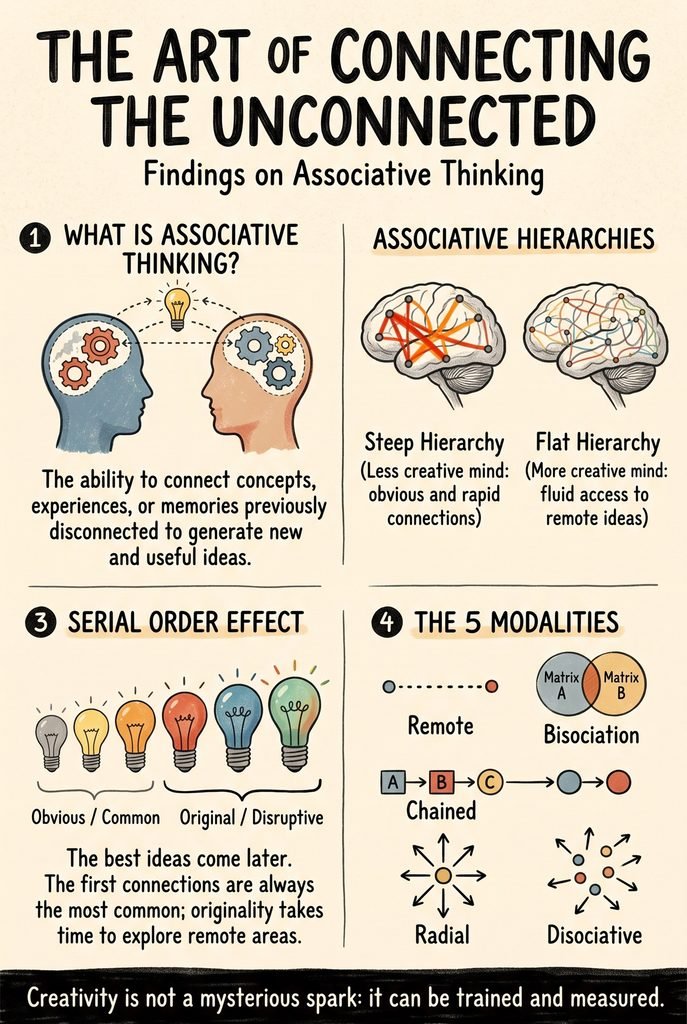
Associative thinking is the capacity to link previously unconnected concepts, memories, or experiences to generate novel ideas of practical value. Within the innovation ecosystem, this discipline is also referred to as the association creative thinking method.
In a landmark review published in Trends in Cognitive Sciences, Beaty and Kenett (2023) highlight that associative thinking forms the core of creative processes: ideation fundamentally consists of retrieving nodes from semantic memory and combining them in unprecedented ways. In line with this perspective, Kenett (2024) emphasizes that semantic memory is not a static structure, but rather a dynamic network that evolves and reconfigures itself through the articulation of concepts, intuitive problem-solving (insight), and the formulation of complex inquiries.
The governing principle of this method is straightforward: the greater the conceptual distance between the combined elements, the greater the originality of the outcome, provided that such integration effectively solves a real-world problem.
This final condition is decisive. Linking an “umbrella” with a “sandwich” represents a remote leap, yet it lacks value if it fails to address a functional need; associative creativity demands, simultaneously, daring conceptual distance and rigorous utility.
Furthermore, associative thinking serves as an essential cognitive mechanism in diagnostic reasoning, facilitating shifts in perspective and the formulation of disruptive hypotheses (Isoda et al., 2026). In this regard, Pawlick (2026) enriches classical associative theory by distinguishing between the mere contiguity of outcomes and the deliberate connection of ideas:
- Formal creativity: Demands that the integrated entities be abstract and universal concepts, and that their linkage be guided by a defined purpose and rational deliberation.
- AI systems versus biological cognition: While large language models associate terms and tokens with remarkable algorithmic precision (material association), they lack intentionality, semantic agency, or critical judgment; consequently, they do not exercise formal associative thinking in the strict sense.
A Brief History: From Empiricist Philosophers to Mednick
The premise that human cognition operates through associations has profound roots. Aristotle posited that memory retrieves information through three fundamental principles: similarity, contrast, and contiguity. Centuries later, the British empiricists—John Locke, George Berkeley, and, most notably, David Hume—systematized the “laws of association,” establishing that ideas are interconnected by affinity, spatio-temporal proximity, or direct causality.
During the 19th century, Scottish philosopher Alexander Bain marked a pivotal milestone by conceptualizing constructive association: the mind does not merely reproduce preexisting connections, but is capable of articulating novel configurations from them.
The modern scientific consolidation arrived in 1962, when psychologist Sarnoff Mednick published his seminal paper, The associative basis of the creative process, in Psychological Review. Mednick defined creative thinking as the structuring of novel combinations from associative elements that meet specific requirements or offer practical utility, further asserting that the degree of creative originality is directly proportional to the conceptual distance between those components.
Applications of Associative Thinking
Associative thinking—defined as the capacity to link semantically distant concepts, experiences, or observations—is implemented across multiple disciplines to resolve complex problems, drive disruptive innovation, and enhance deep learning (Isoda et al., 2026). Based on current scientific evidence, four primary areas of application stand out:
Medical Reasoning and Diagnosis
In clinical practice, associative thinking operates as an essential cognitive catalyst to mitigate diagnostic biases, overcome heuristic impasses, and formulate high-precision differential hypotheses (Isoda et al., 2026). This approach is structured around four core strategies:
- Remote association: Synthesizes semantically divergent clinical manifestations and findings under a unified diagnostic framework, proving vital in complex multisystemic disorders such as systemic lupus erythematosus.
- Chained association: Systematizes hypotheses by linking them to etiology, predisposing factors, and complications through vertical tracing—for instance, connecting heart failure to a diastolic murmur and subsequently to infective endocarditis.
- Radial association: Develops multiple differential diagnoses stemming from a cardinal sign or identifies clinical mimics via clustering techniques (pivot and cluster).
- Dissociative association: Deconstructs and recombines clinical findings to refute biased preliminary diagnoses and open pathways to alternative pathophysiological explanations.
Product Design, Architecture, and the Arts
Within project-based disciplines, this methodology is applied deliberately to unblock ideation and shape innovative formal languages (Wang & Xiu, 2017):
- Compulsory Association method: Catalyzes creative leaps by systematically prompting connections between the core design object and conceptually disparate reference points.
- Biomorphic and conceptual architecture: Translates natural symbols and geometries into cutting-edge structural solutions, such as the avian wing motifs in the TWA Terminal at New York’s JFK Airport or the reinterpretation of ancient coins in the iconic Fangyuan Building.
- Industrial and biomimetic design: Integrates affective user response analysis (Kansei Engineering) with biological morphologies—such as caudal fins or plantar structures—to devise products with high aesthetic and functional impact (Kang, 2024).
- Experimental arts education: Fosters conceptual fluency in students through the hybridization of polar concepts (e.g., “organs and machinery” or “dynamism and stillness”).
Education, Learning, and Cognitive Modeling
Associative thinking is also applied in education, particularly within learning processes, as illustrated by the following examples:
- Knowledge acquisition and retention: Goal-directed associative thinking acts as a decisive mediating bridge between creativity and mnemonic consolidation, fostering the long-term acquisition and retention of second-language vocabulary (Luchini et al., 2025).
- Digital cognitive mapping: Implementing computational cognitive maps facilitates the visualization and execution of conceptual analysis, disaggregation, and recombination, thereby strengthening divergent thinking (Sun et al., 2019).
- Scientific and technological ideation: Associative frameworks structured around the “Source → Function → Goal” paradigm guide the conception of intricate technological solutions and serve as a baseline for designing AI-driven tutoring tools (Sahai et al., 2026).
Socioeconomic Problem-Solving and Social Innovation
Within the Inspiration Economy model (Inspiration Labs), associative capacity is mobilized to address wicked socioeconomic problems without necessitating large-scale capital deployments (Buheji, 2026):
- Transdisciplinary convergence: Transcends epistemic boundaries by integrating tools from behavioral economics, community-based work, and business management to redesign grassroots organizational models.
- Valorization of local assets: Connects indigenous knowledge and underutilized territorial assets with global value chains, as evidenced by bamboo-based community infrastructure initiatives in India or the commercial scaling of shea butter production in Ghana.
How the Associative Mind Works
To unlock the full potential of associative thinking, it is vital to grasp its underlying cognitive dynamics. Key theoretical principles clearly explain why certain individuals and teams devise disruptive breakthroughs while others remain anchored in conventional patterns.
Associative Hierarchies: Steep vs. Flat
Sarnoff Mednick posited that every mental concept possesses a defined associative hierarchy: a structured distribution of responses organized by their activation probability. Presented with the stimulus “table,” the dominant probability immediately elicits “chair”; conversely, activating a remote semantic node such as “plate tectonics” is statistically rare.
- Steep hierarchy: Characterized by a narrow core of highly dominant associations that eclipse secondary linkages. The individual responds rapidly with obvious or stereotypical ideas, leading to early creative impasses.
- Flat hierarchy: Features a more uniform distribution of associative strength across distinct nodes. While retrieving conventional responses requires greater cognitive effort, it facilitates fluid access to remote, unobvious concepts. According to Mednick’s hypothesis, highly creative profiles exhibit markedly flatter associative hierarchies. Modern empirical research corroborates this principle: creative minds navigate complex semantic networks with superior proficiency, activating tenuous conceptual links rather than converging on predictable answers.
Memory as a Semantic Network
Network science has translated this conceptual framework into the experimental domain. Under this approach, semantic memory is modeled as a graph structure, where each concept represents a node and each semantic link acts as a weighted edge. These architectures exhibit “small-world” network properties, indicating that virtually any concept is separated from another by merely a few degrees of connection.
Kenett (2024) demonstrates that the semantic networks of highly creative individuals feature greater flexibility and denser interconnectedness, whereas those of less creative individuals are more rigid and modular. In practice, creative acumen does not stem from accumulating vast amounts of information, but from structuring well-integrated conceptual networks that allow for broader, bolder semantic leaps (Kenett, 2024).
Mednick’s Three Paths: Serendipity, Similarity, and Mediation
Sarnoff Mednick identified three fundamental mechanisms through which cognition achieves creative synthesis:
- Serendipity: An accidental environmental stimulus sparks an unforeseen association. A quintessential example is Swiss engineer George de Mestral, who examined burrs clinging to his clothing and dog’s fur, deducing the core design principle of Velcro from that observation.
- Similarity: Two conceptual or physical entities converge due to structural, morphological, or functional correspondences, forming the cornerstone of conceptual analogy and biomimicry. In this context, Kang (2024) demonstrated how bio-inspired designs drawing from a fish’s caudal fin, a feline paw pad, and the adaptive anatomy of an octopus fulfilled key affective user needs while establishing concrete metric and engineering parameters for industrial manufacturing.
- Mediation: Two remote concepts converge through an intermediate semantic node acting as a cognitive bridge ().
The Serial Order Effect: Superior Ideas Arrive Later
A robust finding in creativity research is the serial order effect: during sustained ideation, initial outputs tend to be conventional, whereas truly original solutions emerge toward the end of the process. The associative perspective provides a compelling explanation: cognition initially exhausts proximal, salient nodes; only after surpassing this saturation threshold does exploration shift toward peripheral and remote regions of the semantic network. The methodological takeaway is critical: cutting a brainstorming session short after a few minutes prematurely terminates the most productive and disruptive phase of the exercise.
The Entropy Modulation Theory
A major theoretical breakthrough is the Entropy Modulation Theory of Creative Exploration, formulated by Thomas Hills and Yoed Kenett in Psychological Review (2025). Their framework posits that divergent creative performance depends not solely on the static architecture of memory, but on how executive control modulates entropy—the degree of variability and stochasticity—during information retrieval.
By regulating the intensity and scope of this activation, semantic retrieval becomes simultaneously rapid and expansive, underpinning the characteristic “faster-and-further” search pattern of innovative thinking. In practical terms, the creative mind introduces a calibrated dose of stochastic noise into its cognitive exploration without derailing from the overarching goal.
Brain Networks: Free Association vs. Executive Control
Cognitive neuroscience complements this view by demonstrating that associative thinking coordinates the interplay between two functional regimes:
- Spontaneous or divergent association: Primarily underpinned by the Default Mode Network (DMN), which dominates during mind-wandering, imaginative prospecting, and episodic memory retrieval.
- Goal-directed or teleological association: Mediated by the Executive Control Network (ECN), responsible for focusing search queries, suppressing distractors, and filtering out unviable outputs.
Benedek et al. (2020) demonstrated via functional neuroimaging that goal-directed creative association requires the synchronous co-activation of both systems. Consequently, innovation arises from a fine-tuned synergy: exploring with unrestrained freedom while evaluating with analytical rigor.
Types of Associative Thinking
Not all conceptual links operate under the same cognitive logic. Recent scientific literature (Benedek et al., 2020; Isoda et al., 2026) delineates at least five core modalities, each tailored to a specific phase of the creative and problem-solving process.
| Modality | Cognitive Mechanism | Practical Exercise | Strategic Use Case |
| Remote Association | Identifies the common vector among semantically distant concepts. | Finding the bridging term that connects three seemingly unrelated words. | Resolving complex challenges with latent or non-obvious solutions. |
| Bisociation | Concurrently merges two distinct frames of reference or complete conceptual domains. | Hybridizing two disparate industries, models, or technologies to conceive an unprecedented category. | Driving disruptive product innovation and business model development. |
| Chained Association | Generates progressive, iterative sequences that diverge step-by-step from the initial node. | Constructing a semantic sequence where each link stems directly from the preceding one. | Overcoming familiarity bias and moving beyond conventional ideas. |
| Radial Association | Projects multidirectional branches outward from a single nuclear stimulus. | Mapping peripheral attributes, functionalities, and relationships around a core object. | Thoroughly exploring an analytical problem; serves as the foundational structure of mind mapping. |
| Dissociative Association | Deliberately induces concepts characterized by maximal mutual semantic divergence. | Generating ten terms or perspectives that remain conceptually unrelated to one another. | Mitigating functional fixedness and broadening the heuristic spectrum of alternatives. |
Remote Association
This modality was operationalized by Sarnoff Mednick through his renowned standardized test. An illustrative example in Spanish: What concept unifies the terms moon, bee, and cake? The answer is honey (honeymoon, bees produce honey, honey cake). Arriving at this solution requires exploring multiple semantic pathways in parallel until converging at their intersecting node.
Bisociation
This involves the synchronous linkage of two entire matrices or frames of reference. Given its crucial relevance to innovation processes, we examine its mechanisms in detail in the following section. In this regard, Benedek et al. (2020) emphasize that the ability to formulate original associations and bisociations correlates significantly with established creativity metrics, such as divergent thinking, engagement in real-world creative activities, and the trait of openness to experience.
Chained Association
This operates through a sequential progression: coffee → wake up → alarm → fire → firefighters → hose. While each transition maintains local logical coherence, the final link ends up semantically distant from the starting stimulus. It is a highly effective strategy for traversing semantic networks toward deeper regions that could rarely be reached via a direct leap.
Radial Association
Also known as radiant association, this stems from a conceptual core and radiates outward in all directions. It serves as the foundational architectural principle behind mind maps. Wang and Xiu (2017) describe how design pedagogy implements an initial stage of radial exploration (divergence stemming from a focal object), coupled with a subsequent phase of linear aggregation aimed at refining and consolidating concepts.
Dissociative Association
Its deliberate aim is to maximize the conceptual distance between elements. This forms the empirical foundation of the Divergent Association Task (DAT), a psychometric creativity assessment discussed below that involves generating words with the greatest possible semantic dispersion. Along these lines, Olson et al. (2021) conclude that naming unrelated terms and quantifying their semantic distance via the DAT offers a concise, objective, and rigorous measure of divergent thinking and verbal creativity.
Koestler’s Bisociation: When Two Worlds Collide
In 1964, writer and philosopher Arthur Koestler published The Act of Creation, a seminal work introducing the concept of bisociation. For Koestler, routine associative thinking operates within a single mental “matrix”—a rigid framework governed by conventions, premises, and established rules. In contrast, genuine creative insight emerges when two previously unlinked matrices collide and converge.
Koestler identified three primary domains where this intersection manifests:
- Humor: The narrative directs attention along an expected matrix only to abruptly shift toward an incompatible one at the punchline; the resulting incongruity releases tension through laughter.
- Science and Discovery: Both epistemic frameworks integrate into a superior synthesis offering greater explanatory power than either perspective alone, epitomizing the classic “Eureka!” moment.
- Art: The two matrices remain juxtaposed in aesthetic tension, allowing the observer to contemplate both realms simultaneously, as seen in the depth of poetic metaphor.
Furthermore, Buheji (2026) highlights that bisociation entails the deliberate articulation of two frameworks of thought or disciplines traditionally considered disconnected or mutually incompatible.
Associative Thinking vs. Categorical Thinking
A recurring question in cognitive science lies in distinguishing associative from categorical thinking, both representing complementary, interdependent paradigms for structuring knowledge:
| Criterion | Categorical Thinking | Associative Thinking |
| Operational Logic | Classifies elements by formal taxonomy and membership (“it is a mammal”). | Links concepts via functional resonance, similarity, or prior experience (“it evokes…”). |
| Cognitive Structure | Hierarchical, systematic, and linear. | Reticular, fluid, and non-linear. |
| Core Strength | Analytical rigor, taxonomic precision, and structured order. | Disruptive originality, semantic flexibility, and novel discovery. |
| Methodological Risk | Cognitive rigidity: forcing empirical data into preexisting schemas. | Conceptual dispersion: proliferation of ideas lacking practical grounding. |
| Ideal Strategic Phase | Critical evaluation, convergent selection, and execution. | Divergent exploration and generation of unprecedented alternatives. |
In essence, while categorical thinking queries “what taxonomy does this belong to?”, associative thinking asks “what other nodes does this connect with?”. Any high-impact innovation methodology demands the seamless integration of both frameworks: expanding cognitive horizons through bold associations while validating feasibility through structured categorical criteria.
Creative Association Techniques
The theoretical framework acquires strategic value when operationalized through practical methodologies. Below are the most effective approaches for systematically and deliberately triggering associations.
Forced Association
The forced association technique induces a deliberate connection between the core challenge and an external stimulus, chosen at random or drawn from a remote conceptual domain. Originally attributed to Charles S. Whiting in 1958, Wang and Xiu (2017) demonstrated that the compulsory (or forced) association method represents a foundational, highly effective heuristic tool across both professional practice and arts-and-design pedagogy.
Its structured implementation in R&D initiatives unfolds across four operational phases:
- Functional abstraction: Synthesize the challenge into its primary teleological function. For instance, rather than framing it as “optimizing packaging,” define it as “shielding a fragile structure against impact during transit.”
- Identification of distant domains: Explore biological ecosystems or heterogeneous industries that solve equivalent principles. What other configurations protect delicate components? An eggshell, a ballistic or cycling helmet, specialized wine packaging, or the cranial vault.
- Extraction and solution modeling: Deconstruct the physical and structural mechanisms of each reference system (honeycomb geometries, shape-memory polymers, dynamic suspension absorption, etc.).
- Forced integration and validation: Transfer these biomorphic or mechanical principles to the original problem and assess their technical and economic feasibility.
Practical case study in digital marketing:
- Challenge: Increase the repeat purchase rate on an e-commerce platform.
- Random stimulus: Garden.
- Associative fields: Sowing, automated irrigation, seasonality, blooming, harvesting.
- Resulting proposals: Implementation of a lead-nurturing protocol delivering tailored reminders aligned with individual consumption cycles; and the rollout of seasonal capsule collections that “bloom” at key milestones within the commercial calendar.
Random Input
Popularized by Edward de Bono within the framework of lateral thinking, this technique involves selecting a random word—from a dictionary, a digital app, or a randomized list—and forcing its connection with the challenge under investigation. Its heuristic value lies in drawing a stimulus from outside the customary semantic network, disrupting automatic heuristic patterns and conventional cognitive trajectories.
Object Stimulation
In this variation, physical objects or visual resources replace lexical stimuli. An interdisciplinary team examines a tangible artifact (such as a paperclip, a sponge, or a compass) and meticulously catalogs its physical and functional properties; subsequently, each attribute is mapped onto the central problem. This tool is particularly effective for visually or kinesthetically driven profiles in hands-on workshops.
Idea Cards and Idea Dice
Conceptual decks featuring terms, imagery, or design principles—alongside “idea dice” displaying disparate concepts on each face—transform stochasticity into a structured, playful resource. Their key methodological advantage lies in reducing evaluative judgment and interpersonal friction: a disruptive or unorthodox proposal is not attributed to an individual’s personal stance, but rather to the randomness of the game stimulus.
Mind Maps
Mind maps represent the graphic manifestation of radial association: they anchor a central conceptual node surrounded by progressively expanding hierarchical branches. In this regard, Sun et al. (2019) demonstrated that computer-assisted cognitive mapping enhances divergent thinking among secondary school students by rendering latent conceptual networks and connections immediately visible.
Associative Chains
This methodology initiates from the baseline challenge and unfolds through a sequence of eight to ten successive associations. Subsequently, the terminal link in the chain is selected and forcibly integrated back into the initial problem. This procedure deliberately capitalizes on the serial order effect, ensuring that the concluding term lies sufficiently distant from obvious, immediate responses.
Comparative Analysis: The Associative Method vs. Lateral Thinking, SCAMPER, and Forced Association
A recurring strategic challenge during innovation processes lies in identifying the most suitable methodology. While all these frameworks aim to generate high-impact ideas, they stem from fundamentally distinct cognitive and operational premises.
| Analytical Dimension | Associative Method | Lateral Thinking (De Bono) | SCAMPER | Forced Association |
| Conceptual Foundation | Semantic distance, cognitive networks, and bisociation. | Disruption of heuristic patterns through deliberate provocation (po). | Systematic checklist of morphological transformations. | Deliberate juxtaposition against an external contextual stimulus. |
| Historical and Theoretical Origin | Sarnoff Mednick (1962), Arthur Koestler (1964). | Edward de Bono (late 1960s). | Bob Eberle (1971), adapted from Alex Osborn’s matrices. | Charles S. Whiting (1958). |
| Operational Mechanism | Exploration and articulation of remote semantic nodes within memory. | Oblique shifts and formulation of disruptive scenarios. | Substitute, Combine, Adapt, Modify, Put to other uses, Eliminate, and Reverse. | Stochastic stimulus + core challenge $\rightarrow$ compulsory linkage. |
| Starting Point | An open strategic challenge. | A prevailing framework or preexisting hegemonic assumption. | A preexisting product, service, or operational workflow. | A defined problem or concrete functional friction. |
| Resulting Innovation Type | Disruptive and cross-sectoral. | Epistemic problem reframing. | Predominantly incremental. | Incremental to disruptive. |
| Methodological Learning Curve | Moderate. | Moderate-to-high. | Low. | Low. |
Advantages and Disadvantages of Each Creative Method
Evaluating the strengths and constraints of each creative framework enables the selection of the optimal tool aligned with strategic innovation goals and team maturity.
| Methodology | Strategic Strengths (Advantages) | Operational Constraints (Disadvantages) |
| Associative Method (Broadly Defined) | • Maximizes disruptive originality and fosters cross-sector innovation. • Strongly supported by modern cognitive psychology and neuroscience. | • Demands longer cognitive incubation, as highest-value linkages emerge late. • Yields a high volume of unfeasible proposals unless paired with rigorous convergent evaluation. |
| Lateral Thinking | • Excels at dismantling orthodox assumptions and reframing the core problem. • Provides an extensive heuristic toolkit (provocations, random input, Six Thinking Hats). | • Provocative exercises may trigger skepticism in analytical teams. • Lacks transformative impact without skilled facilitation, risking unfocused conjecture. |
| SCAMPER | • Highly accessible and intuitive for non-specialist profiles. • Hsu et al. (2025) demonstrated that guided SCAMPER interventions optimize creative performance and stimulate goal-directed associative neural networks. | • Anchoring exclusively to preexisting products or processes limits radical, disruptive leaps. • Risks deteriorating into a mechanical, bureaucratic checklist exercise. |
| Forced Association | • Agile, accessible, and engaging across diverse interdisciplinary teams. • Guarantees external cognitive stimuli outside participants’ standard semantic networks. | • Produces a significant proportion of sterile connections lacking real-world viability. • Effectiveness hinges entirely on the quality and rigor of the problem’s functional abstraction. |
Which Methodology to Choose Based on Your Strategic Objective?
- Optimizing an existing product or service: Begin with SCAMPER to systematically implement incremental transformations.
- Unsticking a team trapped in redundant solutions: Deploy forced association dynamics or leverage random input to dismantle cognitive inertia.
- Overcoming an ill-defined problem constrained by prevailing assumptions: Turn to lateral thinking to effectively reframe the core premise.
- Developing disruptive innovation or entering a new industry: Apply the comprehensive associative method: functional abstraction, remote domain exploration, and bisociation.
- Resolving a technical challenge with inherent structural trade-offs: Integrate the TRIZ methodology, specifically engineered to cross-pollinate validated solutions across disparate engineering fields.
These frameworks are not mutually exclusive, but synergistic; a high-impact methodological workflow entails reframing the challenge through lateral thinking, expanding the solution space via remote associations, and refining the final deliverable using SCAMPER.
How Associative Thinking is Measured
A major strength of the associative framework lies in its psychometric viability, supported by several standardized instruments widely recognized in cognitive research:
| Instrument | Experimental Task | Dimension Assessed | Key Methodological Benchmark |
| RAT (Remote Associates Test) | Identify the common linking term across three stimulus words. | Remote association and creative convergence. | Originally developed by Sarnoff Mednick (initial version in 1959; formalized in 1962). |
| CRAT (Compound Remote Associates) | Same premise, but the solution forms compound words or lexical collocations with the triad. | Remote association and insight phenomena. | Standardized 144-item battery by Bowden & Jung-Beeman (2003). |
| DAT (Divergent Association Task) | Generate ten mutually distant nouns. | Dissociative association and divergent thinking. | Developed by Olson et al. (2021); takes approximately four minutes and is algorithmically scored. |
| AUT (Alternative Uses Test) | Proposes multiple novel uses for a common object. | Ideational fluency, cognitive flexibility, and originality. | Classic paradigm established by J. P. Guilford. |
Two Pathways to Resolution: Analytical Processing vs. Insight
When confronting a remote association challenge, cognition typically operates through two distinct mechanisms:
- Analytical search: Involves deliberate, sequential hypothesis testing supported by working memory, systematically evaluating each potential candidate under conscious scrutiny.
- Insight-driven resolution: The solution emerges suddenly and intuitively following implicit semantic spreading activation within the conceptual network, epitomizing the classic “Aha!” experience. Both trajectories are fundamentally complementary; indeed, CRAT-style test batteries are widely implemented across cognitive neuroscience specifically to delineate the distinct cognitive dynamics and neural correlates underlying each pathway.
How to Apply Associative Thinking in a Team Workshop
In a benchmark meta-analysis, Haase et al. (2023) demonstrated that adult creativity can be significantly enhanced through structured interventions; among these, complex training programs, meditation, and cultural immersion proved to be the most effective strategies for expanding creative potential. This principle indicates that systematically fostering associative thinking within teams is entirely feasible. In line with this approach, Buheji (2026) highlights that, far from being an innate and unalterable trait, associative capacity constitutes a renewable, dynamic human capital that can be developed collectively and deliberately.
The following methodological framework is designed for a hands-on, 90-minute workshop tailored for groups of 5 to 12 participants, requiring no expensive infrastructure or materials:
- Cognitive Warm-up (10 min): Each participant completes an adapted version of the DAT: recording ten conceptually disconnected words. Subsequently, lists are compared and participants reflect on the cognitive resistance felt when attempting to move away from conventional responses. This exercise increases the flexibility of the group’s associative hierarchies.
- Functional Abstraction of the Challenge (15 min): The team reframes the problem in terms of its essential teleological purpose: “What primary function are we seeking to optimize?”. Consensus is formalized into a single governing statement.
- Intensive Associative Divergence (30 min): Three sequential 10-minute rounds, applying a distinct technique per phase:
- Round 1: Random input using unrelated words.
- Round 2: Multisensory stimulation using physical objects or visual representations.
- Round 3: Cross-domain transfer (analyzing how nature, a hospital, a sports arena, or a symphony orchestra would solve the challenge).
- Fundamental rule: Suspend all evaluative judgment during divergence and strictly respect designated timeframes without premature interruptions, capitalizing on the serial order effect.
- Strategic Bisociation (15 min): Two proposals originating from disparate domains are selected and hybridized to formulate a superior third alternative with greater disruptive potential.
- Convergence and Critical Selection (15 min): Executive control is activated. The generated proposals are evaluated through a matrix with explicit criteria (impact, technical feasibility, cost, and implementation timeframe), selecting the two or three most viable solutions for prototyping.
To implement more extensive or intensive ideation methodologies across your organization, we invite you to consult our guide on structuring a high-impact hackathon.
How to Apply the Associative Method to Complex Business Problems
In the corporate realm, the associative method achieves its full potential when paired with rigorous strategic diagnosis. During the initial phase, identifying the root cause of the challenge via tools such as the “5 Whys” is essential. Subsequently, that root cause is reframed into an abstract function to identify distant sectors and industries that have already successfully resolved equivalent friction points.
Case Study: Peak-Hour Congestion
- Scenario: A restaurant chain experiences long wait lines during peak service hours.
- Functional Abstraction: “Managing critical demand fluctuations against fixed operational installed capacity.”
- Cross-Industry Transfer from Heterogeneous Sectors:
- Airlines: Implementing dynamic pricing models and segmented reservations.
- Theme Parks: Adopting virtual queuing systems and mobile-assisted wait-time management.
- Hospitals: Deploying triage protocols and operational workflow prioritization based on urgency and complexity.
Each conceptual domain provides an innovative, battle-tested solution vector, preventing the organization from relying exclusively on linear or conventional remedies.
Digital Tools for Training Associative Thinking
While digital platforms do not replace critical judgment or human cognition, they amplify sensory input and streamline the visual mapping of concepts. Below are the most effective resources, categorized by function:
- Mind-Mapping Software: Specialized applications such as XMind, MindMeister, and Coggle facilitate the structuring of radial networks and the intuitive reconfiguration of nodes, proving essential for practicing radiant association and systematizing ideation findings.
- Cloud-Based Collaborative Whiteboards: Interactive workspaces like Miro or FigJam energize remote dynamics through digital sticky notes, randomized stimulus decks, and convergent voting systems.
- Random Stimulus Generators: Automated external word or image tools enable the execution of the random input method, with their primary methodological value lying in ensuring the conceptual trigger remains independent of the team’s deliberate bias.
- Online Psychometric Batteries: The Divergent Association Task (DAT) offers open-access web platforms that algorithmically evaluate individual dissociative capacity and semantic distance.
- Specialized Training Programs: Spanish-language learning ecosystems such as Platzi offer courses focused on advanced creative techniques, incorporating hands-on modules in conceptual interconnection and SCAMPER-based frameworks.
Operational note: Platform features, integrations, and subscription models evolve regularly; verifying current specifications directly through official channels prior to implementation is recommended.
Artificial Intelligence as an Associative Engine
Generative artificial intelligence has ushered in a new frontier within creative processes. Large language models (LLMs) project terms and concepts as geometric vectors within an embedding space, where the Euclidean distance between them reflects their semantic proximity. In essence, this constitutes a mathematical formalization of the human semantic network; indeed, psychometric instruments such as the DAT rely on equivalent algorithms to quantify the lexical dispersion among words.
Furthermore, these architectures incorporate a hyperparameter termed “temperature,” which modulates the degree of stochasticity or randomness across predictions. As a conceptual parallel—though not a strict neurobiological equivalence—this mechanism evokes the entropy modulation characteristic of divergent cognition: low temperature values yield conservative, predictable outputs, whereas elevated thresholds produce disruptive, and occasionally disjointed, combinations.
When deployed with methodological rigor, AI serves as an inexhaustible catalyst of stimuli for forced association: linking remote domains, proposing novel analogies, and unveiling unforeseen correlations. Nevertheless, critical judgment, feasibility assessment, and ultimate decision-making remain squarely within the human domain.
How to Structure an Organization to Trigger Associative Thinking
Associative thinking is not merely an isolated intrapsychic process; it is profoundly shaped by the relational ecosystem and the diversity of circulating ideas. Certain organizational practices deliberately enhance this capability:
- Dismantling departmental silos: Building interdisciplinary teams and fostering cross-functional rotation maximize semantic contiguity and cross-pollinate heterogeneous expertise.
- Designing informal interaction spaces: Shared communal areas, collective dining spaces, and cross-departmental events foster spontaneous collisions that catalyze serendipity.
- Injecting systematic external stimuli: Immersions in disparate industries, curated extracurricular reading, and lectures by specialists from other fields expand the collective semantic network.
- Safeguarding temporal incubation margins: Given that disruptive breakthroughs surface late in ideation cycles, high-pressure environments demanding immediate returns penalize exploratory thinking and stifle innovation.
In this regard, Luchini et al. (2025) demonstrated that goal-directed associative thinking serves as the pivotal cognitive bridge linking creativity with organizational learning: an organization that connects better learns deeper, and vice versa. Furthermore, Kang (2024) concluded that integrating Kansei Engineering (KE) with the Association Creative Thinking Method (ACTM) transcends the mechanical constraints of traditional KE, facilitating biomimetic solutions that substantially elevate affective user value and overall satisfaction.
Conclusion: The Capacity to Connect Is a Renewable Resource
Associative thinking is not an innate privilege reserved for exceptional minds; rather, it represents a cognitive competence grounded in a precise architecture—a semantic network of concepts, defined mental trajectories, and a strategic equilibrium between divergent exploration and evaluative rigor. Over six decades of cumulative scientific evidence—from Mednick’s seminal formulations to contemporary 2025 entropy modulation frameworks—converge on an unequivocal principle: this faculty is entirely measurable and trainable.
For leaders, teams, and innovators, the operational implication is immediate: select the methodology aligned with the strategic objective—deploying SCAMPER to optimize existing assets, forced association to dismantle cognitive inertia, and bisociation to synthesize unprecedented paradigms. Furthermore, safeguarding space for divergence without prematurely truncating the process is paramount to accessing remote connections, alongside actively cultivating interdisciplinary breadth, as one can only synthesize what has previously been assimilated.
Unlike financial capital or technological assets, the proficiency to bridge disparate observations and disciplines does not depreciate through use; rather, deliberate practice compounds its returns. In an enterprise landscape governed by the imperative to innovate or perish, few competitive advantages prove as enduring and universally applicable.
Frequently Asked Questions About Associative Thinking
What is associative thinking in simple terms?
It is the cognitive ability to bridge previously unconnected concepts, experiences, or memories to devise novel solutions of practical value. It serves as the core engine of the creative process: the greater the semantic distance between the linked elements, the more original the resulting idea—provided it effectively addresses a concrete need.
What are the most representative examples of associative thinking?
In everyday contexts, prime examples include identifying the unifying node across divergent terms like moon, bee, and cake (honey), or designing customer retention strategies inspired by gardening cycles. At historical and technological levels, notable breakthroughs include Velcro inspired by burdock burrs and the aerodynamic profile of the Japanese bullet train modeled after the kingfisher’s beak.
What are the modalities of associative thinking?
Scientific literature delineates five strategic typologies: remote association (identifying the intersection among distant concepts), bisociation (fusing two entire epistemic matrices), chained association (logical sequences that progressively diverge from the point of origin), radial association (multidirectional projection stemming from a central core), and dissociative association (the deliberate pursuit of maximal semantic divergence).
What distinguishes associative thinking from categorical thinking?
Categorical thinking classifies information hierarchically, linearly, and analytically based on formal taxonomic membership (‘what group does this belong to?’), whereas associative thinking operates as a fluid, relational network (‘what other nodes does this connect with?’). While the former ensures precision, order, and evaluative feasibility, the latter drives cognitive flexibility, divergence, and disruptive discovery.
What does bisociation entail?
Formulated by Arthur Koestler (1964), this concept defines the creative act as the deliberate collision or intersection of two habitually independent or incompatible conceptual matrices. According to Koestler, this convergence yields distinct outcomes depending on its dynamics: humor (a sudden discharge prompted by incongruity), science (a superior theoretical synthesis or ‘eureka!’ insight), and art (a sustained, simultaneous aesthetic juxtaposition).
How is the forced association technique implemented?
The core problem is first abstracted into its essential functional purpose, after which an external stimulus—such as an object, word, or biological system from an unrelated domain—is introduced. Next, its structural and operational properties are systematically deconstructed to compel deliberate linkages with the baseline challenge, and the resulting concepts are subsequently filtered against explicit criteria of strategic impact and technical feasibility.
Can associative thinking be trained and developed?
Yes. Evidence from cognitive neuroscience demonstrates that associative architecture constitutes a malleable, trainable asset. Empirical interventions confirm that practices such as cross-domain immersion, computer-assisted cognitive mapping, and structured frameworks like SCAMPER enhance ideational fluency and originality, fostering flatter and more flexible associative hierarchies.
What is the relationship between associative thinking and ADHD?
Various clinical and descriptive observations link Attention Deficit Hyperactivity Disorder (ADHD) with a cognitive profile characterized by wide associative dispersion and accelerated semantic transitions. Nevertheless, empirical evidence regarding a causal correlation between ADHD and sustained creative output remains mixed and inconclusive, cautioning against broad generalizations and underscoring the importance of specialized mental health guidance.
What digital tools enhance the association of ideas?
Key solutions include mind-mapping software (XMind, MindMeister, Coggle) for charting radial networks, interactive visual collaboration platforms (Miro, FigJam) for remote divergence sessions, and automated stochastic stimulus generators. Furthermore, large language models (LLMs) operate as forced-association catalysts by mapping embedding vectors and suggesting cross-sector analogies.
How is associative thinking quantitatively assessed?
Validated psychometric instruments exist, such as the Divergent Association Task (DAT)—which computationally quantifies the semantic distance among ten disparate nouns in four minutes—and the Remote Associates Test (RAT).
References
Beaty, R. E., & Kenett, Y. N. (2023). Associative thinking at the core of creativity. Trends in Cognitive Sciences, 27(7). https://doi.org/10.1016/j.tics.2023.04.004
Benedek, M., Jurisch, J., Koschutnig, K., Fink, A., & Beaty, R. E. (2020). Elements of creative thought: Investigating the cognitive and neural correlates of association and bi-association processes. NeuroImage, 210, 116586. https://doi.org/10.1016/j.neuroimage.2020.116586
Bowden, E. M., & Jung-Beeman, M. (2003). Normative data for 144 compound remote associate problems. Behavior Research Methods, Instruments, & Computers, 35(4), 634–639.
Buheji, M. (2026). Associative thinking as a generative mechanism in socio-economic problem-solving – A longitudinal study of Inspiration Economy Labs. International Journal of Social Sciences and Management Review, 9 (5), 419–444. https://doi.org/10.37602/IJSSMR.2026.9519
Haase, J., Hanel, P., & Gronau, N. (2023). Creativity enhancement methods for adults: A meta-analysis. Psychology of Aesthetics, Creativity, and the Arts. https://doi.org/10.1037/aca0000557
Hills, T. T., & Kenett, Y. N. (2025). An entropy modulation theory of creative exploration. Psychological Review, 132(1), 239.
Hsu, W.-C., Yeh, Y.-C., & Chang, C.-Y. (2025). SCAMPER intervention enhances creative performance by activating goal-directed association brain networks in constrained product-design tasks. Creativity Research Journal. https://doi.org/10.1080/10400419.2025.2568322
Isoda, S., Shimizu, T., & Hattori, M. (2026). Associative thinking as a lever for diagnostic creativity. Diagnosis, 13, 193–199. https://doi.org/10.1515/dx-2025-0169
Kang, X. (2024). Biologically inspired product design combining Kansei Engineering and Association Creative Thinking Method. Advanced Engineering Informatics, 62, 102615. https://doi.org/10.1016/j.aei.2024.102615
Kenett, Y. N. (2024). The role of knowledge in creative thinking. Creativity Research Journal, 37, 242–249. https://doi.org/10.1080/10400419.2024.2322858
Koestler, A. (1964). The Act of Creation. Hutchinson.
Luchini, S., Kaufman, J. C., Goecke, B., Wilhelm, O., Kenett, Y. N., Lei, D., Benedek, M., Van Hell, J. G., & Beaty, R. E. (2025). Creativity supports learning through associative thinking. npj Science of Learning, 10. https://doi.org/10.1038/s41539-025-00334-1
Mednick, S. A. (1962). The associative basis of the creative process. Psychological Review, 69(3), 220–232.
Olson, J. A., Nahas, J., Chmoulevitch, D., Cropper, S. J., & Webb, M. E. (2021). Naming unrelated words predicts creativity. PNAS, 118(25).
Pawlick, J. (2026). Formal creativity: On the philosophy of associative thinking. Journal of Creativity, 36(1), 100122. https://doi.org/10.1016/j.yjoc.2026.100122
Peláez-Alfonso, J. L., Pelegrina, S., & Lechuga, M. T. (2020). Normative data for 102 Spanish remote associate problems and age-related differences in performance. Psicológica, 41(1), 39–65.
Sahai C., K. Suanpong and P. I. N. Ayudhya, “Modeling Expert Associative Thinking for AI-Assisted Ideation in Science and Technology Education,” 2026 17th International Conference on E-Education, E-Business, E-Management and E-Learning (IC4e), Fukuoka, Japan, 2026, pp. 594-598, doi: 10.1109/IC4e69618.2026.11631598.
Sun, M., Wang, M., & Wegerif, R. (2019). Using computer-based cognitive mapping to improve students’ divergent thinking for creativity development. British Journal of Educational Technology, 50, 2217–2233. https://doi.org/10.1111/bjet.12825
Wang B. and X. Xiu (2017). Research on the application and ability training of compulsory association method in art design. https://doi.org/10.2991/icadce-17.2017.109
Zhan, Z., Yao, X., & Li, T. (2022). Effects of association interventions on students’ creative thinking, aptitude, empathy, and design scheme in a STEAM course: Considering remote and close association. International Journal of Technology and Design Education, 1–23. https://doi.org/10.1007/s10798-022-09801-x

Editor and founder of “Innovar o Morir” (‘Innovate or Die’). Milthon holds a Master’s degree in Science and Innovation Management from the Polytechnic University of Valencia, with postgraduate diplomas in Business Innovation (UPV) and Market-Oriented Innovation Management (UPCH-Universitat Leipzig). He has practical experience in innovation management, having led the Fisheries Innovation Unit of the National Program for Innovation in Fisheries and Aquaculture (PNIPA) and worked as a consultant on open innovation diagnostics and technology watch. He firmly believes in the power of innovation and creativity as drivers of change and development.