Key Takeaways on the Triple Bottom Line
- Beyond an Accounting Framework: The Triple Bottom Line (TBL) must transcend superficial compliance and greenwashing to function as a comprehensive managerial tool driving substantive strategic impact.
- Transparency and Regulatory Shielding: TBL auditing is not designed to project infallibility, but rather to foster transparent, operationally resilient business models insulated against an increasingly stringent regulatory landscape.
- Ecological Primacy and Planetary Boundaries: Economic activity remains fundamentally subordinate to the biosphere, precluding superficial trade-offs and requiring operations to respect non-negotiable biophysical thresholds.
- Methodological Advancement: Scientific consensus underscores that the enduring efficacy of the TBL hinges on integrating advanced analytics and quantitative decision models amidst market volatility.
- Prerequisite for Market Access: With capital markets and consumers demanding auditable traceability, the TBL has become a decisive benchmark for competitiveness, solvency, and value-chain resilience.
The Triple Bottom Line (TBL)—or Triple Result—is perhaps the most widely cited corporate sustainability framework of the past three decades, yet it remains one of the most misunderstood. This approach is routinely applied in corporate governance, public policy design, corporate reporting, and sustainable urban planning (Nica et al., 2025).
However, in contrast to the growing interest in implementing it, the reality is far more complex: its own creator called for a “product recall” in 2018, the scientific community continues to question its foundational structure, and in Europe, what began as a voluntary benchmark underwent a profound regulatory overhaul between 2025 and 2026.
This guide goes beyond conventional theory. You will discover what the Triple Bottom Line truly entails, how the three-circle model contrasts with nested dependencies, and why “weak” sustainability is losing ground to frameworks such as the CARE model. Our goal is to equip you with the tools to distinguish genuine responsible management from accounting greenwashing.
What Is the Triple Bottom Line?
The Triple Bottom Line (TBL or 3BL) constitutes an accounting and management framework (Slaper & Hall, 2011) designed to measure organizational performance beyond mere financial gain by integrating three core pillars: people, planet, and profit—the well-known “3Ps.” In this regard, Elkington (2013) posits that the Triple Bottom Line requires corporations to evaluate not only the economic value added, but also the social and environmental value they generate or deplete. Ultimately, it serves as a comprehensive methodology for auditing global corporate sustainability (López, 2015).
This premise fundamentally departs from the conventional logic of the traditional bottom line—the final line of an income statement focused solely on net profit. The Triple Bottom Line demonstrates that an organization that degrades its environment or exploits its community to maximize margins is not genuinely profitable; it is merely externalizing costs onto the future, society, or the broader ecosystem.
Core Purpose
In contrast to conventional accounting focused strictly on financial profitability, the TBL approach posits that genuine corporate viability lies in the harmonious balance of the “3Ps” (López, 2015). Furthermore, as Zaharia and Zaharia (2021) point out, for the TBL to exert a substantive impact, it must be structurally embedded into the core corporate business model. In this vein, Abraham (2024) reported that the scientific literature has demonstrated logical linkages among responsible leadership, the triple bottom line, and corporate sustainability.
The Origins of the Framework: John Elkington and the “3Ps”
The term was coined in 1994 by British author and consultant John Elkington (Elkington, 2013) and, as noted by López (2013), thoroughly developed in his seminal work Cannibals with Forks: The Triple Bottom Line of 21st Century Business (1997). His thesis was provocative for its time: demanding that organizations actively manage three parallel accounting systems. According to Alhaddi (2015) and Miller (2020), the framework articulates three strategic dimensions designed to examine corporate operations and their overall impact:
- Economic — Profit: Historically, corporate management gauged success solely by financial returns for shareholders. The TBL framework does not discard profitability; rather, it aligns profit with a broader corporate purpose. Indeed, empirical evidence confirms that sustainable initiatives do not undermine financial performance, but often enhance it.
- Social — People: This dimension marks a decisive pivot from shareholders to the entire spectrum of stakeholders, encompassing employees, customers, and the local communities touched by corporate operations. This pillar is reinforced through equitable hiring practices, employee volunteer initiatives, and strategic partnerships with third-sector organizations.
- Environmental — Planet: This axis audits an enterprise’s ecological accountability. In light of industry’s historical role in the climate crisis, the TBL contends that any organization, regardless of scale, can curtail its carbon footprint through sustainable procurement, energy efficiency, and logistical optimization.
Crucially, Elkington never envisioned the TBL as a marketing badge, but as a structural lever to reshape capitalism, compelling boards of directors to account for costs traditionally externalized. Grasping this founding aspiration is essential to understanding his eventual “product recall.” Echoing this trajectory, Nica et al. (2025) note that the Triple Bottom Line has transcended theoretical discourse to establish itself as an operational decision-making instrument for corporate sustainability.
The adoption of this framework marks a substantive evolution in the understanding of corporate success: rather than focusing solely on maximizing returns for shareholders, organizations implementing the TBL assume ethical accountability toward the entirety of their stakeholders—including employees, clients, suppliers, local communities, and the natural environment (Slaper & Hall, 2011). Under this guiding principle, it becomes viable to “do well by doing good,” underpinning long-term profitability through authentically sustainable practices (Miller, 2020).
The Seven Sustainability Revolutions
Elkington (2013) posits that transitioning toward sustainable capitalism demands orchestrating seven strategic and interconnected transformations, representing a decisive paradigm shift for the corporate landscape:
- Markets: An evolution from mere formal regulatory compliance toward competitive differentiation across open global markets.
- Values: A shift from strictly financial and quantitative metrics to ethical and social principles; today, an integrity crisis can bring entire sectors down.
- Transparency: A departure from closed, proprietary models toward open frameworks subject to ongoing public scrutiny, bolstered by digitalization and benchmarks such as the Global Reporting Initiative (GRI).
- Life-Cycle Technology: Moving beyond an exclusive focus on the end product to embrace a comprehensive “cradle-to-grave” assessment that audits the ecological footprint across the entire value chain.
- Partners: Transcending historical friction with civil society activism to establish strategic alliances and symbiotic collaboration models.
- Time: Navigating the critical tension between “wide time”—the immediacy of quarterly reporting and 24-hour news cycles—and “long time,” which is vital for intergenerational planning.
- Corporate Governance: Moving away from exclusive, shareholder-centric management toward an inclusive governance model that balances the expectations of all stakeholders.
What Are the Advantages and Disadvantages of Implementing the TBL?
Advantages
Implementing the Triple Bottom Line (TBL) delivers strategic, financial, and operational advantages that transcend traditional philanthropy and conventional public relations (López, 2015; Miller, 2020). By systematically balancing profit, people, and the planet, enterprises transform regulatory hurdles into catalysts for long-term profitability and resilience (Slaper & Hall, 2011; Gallardo-Vázquez, 2025). The concrete benefits of adopting this model are structured along the following pillars:
The TBL framework facilitates entry into a rapidly expanding consumer segment: purpose-driven, conscious buyers. Indeed, Miller (2020) notes that half of consumers are willing to pay a premium for sustainable goods, with purpose-driven consumers making up the largest market segment (44%). This commercial positioning drives top-line revenue, accelerates penetration across strategic markets, and enhances global competitiveness (López, 2015; Aransyah et al., 2025). Furthermore, Alhaddi (2015) and Gallardo-Vázquez (2025) note that sustainable enterprises exhibit greater resilience during macroeconomic downturns, outperforming peers through structural cost containment and revenues generated by green innovation.
Operational Efficiency and Cost Reduction
Beyond direct commercial performance, López (2015) underscores that the TBL optimizes key resource utilization, curbing expenditures on raw materials, energy, water, and waste management. At the same time, eco-design and supply chain best practices reduce logistical costs across transportation, warehousing, and packaging. Ultimately, this framework mitigates financial exposure by curbing regulatory fines, insurance premiums, and workplace liabilities arising from occupational accidents or environmental hazards (López, 2015).
Human Capital Strengthening and Productivity
Managing the triple bottom line directly impacts workforce performance: López (2013) and Gallardo-Vázquez (2025) emphasize that fostering workplace well-being, internal equity, and career development boosts employee motivation, creativity, and productivity. Concurrently, Nogueira et al. (2023) and Gallardo-Vázquez (2025) report that purpose-driven organizations with robust social pillars attract top-tier talent and significantly curb employee turnover.
Preferential Access and Lower Cost of Capital
The TBL framework streamlines fundraising through vehicles prioritizing Environmental, Social, and Governance (ESG) criteria, as enterprises with top-tier ESG metrics deliver superior financial returns (Miller, 2020). Furthermore, it unlocks access to public grants and fiscal incentives geared toward the ecological transition (López, 2015).
Organizational Excellence, Reputation, and Decision-Making
By supplying multidimensional operational data, the TBL streamlines managerial decision-making (López, 2013) and delineates executive accountability under auditable frameworks such as the GRI (Elkington, 2013). Finally, Gallardo-Vázquez (2025) highlights that this paradigm bolsters social license and community trust, mitigating public pushback and safeguarding the viability of future commercial ventures.
Disadvantages
Although the Triple Bottom Line (TBL) is a widespread framework, its practical application faces notable operational constraints, methodological friction, and fundamental critiques. These limitations call into question both its day-to-day managerial viability and its genuine transformative capacity. The following section examines the primary drawbacks associated with implementing the TBL:
The Measurement Challenge and the Lack of a Common Unit
According to Ferrer-Serrano and Salesa (2025), it cannot be categorically affirmed that models such as the circular economy achieve comprehensive sustainability under the TBL framework, primarily due to the absence of standardized methodologies and Key Performance Indicators (KPIs) capable of weighting all three pillars simultaneously and equitably.
Furthermore, while the economic dimension is tracked with precision through regulated monetary metrics, there is no universally accepted unit of measurement to objectively gauge social outcomes or ecological integrity (López, 2013). As Slaper and Hall (2011) argue, calculating the monetary value of natural capital remains both conceptually and ethically contentious, as seen in attempts to assign market prices to wetlands or endangered species.
Similarly, the inherent subjectivity of social indicators presents another critical hurdle: variables such as employee engagement, community cohesion, and human well-being are largely qualitative, leaving them vulnerable to interpretive bias and undermining meaningful cross-organizational comparisons (López, 2013; Zaharia & Zaharia, 2021).
Structural Tensions and the “Win-Win” Fallacy (Trade-offs)
Implementing the TBL triggers inherent conflicts of interest where short-term financial profitability typically takes precedence. As Wu et al. (2024) argue, the framework assumes an idealized win-win scenario, whereas organizations routinely confront stark trade-offs: deploying automation to curb an environmental footprint, for instance, may eliminate jobs and thereby compromise the social pillar (Anurag & Johnpaul, 2026). Faced with such competing priorities, most corporations defer socio-environmental commitments to safeguard capital targets (Zaharia & Zaharia, 2021).
Steep Implementation Costs and Resource Asymmetries
Deploying the TBL entails rigorous financial and technical demands that disproportionately sideline resource-constrained organizations. As Zaharia and Zaharia (2021) and Gallardo-Vázquez (2025) observe, auditing and processing non-financial disclosures requires a substantial outlay of time, specialized talent, and analytical infrastructure. Consequently, global reporting frameworks such as the GRI prove cost-prohibitive for small and medium-sized enterprises (SMEs) lacking discretionary budgetary buffers (Gallardo-Vázquez, 2025). Thus, while the triple bottom line commands broad conceptual consensus, its operational adoption remains highly fragmented and uneven across industrial sectors (Ch Das et al., 2025).
Instrumentalization and Corporate Greenwashing
López (2013) asserts that the framework’s technical ambiguity allows organizations to exploit it as a mere public-relations smokescreen, projecting cosmetic compliance while leaving unsustainable operational models intact (Ferrer-Serrano & Salesa, 2025).
Scale Limitations: The Fallacy of Isolated Sustainability
Scholars emphasize the epistemological flaw of labeling any single enterprise “sustainable” while it operates within fundamentally extractive macroeconomic systems (Ch Das et al., 2025). Reducing planetary biophysical boundaries to a firm-level accounting exercise grossly oversimplifies the true magnitude of global ecological breakdown.
Who Can Implement the TBL?
Because it does not rely on a rigid set of universal indicators, the Triple Bottom Line (TBL) can be tailored to the operational demands, organizational scale, and geographic footprint of virtually any entity (Slaper & Hall, 2011). Academic literature confirms that the TBL is equally viable for for-profit corporations, non-profit organizations, and public sector agencies.
Along these lines, Nogueira et al. (2023) emphasize that the Triple Bottom Line directly drives economic development; hence, both corporate executives and policymakers must move beyond viewing sustainability as a mere compliance burden and embrace it as a strategic lever for competitiveness and growth. Nonetheless, Wu et al. (2024) caution that no country has yet managed to reconcile high prosperity, low inequality, and minimal environmental degradation simultaneously, pointing instead to an underlying “sustainability trilemma” defined by severe structural tensions among these three pillars.
Overlapping Circles vs. Nested Dependencies: The Scientific Correction to the TBL
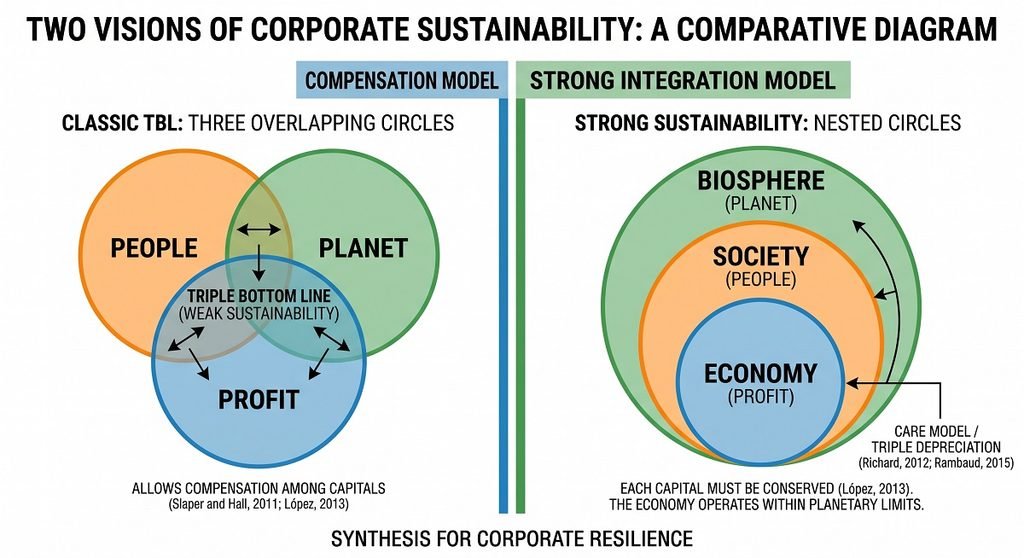
The visual representation of the Triple Bottom Line inherently shapes its operational interpretation; however, from the standpoint of sustainability science, the most widespread graphic model remains conceptually misleading.
The Myth of Three Independent Pillars and Trade-offs
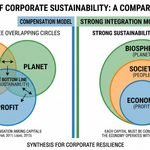
As Zaharia and Zaharia (2021) observe, the conventional TBL model depicts a Venn diagram of three intersecting, equal circles representing the economy, society, and the environment as autonomous pillars of equivalent weight, converging upon a narrow central intersection labeled “sustainability.”
The fundamental flaw in this depiction is not merely aesthetic, but ontological: portraying these spheres as equivalent presumes they can be traded off against one another—suggesting severe environmental degradation can be offset by substantial financial returns, or that social disruption can be redeemed through wider profit margins. This transactional, trade-off logic has long enabled inherently unsustainable practices to be justified under the guise of an alleged “net-positive balance.”
The Nested Dependencies Model
The scientific consensus favors the nested dependencies model. As articulated by Wu et al. (2024), this framework replaces autonomous spheres with concentric circles:
- The outermost layer and foundational container is the biosphere (the natural environment).
- Nested entirely within it is society.
- Embedded within the societal fabric, operating as a subordinate subsystem, lies the economy.
This distinction is decisive. Grounded in thermodynamics, it underscores that the economy does not bargain with nature as an equal; rather, it is merely a social subsystem bounded by the biosphere. Consequently, it dismantles the core premise of classical TBL: since economic activity depends entirely on biophysical life-support systems, ecological collapse renders financial returns irrelevant, unravelling the entire architecture.
Comparative Matrix: Classical Model vs. Scientific Model.
| Criterion | Classical Model: Overlapping Circles | Scientific Model: Nested Dependencies |
| Geometry | Three intersecting circles of equal size | Three concentric circles (Economy ⊂ Society ⊂ Biosphere) |
| Pillar Interrelationship | Independent, equivalent weight | Hierarchical; biophysical subordination |
| Allows Trade-offs? | Yes (compensatory logic) | No: natural capital has no viable economic substitute |
| Conceptual Foundation | Traditional 1990s corporate management | Thermodynamics and general systems theory |
| Inherent Risk | Enables greenwashing and policy inertia | Enforces non-negotiable ecological boundaries |
| Sustainability Paradigms | Weak sustainability | Strong sustainability |
John Elkington’s Historic 2018 “Product Recall”
If there is one milestone that distinguishes superficial commentary from genuinely authoritative editorial analysis, it is this: the architect of the Triple Bottom Line formally called for its withdrawal. While the bulk of corporate literature glosses over this turning point, it remains essential to contextualizing the framework today.
Why the Creator of the TBL “Recalled” His Own Concept
In June 2018, marking the concept’s 25th anniversary, Elkington published a seminal op-ed in Harvard Business Review proposing a strategic “product recall”—akin to an automaker recalling a vehicle over a critical design flaw—of his theoretical model. His rationale was not an inherent analytical defect within the TBL, but rather the failure of its transformative mandate: while conceived as a lever to disrupt the foundations of capitalism, the corporate sphere reduced it to a routine accounting exercise and a public relations veneer.
The TBL as an Alibi for Corporate Inaction and Greenwashing
The crux of the critique charges that corporations reduced the Triple Bottom Line to a transactional accounting exercise, dressing up annual reports without altering their underlying operational models. In this degraded incarnation, the framework functions as a veneer of legitimacy: enabling enterprises to disclose pristine sustainability reports while perpetuating harmful practices under the pretext of an alleged “net-positive balance”—the very rhetorical engineering of greenwashing.
For executive leadership, the takeaway is absolute: auditing the Triple Bottom Line without executing a structural overhaul of the business model does not represent sustainability, but rather reputational creative accounting.
The Core Challenge: How Is Non-Financial Impact Measured and Calculated?
López (2013) highlights that the TBL seeks to audit a comprehensive set of processes, values, and investments aimed at mitigating negative corporate externalities while simultaneously generating economic, social, and environmental value. Nevertheless, as noted by Nica et al. (2025), a pressing need persists to standardize Triple Bottom Line indicators to ensure robust comparability and seamless applicability across disparate regulatory and economic environments.
The Methodological Bottleneck: The Absence of a Common Unit of Measurement
Financial performance is denominated in euros, dollars, or any fiat currency—it constitutes a homogeneous, universal, and fungible metric. In contrast, the structural bottleneck of the Triple Bottom Line lies in the lack of a standardized unit to aggregate its three dimensions (Slaper & Hall, 2011).
How can one reconcile avoided metric tons of , workforce training hours, and operating margins into a single “net bottom line”? This aggregation is unattainable without imposing value judgments: researchers such as López (2013) have demonstrated the impossibility of constructing a purely objective “net social balance sheet,” as weighting qualitative variables inevitably demands discretionary criteria.
Monetization (Assigning Monetary Value)
This approach entails converting social and environmental externalities into monetary units to consolidate them directly into the traditional financial bottom line (Slaper & Hall, 2011).
- Calculation Methodology: Specific metrics are identified and assigned an estimated shadow price or an attributed societal and ecological damage cost. A prime example is the Genuine Progress Indicator (GPI), which synthesizes 25 economic, social, and environmental indicators, monetizes each parameter, and aggregates them algebraically into a single composite figure.
- Limitations: As Slaper and Hall (2011) and López (2013) emphasize, this framework encounters profound ethical and conceptual resistance, as pricing the intrinsic value of a wetland, endangered species conservation, or public health remains deeply contentious. Furthermore, methodologies aimed at calculating the “exact” cost of biodiversity loss or degraded community cohesion remain highly contested and inherently subjective.
Computation of Composite Indices (Normalization)
According to Slaper and Hall (2011), this approach resolves disparities across divergent units of measurement through the construction of a dimensionless numerical index.
- Calculation Methodology: Quantitative and qualitative data—such as pollutant emission volumes, workplace climate audits, or water consumption rates—are normalized onto a shared analytical scale (e.g., a 1-to-7 range or standardized percentages). Once homogenized, these inputs are integrated via mathematical modeling. In this vein, Varriale et al. (2023) propose computing the 3BL Index by consolidating each dimensional sub-index through the following quadratic mean:
- Limitations: The primary vulnerability of this methodology lies in the discretion inherent in assigned weighting schemes. As López (2013) observes, determining the relative weight of each pillar (such as prioritizing ecological capital over financial profitability) or calibrating the specific weight of individual metrics remains an arbitrary value judgment determined by analysts, executive leadership, or stakeholders.
Methodological Frameworks and Tools to Streamline the Process
To structure and operationalize these three approaches, organizations deploy standardized methodologies that confer technical rigor and objectivity upon indicator computation (Slaper & Hall, 2011; López, 2013):
- Global Reporting Initiative (GRI): The most widely adopted international non-financial disclosure standard, enabling executive steering committees to establish and systematize auditable socio-environmental indicators for their sustainability reports (Nogueira et al., 2023).
- Life Cycle Assessment (LCA) and Environmental Management Systems (EMS): Science-based frameworks such as ISO 14001 or EMAS engineered to model, quantify, and oversee balances of energy flows, material inputs, and waste streams generated throughout a product’s life cycle (Nogueira et al., 2023).
- Multi-Criteria Decision Analysis (SWARA-TOPSIS): Advanced analytical decision models designed to evaluate and weight qualitative socio-environmental criteria—such as labor rights or occupational health—through expert consensus, optimizing alternative ranking and sustainable supplier selection (Sithi et al., 2025).
- Industry 4.0 Technologies (Big Data, AI, and IoT): The integration of IoT sensors for real-time environmental monitoring (air quality, acoustic levels, sedimentation) paired with AI-driven analytics delivers granular extra-financial cost-benefit simulations, mitigating reporting bias and curtailing greenwashing exposure (Chowdhury et al., 2026).
The CARE Model and the “Triple Depreciation Line”: The Strong Sustainability Alternative
In contrast to the “weak sustainability” of the classical TBL—which tolerates trade-offs across dimensions—accounting frameworks engineered for strong sustainability have gained significant ground, most notably the CARE model (Comprehensive Accounting in Respect of Ecology). Originally conceived in French as Comptabilité Adaptée au Renouvellement de l’Environnement, CARE is an integrated accounting framework geared toward irreplaceable biophysical preservation (Dias, 2025). Formulated by Jacques Richard (2012) and refined with Alexandre Rambaud (2015), it re-engineers accounting architectures to align them with a structural socio-ecological transition (Rambaud & Chenet, 2021).
The fundamental premise of CARE is to audit natural and human capital under the identical accounting rigor applied to financial assets: as entities requiring preservation and, in the event of impairment, mandatory amortization and replenishment. Hence the concept of the “triple depreciation line”: analogous to depreciating a fixed asset, the enterprise recognizes the cost of ecosystem degradation or workforce health wear, provisioning dedicated financial reserves for their complete restoration.
The conceptual divergence from traditional TBL is profound:
| Criterion | Classical TBL | CARE Model / Triple Depreciation |
| Sustainability Paradigm | Weak (allows trade-offs across capitals) | Strong (mandates intact preservation of each capital) |
| Treatment of Natural Capital | Measurable, substitutable externality | Capital to be safeguarded and amortized with financial rigor |
| Core Objective | Reporting corporate impacts | Legally and operationally binding prevention of capital degradation |
| Implementation Complexity | Moderate | High |
According to Richard (2020), by placing natural, human, and financial capital on an equal footing within the balance-sheet liability structure, the CARE model drives a radical transformation of corporate governance. It establishes a socio-environmental co-management framework wherein the custodians of all three capitals—workers, ecological auditors, and capital investors—participate with equal authority in shaping the organization’s strategic trajectory.
From Voluntary Adoption to Regulatory Mandate
The implementation of the Triple Bottom Line varies substantially depending on the corporation’s operating jurisdiction. In this regard, Pasamar et al. (2025) note that while external pressures incentivize adoption, executive strategy serves as the pivotal transmission mechanism transforming institutional demands into tangible ecological impacts. Nevertheless, Anurag and Johnpaul (2026) reveal a critical structural asymmetry: although scholarly output on the TBL has surged since 2018—spearheaded by India, China, and the United Kingdom—the financial and environmental vectors continue to dominate academic discourse, relegating the social pillar to an overlooked “missing layer” within the literature.
The U.S. Approach: Voluntary and Market-Driven
In the United States, the adoption of the Triple Bottom Line is predominantly shaped by voluntary, market-driven mechanisms rather than prescriptive statutory mandates. Its primary catalysts stem from demand by ethical investors and conscious consumers, corporate brand equity, and third-party certifications—most notably the B Corp benchmark.
An enterprise attains B Corp certification only after completing a rigorous impact assessment and amending its corporate bylaws, thereby legally codifying the fiduciary duty to balance stakeholder interests alongside shareholder returns. In practice, this formalizes the TBL as a self-regulated, binding governance mandate.
The European Model: From Voluntary Action to Statutory Mandates… and Its Subsequent Recalibration
In the European Union, sustainability has evolved past corporate public relations into a legally binding regulatory mandate via the Corporate Sustainability Reporting Directive (CSRD), which demands standardized disclosure under ESRS protocols and enforces mandatory statutory assurance. Crucially, a defining development absent from pre-2026 analyses is that the CSRD architecture has undergone extensive technical streamlining.
Key Tools for Implementing the Triple Bottom Line Effectively
The practical operationalization of the Triple Bottom Line demands transcending mere corporate rhetoric to integrate rigorous methodologies capable of systematically auditing, measuring, and managing economic, social, and environmental dimensions (López, 2013). To execute this strategic transition, the essential tools are structured across the following operational domains:
Integrated Accounting Models
To prevent sustainability from devolving into mere corporate rhetoric, it is imperative to embed it within organizations’ core financial and accounting architectures. According to Dias (2025), two methodologies stand out in this domain:
- The CARE Methodology (Comprehensive Accounting in Respect of Ecology): This “strong sustainability” framework fundamentally re-engineers traditional accounting. Rather than treating the natural environment and individuals as exploitable assets, CARE categorizes them as liabilities or debts (human and natural capital) incurred by the entity, enforcing a strict obligation to preserve and “repay” them. The economic valuation of both capitals is anchored in conservation costs, establishing binding financial provisions to settle this ecological debt (such as neutralizing carbon footprints).
- Universal Accounting (Comptabilité Universelle): Grounded in standard double-entry bookkeeping (debit and credit), this model systematically records the social, environmental, and governance externalities generated by corporate decision-making. By integrating dedicated ESG balance sheets directly into classical financial accounting, it ensures that non-financial impacts are audited on an equal footing with economic performance.
The Triple Bottom Line Matrix
Engineered to bridge shareholder returns with societal well-being, this tool maps the three dimensions of sustainability across key stakeholder groups: employees, suppliers, customers, local communities, future generations, and the natural environment. According to López (2013), this framework streamlines the quantification and financial auditing of strategic impacts through standardized indicators:
- Environmental: Water and energy consumption, material balances, atmospheric emissions, waste management, and eco-efficient operational design.
- Social: Occupational health and safety, lost-time injury frequency rates, internal equity (such as gender parity in executive leadership), the eradication of child labor, and community social investment.
- Economic: Return on investment (ROI), total factor productivity, cost of capital, and the mitigation of governance risks.
Global Reporting and Certification Standards
According to López (2013), international reporting frameworks standardize data capture and guarantee the external auditability of sustainability indicators:
- Global Reporting Initiative (GRI): The undisputed global benchmark for sustainability reporting, whose foundational principles—transparency, comprehensiveness, comparability, and auditability—insulate corporate disclosures against superficial claims and greenwashing risks.
- SA8000 and AA1000 (AccountAbility): Normative standards engineered to operationalize, quantify, and audit ethical performance, social accountability, and human rights compliance across complex global supply chains.
- Environmental Management Systems (EMS): Operational instruments such as ISO 14001 and the European Eco-Management and Audit Scheme (EMAS) designed to systematize strategic ecological planning, continuous environmental monitoring, and corporate decision-making (Nogueira et al., 2023).
Life Cycle Assessment (LCA) and Industry 4.0 Technologies
- Life Cycle Assessment (LCA): A high-precision instrument for strategic decision-making, LCA audits the aggregate environmental impact of a product or service across its entire life cycle, preventing the mere shifting of environmental burdens across operational phases (Nogueira et al., 2023; Nica et al., 2025).
- Industry 4.0 Technologies: The convergence of IoT, big data, blockchain, and artificial intelligence accelerates the real-time capture and analysis of biophysical metrics and emissions, enhancing corporate transparency, supply chain traceability, and data-driven, agile TBL management (Meena et al., 2025).
Multi-Criteria Decision-Making (MCDM) Tools
In operational practice, organizations grapple with persistent structural tensions and trade-offs across the three dimensions of sustainability (Wu et al., 2024; Ch Das et al., 2025). According to Sithi et al. (2025), to mitigate subjectivity in strategic decision-making—such as sustainable supplier selection—mathematical methodologies are integrated alongside the TBL framework:
- SWARA (Step-wise Weight Assessment Ratio Analysis): Enables expert panels to analytically weight and rank diverse environmental, social, and economic criteria with methodological rigor.
- TOPSIS (Technique for Order of Preference by Similarity to Ideal Solution): Ranks and prioritizes operational alternatives by benchmarking them against positive-ideal and negative-ideal solutions, ensuring an objective and transparent evaluation of trade-offs.
Real-World Case Studies: Organizations Operationalizing the Triple Bottom Line
Academic literature documents pragmatic applications of the Triple Bottom Line (TBL) across a spectrum encompassing multinational conglomerates, privately held enterprises, municipal authorities, port commissions, and non-profit foundations. Among the most representative benchmarks are:
Pioneering Corporate Leaders
Eroa et al. (2026) establish that innovative performance serves as the single most critical transversal catalyst of corporate sustainability; while other factors merely alter isolated metrics, organizational innovation directly drives all three dimensions of the TBL simultaneously. Notable institutional pioneers include:
- Cascade Engineering: This private manufacturing firm exemplifies one of the most rigorous frameworks for internal TBL auditing. As documented by Slaper and Hall (2011), the enterprise deploys a granular multi-tier scorecard tracking targeted indicators:
- Economic: Gross corporate tax liabilities and accrued fiscal contributions.
- Social: Average continuous professional development hours per employee, retention rates for welfare-to-career transitions, and philanthropic giving.
- Environmental and Safety: Lost-time injury incident rates, revenue generated per kilowatt-hour consumed, net greenhouse gas (GHG) emissions, utilization rates of post-consumer and post-industrial regrind, direct water footprints, and total landfill diversion rates.
- Shell: Elkington (2013) observes that Shell was among the first global multinationals to institutionalize the “3Ps” architecture (People, Planet, Profit), articulating its landmark Shell Report in the mid-1990s as a pioneering milestone in integrated corporate reporting.
- Nike: Elkington (2013) highlights Nike as the emblematic “poster child” for mitigating socio-environmental supply-chain externalities through a holistic “cradle-to-grave” life-cycle strategy, systematically steering stakeholder alignment across the global apparel industry (Pasamar et al., 2025).
- Fontanafredda Winery: Operating at the nexus of viticulture and ecotourism, this enterprise demonstrates an operational model leveraging byproduct upcycling and closed-loop waste valorization to capture conscious consumer segments, consolidate competitive advantage, and drive commercial profitability (Aransyah et al., 2025).
- Unilever, General Electric, Procter & Gamble (P&G), and 3M: Slaper and Hall (2011) demonstrate how these corporations embed core sustainability imperatives into core operations, validating that minimizing environmental footprints—such as packaging lightweighting and circular redesign—yields superior financial returns and sustained economies of scale.
Sectors and Infrastructure: Sustainable Port Management
Chowdhury et al. (2026) report that within the maritime and logistics sectors, leading global ports implement TBL-driven governance frameworks to reconcile commercial objectives with environmental and social stewardship:
- Port of Rotterdam (Netherlands) and the Port Authority of New York and New Jersey (USA): Embed dedicated social programs directly into their operations and strategic community engagement initiatives.
- Port of Hamburg (Germany): Deploys mathematical optimization models for heavy equipment allocation and flow routing to maximize operational throughput while curbing energy consumption.
- Rotterdam World Gateway (Netherlands): Utilizes advanced scheduling algorithms for automated guided vehicle (AGV) charging cycles, directly mitigating terminal emissions.
Nonetheless, Goh et al. (2020) caution that construction contractors frequently implement TBL pillars in a fragmented or selective manner—subordinating socio-ecological imperatives to financial returns—while noting that adherence to these criteria remains significantly higher among European contractors than their regional peers.
Tourism
Aransyah et al. (2025) demonstrate that sustainability-oriented innovations (SOIs) across the tourism industry must not be evaluated in isolation or through an exclusively financial lens, but rather via the balanced operationalization of the three TBL pillars: economic viability, environmental preservation, and social equity.
In parallel, Tufo and Esposito (2026) adapted the Triple Bottom Line framework to cultural tourism by reframing public value within museums. Historically, performance audits for cultural venues were confined to financial metrics and private user benefits while overlooking ecological impacts; to overcome this shortfall and measure how museums foster sustainable tourism, the authors structured the TBL at the theoretical nexus of the triple bottom line and public value theory.
Government and Regional Economic Development (Local Governance)
The Triple Bottom Line transcends the corporate domain: public entities likewise leverage the framework to strengthen municipal governance and regional sustainability. Slaper and Hall (2011) highlight several landmark initiatives:
- Sustainable Cleveland 2019 (Cleveland, Ohio): A ten-year initiative engineered to revitalize the urban economy around TBL principles, audited through a dashboard tracking environmental quality indicators (waste management, energy generation mix, water consumption, emissions, LEED certifications, and land use planning), the built environment, community cohesion, and social well-being (poverty levels and food security access).
- Grand Rapids Community Sustainability Partnership (Michigan): A pioneering U.S. municipal initiative that established a roadmap of 14 discrete TBL metrics assessing social equity (education, public safety, community health), local economic prosperity, and environmental protection—setting pillar-specific targets rather than an aggregated monetary index to preclude analytical bias.
- State of Maryland: Deploys a methodology coupling the TBL with the Genuine Progress Indicator (GPI) to forecast and audit the strategic impact of public policies, such as clean energy transition investments.
- Other Jurisdictions: States including Minnesota, Vermont, and Utah, alongside the San Francisco Bay Area, have integrated TBL-based assessments to monitor institutional performance and guide regional economic development strategies.
Investments and Non-Profit Organizations
Slaper and Hall (2011) emphasize that third-sector institutions likewise leverage the TBL framework to steer their organizational strategies, highlighting two prominent benchmarks:
- RSF Social Finance: This non-profit entity utilizes the TBL to audit and structure its impact investment decisions, ensuring disbursed capital systematically fosters social justice, economic vitality, and ecological renewal in tandem.
- Ford Foundation: Underwrote research initiatives engineered to systematically measure the outcomes of rural economic development interventions across the United States, utilizing custom methodological adaptations of the TBL model.
The Quadruple Bottom Line (QBL)?
Zaharia and Zaharia (2021) examine the evolution toward more comprehensive frameworks such as the Quadruple Bottom Line (QBL), which incorporates a strategic fourth dimension: spirituality, culture, or governance. Building on this momentum, Khan et al. (2024) advocate transitioning beyond conventional frameworks toward a “quintuple bottom line,” formally embedding technological and organizational vectors within the overarching paradigm of digital transformation.
Industry 4.0 and 5.0
Varriale et al. (2023) conclude that the 3BL framework illustrates how legacy Industry 4.0 technologies can be repurposed to align with the Industry 5.0 paradigm—which institutionalizes human-centricity, operational resilience, and biophysical sustainability. In line with this premise, Meena et al. (2025) note that the Triple Bottom Line (People, Profit, and Planet) provides the optimal architecture to harmonize technological disruption with sustainability mandates.
Furthermore, Yu et al. (2026) demonstrate that for digitalization (DOS) to translate into circular economy capabilities (CEC) that reinforce the environmental pillar of the TBL, organizations must adhere to a strict strategic hierarchy: subordinating digital infrastructure to a circular economy strategy (COS), which anchors, orchestrates, and channels digital tools to deliver genuine closed-loop ecological impacts.
Conclusion: The Triple Bottom Line Is Not an Option—It Is the Linchpin of Corporate Resilience
The Triple Bottom Line emerged as an urgent call to transform our economic model, yet all too often degenerated into cosmetic accounting. Grasping this core tension—between classical dogma and scientific scrutiny, weak versus strong sustainability, and voluntary commitments versus binding legal mandates—delineates the frontier between corporate greenwashing and the rigorous stewardship of strategic impacts.
The operational imperative is twofold. First, auditing the Triple Bottom Line is not about projecting infallibility; it is about engineering a transparent corporate architecture that is operationally resilient and legally fortified against evolving regulatory frameworks. Second, ecological hierarchy is paramount: recognizing that economic activity is strictly subordinate to the biosphere eliminates specious compensatory trade-offs and compels management within genuine planetary boundaries. As Nica et al. (2025) conclude, the TBL will continue to shape corporate governance and public policy, yet its longevity hinges on integrating advanced analytical models resilient to global macroeconomic volatility.
In an arena where consumers, financial institutions, and asset managers demand auditable traceability, the TBL ceases to be an optional reputational accessory; it stands as an indispensable driver of resilience and sustained competitive advantage across the global value chain. Today’s strategic imperative is no longer whether to report it, but whether executive leadership possesses the resolve to structurally overhaul the underlying business model.
Frequently Asked Questions About the Triple Bottom Line (TBL)
What exactly is the Triple Bottom Line (TBL)?
Originally formulated by John Elkington, it is a strategic management and accounting framework that broadens the traditional financial bottom line by simultaneously and interdependently evaluating corporate performance across three core pillars: economic (profit), social (people), and environmental (planet).
What is the critical distinction between the weak sustainability of the TBL and strong sustainability (such as the CARE model)?
Classical TBL operates on the premise of “weak sustainability,” permitting fungibility and trade-offs among capitals (e.g., offsetting environmental liabilities with social philanthropy or financial returns). In contrast, “strong sustainability” frameworks, such as the CARE (Comprehensive Accounting in Respect of Ecology) methodology, posit that natural and human capital are non-substitutable; consequently, they audit both as non-negotiable liabilities that mandate conservation, mandatory amortization, and full ecological restoration without the possibility of financial offset.
Why is monetary valuation (monetization) within the TBL framework contentious?
Although frameworks like the Genuine Progress Indicator (GPI) aggregate diverse impacts into a singular monetary figure, economists and ethicists argue that assigning a market price to biodiversity loss, species extinction, or human health impairment is inherently subjective and complex, thereby risking the commodification of invaluable public goods.
How do Industry 4.0 technologies help mitigate greenwashing in TBL reporting?
The convergence of IoT sensors, AI-driven analytics, and immutable blockchain ledgers enables the real-time capture and auditing of biophysical variables—such as air quality, water consumption, and emissions—across entire supply chains. This drastically curtails managerial discretion and human bias in corporate disclosures, preventing sustainability from devolving into mere PR cosmetic exercises.
Is the TBL applicable solely to for-profit private corporations?
No. Academic scholarship and empirical practice demonstrate that the TBL framework is widely operationalized by public administrations (such as municipal and regional governments in Cleveland or Grand Rapids) to steer territorial development policies, by port and transit authorities to design eco-efficient operations, and by non-profit foundations (such as RSF Social Finance) to deploy social and environmental impact investments.
What do conceptual evolutions such as the QBL or the quintuple bottom line represent?
Frameworks such as the Quadruple Bottom Line (QBL) extend the original triad by incorporating a strategic fourth dimension—namely culture, spirituality, or governance. Similarly, emerging proposals for a “quintuple bottom line” formally integrate technological and organizational vectors to address the systemic imperatives of global digitalization.
References
Abraham KT (2024), “Responsible leadership and triple bottom line performance: imperatives for corporate sustainability“. Journal of Global Responsibility, Vol. 15 No. 4 pp. 485–500, doi: https://doi.org/10.1108/JGR-06-2023-0111
Alhaddi, H. (2015). Triple Bottom Line and Sustainability: A Literature Review. Business and Management Studies, 1(2), 6-10. https://doi.org/10.11114/bms.v1i2.752
Anurag, A., & Johnpaul, M. (2026). Mapping the global research landscape of sustainable supply chains in the industry 4.0 era through a triple bottom line perspective. Cleaner Logistics and Supply Chain, 19, 100323. https://doi.org/10.1016/j.clscn.2026.100323
Aransyah, M. F., Hermanto, B., Muftiadi, A., & Oktadiana, H. (2025). Exploring sustainability oriented innovations in tourism: insights from ecological modernization, diffusion of innovations, and the triple bottom line. Cogent Social Sciences, 11(1). https://doi.org/10.1080/23311886.2024.2447396
Bahaw, P., Forgenie, D., Sadiq, G., & Sookhai, S. (2025). Generative AI for business sustainability: Examining usability, usefulness, and triple bottom line impacts in small and medium enterprises. Sustainable Futures, 10, 100815. https://doi.org/10.1016/j.sftr.2025.100815
Ch Das, Tilak & Bora, Prathana Kashyap & Das, Jyotisman, 2025. “Corporate Sustainability, ESG, and the Triple Bottom Line: A Review of Key Challenges,” International Review of Management and Marketing, Econjournals, vol. 15(5), pages 345-355, August. https://ideas.repec.org/a/eco/journ3/v15y2025i5id19768.html
Chowdhury, M. M. H., Shi, W., & Zhang, W. (2026). Achieving port sustainability through the triple bottom line framework: A review. Transportation Research Part E: Logistics and Transportation Review, 211, 104880. https://doi.org/10.1016/j.tre.2026.104880
DIAS PEREIRA FILHO, Antônio. AS CONTRIBUIÇÕES DA CONTABILIDADE PARA A ECOLOGIA INTEGRAL. PARALELLUS Revista de Estudos de Religião – UNICAP, Recife, PE, Brasil, v. 16, n. 39, p. 441–463, 2025. DOI: 10.25247/paralellus.2025.v16n39.p441-463. https://periodicos.unicap.br/paralellus/article/view/2967
Elkington, J. (2013). Enter the triple bottom line. In The triple bottom line (pp. 1-16). Routledge.
Eroa, M., Himang, C., Aro, J. L., & Ocampo, L. (2026). Toward sustainable business models for startups from a triple bottom line perspective. Journal of Open Innovation: Technology, Market, and Complexity, 12(2), 100802. https://doi.org/10.1016/j.joitmc.2026.100802
Ferrer-Serrano, M., & Salesa, A. (2025). Revisiting the Circular Economy Paradox: A Triple Bottom Line Perspective. Sustainable Development, 33(5), 7526-7545. https://doi.org/10.1002/sd.3539
Gallardo-Vázquez, D. (2025). Defining the Path to Sustainability Based on Triple Bottom Line Dimensions. Corporate Social Responsibility and Environmental Management, 32(4), 4743-4768. https://doi.org/10.1002/csr.3216
Goh, C. S., Chong, H., Jack, L., & Mohd Faris, A. F. (2020). Revisiting triple bottom line within the context of sustainable construction: A systematic review. Journal of Cleaner Production, 252, 119884. https://doi.org/10.1016/j.jclepro.2019.119884
Khan, I. S., Ahmad, M. O., & Majava, J. (2021). Industry 4.0 and sustainable development: A systematic mapping of triple bottom line, Circular Economy and Sustainable Business Models perspectives. Journal of Cleaner Production, 297, 126655. https://doi.org/10.1016/j.jclepro.2021.126655
López, M. J. G. (2015). La cuenta del triple resultado o triple bottom line. Revista de contabilidad y dirección, 20, 65-77.
Meena, R., Sahoo, S., Malik, A. et al. Artificial intelligence and circular supply chains: framework for applications and deployment from the triple bottom line model perspective. Ann Oper Res 354, 71–101 (2025). https://doi.org/10.1007/s10479-025-06510-1
Miller, K. (2020, 8 de diciembre). The Triple Bottom Line: What It Is & Why It’s Important. Harvard Business School Online.
Nica, I., Chirita, N., & Georgescu, I. (2025). Triple Bottom Line in Sustainable Development: A Comprehensive Bibliometric Analysis. Sustainability, 17(5), 1932. https://doi.org/10.3390/su17051932
Nogueira, E., Gomes, S., & Lopes, J. M. (2023). Triple Bottom Line, Sustainability, and Economic Development: What Binds Them Together? A Bibliometric Approach. Sustainability, 15(8), 6706. https://doi.org/10.3390/su15086706
Pasamar S, Bornay-Barrachina M, Morales-Sánchez R (2025), “Institutional pressures for sustainability: a triple bottom line approach“. European Journal of Management and Business Economics, Vol. 34 No. 4 pp. 460–484, doi: https://doi.org/10.1108/EJMBE-07-2022-0241
Rambaud, A. et Chenet, H. (2021). How to re-conceptualise and re-integrate climate-related finance into society through ecological accounting? Bankers, Markets & Investors, 166(3), 20-43. https://doi.org/10.54695/bmi.166.0020.
Richard, J. (2020). Towards a new ecological and human type of national accounting for developing economies (The CARE/TDL model). BRICS Journal of Economics, 1(1), 43-59.
Sithi, S.S., Ara, M.A., Dhrubo, A.T. et al. Sustainable supplier selection in the textile industry using triple bottom line and SWARA-TOPSIS approaches. Discov Sustain 6, 344 (2025). https://doi.org/10.1007/s43621-025-01206-9
Slaper, T. F., & Hall, T. J. (2011). The triple bottom line: What is it and how does it work. Indiana business review, 86(1), 4-8.
Tufo M, Esposito P (2026), “Can public value be measured? A triple bottom line perspective on sustainable tourism“. Management Decision, Vol. ahead-of-print No. ahead-of-print. https://doi.org/10.1108/MD-09-2025-2932
Varriale, V., Cammarano, A., Michelino, F., & Caputo, M. (2023). Industry 5.0 and Triple Bottom Line Approach in Supply Chain Management: The State-of-the-Art. Sustainability, 15(7), 5712. https://doi.org/10.3390/su15075712
Wu, T., Rocha, J. C., Berry, K., Chaigneau, T., Hamann, M., Lindkvist, E., Qiu, J., Schill, C., Shepon, A., Crépin, A., & Folke, C. (2024). Triple Bottom Line or Trilemma? Global Tradeoffs Between Prosperity, Inequality, and the Environment. World Development, 178, 106595. https://doi.org/10.1016/j.worlddev.2024.106595
Yu, W., Wong, C. Y., Chavez, R., Jacobs, M. A., & Cadden, T. (2026). Fostering circular economy capabilities through digital- and circular-oriented strategies for boosting triple bottom line performance. International Journal of Production Economics, 298, 110033. https://doi.org/10.1016/j.ijpe.2026.110033
Zaharia, R.M., Zaharia, R. (2021). Triple Bottom Line. In: Crowther, D., Seifi, S. (eds) The Palgrave Handbook of Corporate Social Responsibility. Palgrave Macmillan, Cham. https://doi.org/10.1007/978-3-030-42465-7_2

Editor and founder of “Innovar o Morir” (‘Innovate or Die’). Milthon holds a Master’s degree in Science and Innovation Management from the Polytechnic University of Valencia, with postgraduate diplomas in Business Innovation (UPV) and Market-Oriented Innovation Management (UPCH-Universitat Leipzig). He has practical experience in innovation management, having led the Fisheries Innovation Unit of the National Program for Innovation in Fisheries and Aquaculture (PNIPA) and worked as a consultant on open innovation diagnostics and technology watch. He firmly believes in the power of innovation and creativity as drivers of change and development.