Key Takeaways of the Article
- Strategy Over Tools: The choice between Kanban and Scrum is not a superficial technical debate, but a fundamental decision that defines team culture and daily experience (rhythm, predictability, stress, and change management).
- Structural Difference (Push vs. Pull): Kanban operates as a strict pull system where Work in Progress (WIP) limits mechanically prevent overload. Conversely, Scrum operates partly as a push system, where potential overload must be consciously regulated during Sprint Planning.
- Organizational Cost and Impact: Adopting Scrum carries a steep structural transformation cost (mandatory roles like Product Owner and Scrum Master, set events, and cross-functionality). Kanban is evolutionary and low-cost, seamlessly layering onto existing operational workflows while respecting current roles and hierarchies.
- The Human Factor and Flow Health: End-of-sprint pressure (“merge crunch”) induces stress and risks technical debt if cycles are treated as rigid deadlines. On the other hand, Kanban’s lack of built-in events requires establishing explicit review cadences to avoid turning work into an endless, unreflective assembly line.
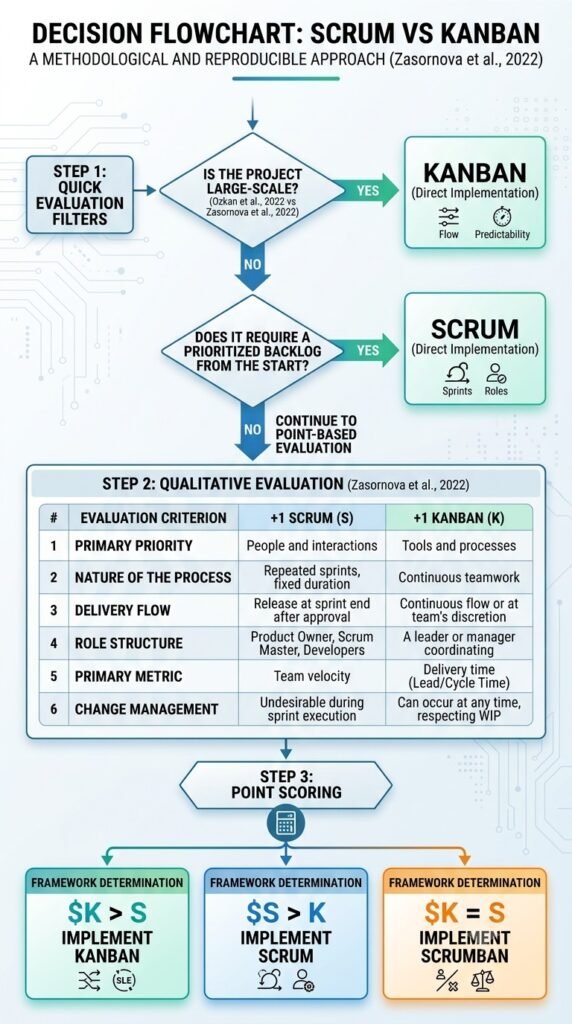
- Objective and Academic Decision-Making: The decision tree by Zasornova et al. (2022) transforms this choice into a reproducible three-step process (filtering by project scale and backlog needs, qualitative evaluation across 6 criteria, and point scoring), validating hybrid approaches (Scrumban) in the event of a tie (K = S).
- The Decisive Question: The final decision comes down to the predictability of operational demand: Can you plan your work two weeks in advance? If yes, Scrum provides rhythm and focus; if not, Kanban efficiently manages variability without enforcing unrealistic planning.
Choosing between Kanban vs Scrum may seem like a mere technical decision, but it actually defines your organization’s culture. On paper, cadences, roles, and boards are debated; in practice, you determine how your team experiences work each week: whether they face a biweekly race against the clock or a steady flow, whether priorities remain fixed or reorder daily, and whether stress peaks at deadlines or is evenly distributed.
Most guides offer superficial comparisons—sprints versus continuous flow, strict versus flexible roles, and a basic summary table—which fail to support real decision-making or execution. They do not explain how to navigate the transition smoothly, how to bill clients under a continuous flow model, or what updates were introduced in the official 2025 framework guides.
This guide addresses the challenge comprehensively. Beyond conceptual differences, you will find an analysis of recent updates in official Scrum and Kanban documentation, alongside an academically validated decision tree that turns framework selection into an objective, reproducible process with a clear scoring system.
What Changed in 2025
Before comparing, it helps to update our baseline, as much of the content circulating online regarding Kanban vs. Scrum describes outdated versions of these frameworks.
In Scrum, the official reference remains the November 2020 Scrum Guide by Ken Schwaber and Jeff Sutherland; however, the Scrum Guide Expansion Pack was introduced on June 11, 2025 (with a subsequent revision in January 2026) to extend rather than replace it. Its most notable contributions include introducing stakeholder and supporter roles around the team, explicitly treating AI as a product development collaborator while maintaining human accountability, and distinguishing between delivering a feature and verifying that it produced an outcome.
In Kanban, the transformation is even deeper: the Kanban Guide was updated in May 2025 (version 2025.5), alongside the release of the Open Guide to Kanban in July 2025 to unify communities. This update streamlined core practices, incorporated the Service Level Expectation directly into the Definition of Workflow, increased flexibility around WIP management, and rebranded former “Kanban Measures” as Flow Metrics.
Why does this matter for your decision? Both frameworks have evolved toward less prescription and greater context awareness—making “Which framework is less restrictive?” the wrong question to ask. The relevant question today is: What type of demand does your team actually face?
What are Agile methodologies, and where do Kanban and Scrum fit in?
Before analyzing the differences between Scrum and Kanban, it is crucial to clarify their conceptual standing, as they are frequently mislabeled as “methodologies” when, strictly speaking, neither is.
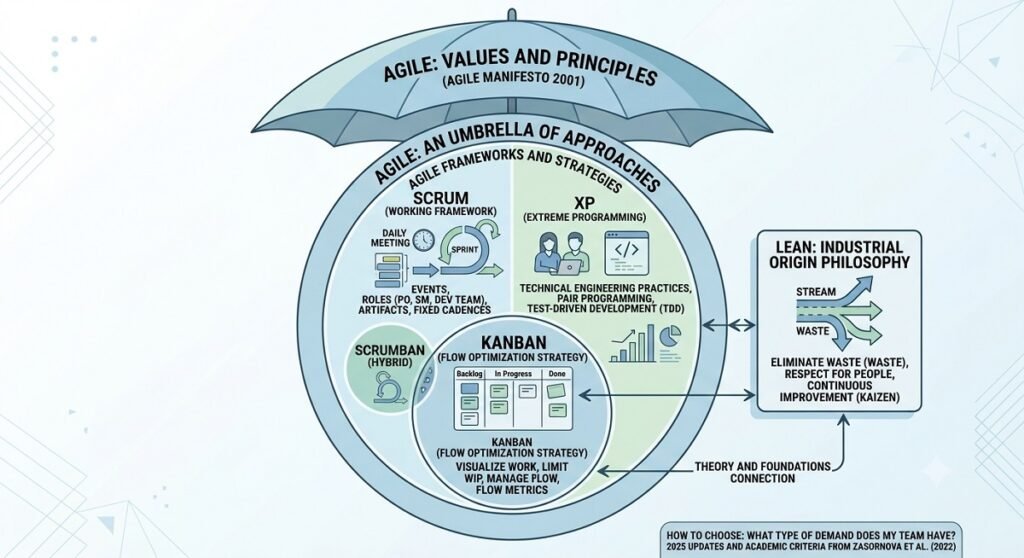
Agile is not a method, but rather a set of values and principles established in the 2001 Agile Manifesto by seventeen software development experts. This approach prioritizes individuals and interactions over processes; working software over comprehensive documentation; customer collaboration over contract negotiation; and responding to change over rigidly following a plan.
Under this umbrella, several approaches with distinct purposes coexist:
- Scrum: A framework that defines a minimal set of events, accountabilities, and artifacts, leaving ample room for each team to tailor the rest of their operations.
- Kanban: A strategy aimed at optimizing the flow of value. It imposes no mandatory roles or meetings; instead, it establishes clear practices to visualize and manage ongoing work.
- Lean: An industrial philosophy focused on the systematic elimination of waste, which serves as the theoretical foundation for much of Kanban.
- Waterfall: The traditional sequential model (requirements, design, development, testing, and delivery) that precludes early iterations without incurring high rework costs.
The practical consequence of this distinction is paramount and explains a significant portion of implementation failures: Scrum replaces your current process, whereas Kanban overlays it. Adopting Scrum requires an immediate transformation of how work is organized. In contrast, implementing Kanban starts with mapping your actual workflow to foster evolutionary improvement.
Key Differences Between Kanban and Scrum
To answer the question of which framework to choose, we must first understand the fundamental differences between Kanban and Scrum. In this regard, Reiter (2025) points out that while Scrum operates through structured, iterative cycles called sprints—requiring defined roles (Scrum Master, Product Owner, and Developers) and fixed events such as Sprint Planning, Daily Scrums, and Retrospectives—Kanban provides a dynamic approach based on continuous flow. This strategy focuses on visual management via a clear task board and limiting Work in Progress (WIP) to maximize efficiency, without imposing rigid roles or ceremonies.
The table below summarizes these key differences, while subsequent sections detail how each criterion plays out in daily operations:
Comparison Between Scrum and Kanban
| Criterion | Scrum | Kanban |
| Concept | Framework | Flow optimization strategy |
| Official Reference | Scrum Guide, Nov 2020 (+ Expansion Pack 2025) | Kanban Guide, May 2025 |
| Cadence | Fixed sprints of one month or less | Continuous flow, no mandatory iterations |
| Delivery | At least one increment per sprint | As soon as the work item is completed |
| Roles and Accountabilities | Product Owner, Scrum Master, Developers | None prescribed |
| Team Size | Recommended 10 people or fewer | No prescribed limit |
| Mandatory Events | Planning, Daily, Review, Retrospective | None; periodic flow reviews are recommended |
| Changes During Cycle | Allowed, provided they don’t compromise the Sprint Goal | At any time, respecting the WIP limit |
| Workload Management | Sprint commitment | Explicit Work in Progress (WIP) limits |
| Typical Metrics | Velocity, Burndown Chart | WIP, Throughput, Work Item Age, Cycle Time |
| Forecasting | Historical velocity per sprint | Probabilistic Service Level Expectation (SLE, e.g., 85% in ≤ 8 days) |
| Board | Reset at the beginning of each sprint | Persistent and incremental |
| Improvement Model | Retrospective at the end of each sprint | Continuous improvement (Kaizen) and Just-In-Time |
| Assignment Mechanics | Partially push: a batch is allocated to the sprint | Pull: work is pulled only when capacity is available |
| Organizational Cost of Change | High: requires structural transformation | Low: evolves on top of the existing structure |
| Adoption Curve | Immediate structural transformation | Progressive evolution of the current process |
| Behavior When Scaling | Risk of inter-team fragmentation | Systemic value-stream approach |
| Key Metric | Cycle time (active work time) | Lead time (from request to delivery) |
| Best Fit | Product development with target horizons | Environments with unpredictable demand and fluid priorities |
Pull System vs. Push System: The Structural Difference
This is the most profound distinction between both approaches, yet very few comparisons explore it deeply, despite explaining nearly all of their inner workings.
Ozkan et al. (2022) note that Kanban implements a pull system through Work in Progress (WIP) limits: a new task is taken on only when there is a clear signal of available capacity, preventing system collapse. Conversely, Scrum operates partially as a push system, as a closed batch of requirements is “pushed” into the sprint during planning, bound by the commitment to deliver a functional increment by the end of the cycle.
The practical consequence is direct:
- In a push system: Overload is typically detected at the end of the cycle, when maneuvering space is minimal and the team is forced to race against the clock.
- In a pull system: Overload is prevented by design; once the WIP limit is reached, the system automatically stops admitting new work.
This does not mean Scrum is a flawed framework; rather, it implies that protection against overload in Scrum relies on a conscious decision during Sprint Planning, whereas in Kanban it is a structural constraint of the flow itself. A mature Scrum team that properly estimates its capacity achieves the same balance; a team planning out of optimism does not.
This dynamic explains why combining both frameworks (Scrumban) proves so effective: integrating WIP limits within a sprint introduces pull mechanics into a framework that does not naturally include them.
Cadence: Fixed Iteration vs. Continuous Flow
Scrum compresses the cycle of planning, execution, and review into a bounded, repeating timebox. While this fixed cadence provides rhythm, focus, and a natural point for stakeholder alignment, it can also create friction when operational realities—such as urgent incidents, external dependencies, or difficult-to-estimate tasks—spill over the frame.
Conversely, Kanban operates without rigid time blocks: work items enter the system, flow continuously, and are delivered upon completion. In this framework, predictability relies on the statistical behavior of the flow—formally expressed through the Service Level Expectation (SLE)—rather than the conclusion of a sprint.
In this regard, Mojabi et al. (2026) highlight that while Scrum reinforces structured iteration and event discipline, Kanban maximizes workflow transparency and optimizes end-to-end management.
Change Management and Priorities
This is likely the most consequential difference. In Scrum, the Sprint Backlog belongs to the Developers, and changes that endanger the Sprint Goal should not be added. While scope can be renegotiated with the Product Owner as new learnings emerge, protecting the goal remains explicit. In Kanban, the backlog can be reordered at any time. The only non-negotiable rule is the WIP limit: if you want to introduce an urgent item and capacity is full, another item must be removed—a conversation Kanban strictly forces, whereas Scrum handles it via fixed calendar cycles.
Roles and Team Structure
Scrum requires cross-functional teams equipped with all the skills needed to deliver a functional increment independently. Kanban imposes no such structural constraint, making it highly viable in environments with scarce specialists—such as a single DBA or designer—where forcing cross-functionality would be unrealistic. The trade-off is that Kanban does not require you to resolve this dependency immediately; it simply surfaces it as a bottleneck directly on the board.
Organizational Change: Cost and Depth
Ozkan et al. (2022) highlight a difference rarely analyzed in economic terms: Scrum requires high-cost transformations, as it mandates specific configurations, demands cross-functional teams, and introduces structured roles like Scrum Master and Product Owner. Conversely, Kanban respects the existing operational framework—it preserves job titles, avoids rearranging hierarchies, and fosters organic evolution.
In business practice, the critical question is not merely which framework is superior, but rather: What is the organization’s current capacity for change management?
- If strategic bandwidth exists: To reorganize teams, train staff, and sustain a months-long transition, Scrum is a viable option.
- If the structure is unyielding: Due to company size, internal politics, or business timing, Kanban optimizes workflow without requiring prior restructuring.
Many Scrum implementations fail not due to flaws in the framework, but because organizations undertake a cultural and structural shift believing they are simply acquiring a management tool. In this regard, Mojabi et al. (2026) emphasize the necessity of tailoring agile approaches to each specific context, as no single framework fully addresses the adaptability and uncertainty inherent in highly dynamic environments like startups.
The Human Factor: Stress, Pace, and Quality of Life
When comparing Kanban vs. Scrum, most analyses focus exclusively on operational efficiency, ignoring the most critical factor: people. Team members execute the strategy, make key decisions, and ultimately determine the implementation’s success or failure. Therefore, evaluating how each framework impacts stress levels, work cadence, and the team’s overall quality of life is essential.
The End-of-Sprint Merge Crunch
The pattern is widely recognizable: the first days of the sprint pass with relative calm, while the final two days concentrate code integration, stacked reviews, compressed testing, and heavy artificial pressure to close tasks before the Sprint Review. Although this scenario is not found in the Scrum Guide—which actually promotes a sustainable pace and strict adherence to the Definition of Done—it frequently arises when the iteration is interpreted as a rigid delivery deadline rather than a learning cycle.
This issue extends beyond typical developer community discussions. Ozkan et al. (2022) explicitly document this phenomenon: Scrum’s fixed cycles impose preset deadlines that require estimating capacity, which can generate stress and compromise technical quality under tight schedules. Conversely, the authors highlight that Kanban’s continuous flow reduces pressure and accelerates feedback by allowing constant reprioritization without waiting for a cycle to close.
Ultimately, the operational friction frequently debated within engineering teams is fully supported by comparative literature.
Workload in Kanban: More Equitable
Continuous flow distributes operational workload more evenly, representing its main benefit for team well-being. However, this model carries its own pitfall: a system lacking defined cadences can turn into an endless assembly line with no milestones, no space to celebrate achievements, and no natural moments to pause and reflect. Since Kanban does not prescribe mandatory meetings, many teams misinterpret this flexibility as a total absence of events, resulting in a workflow that moves forward but fails to evolve. Therefore, keeping periodic review cadences—even if not enforced by the framework—fulfills the same transformative purpose as Scrum’s Retrospective.
The Autonomy Factor
There is a critical nuance that is often overlooked: Scrum grants the team an explicit shield against external interruptions during the sprint. For teams struggling with micromanagement or daily priority shifts imposed by third parties, this protection alone marks a major boost to their well-being and focus. Conversely, Kanban brings this exact issue into plain sight with complete transparency, but lacks an automatic shielding mechanism.
Transition Guide: How to Migrate Without Causing Chaos
In any migration process—whether from Scrum to Kanban or vice versa—failure rarely stems from methodological flaws; rather, it results from inadequate change management. Both transitions are asymmetric: as noted by Ozkan et al. (2022), adopting Scrum requires a revolutionary transformation with steep organizational costs, explicit structural configurations, and new roles, whereas Kanban is an evolutionary process that overlays existing workflows without altering titles or hierarchies. In practical terms, transitioning to Kanban can begin next week, while migrating to Scrum demands executive sponsorship and a strategic plan. In this regard, Stankovski (2023) highlights that organizations should strongly consider moving from Kanban to Scrum if at least two of the following conditions are met:
- Project Duration: Kanban is ideal for short-term initiatives (under 3 months), whereas Scrum becomes necessary for larger-scope projects (over 3 months).
- Team Size: Kanban operates optimally with smaller teams (fewer than 7 members), while Scrum is the required option for groups of 7 or more.
- Third-Party Integration: Kanban adapts well to strictly internal development, but if the project involves integration with multiple vendors or direct external stakeholder dependencies, Scrum is the framework to choose.
Common Mistakes When Transitioning from Scrum to Kanban
A literature review reveals the following frequent pitfalls:
- Eliminating events without establishing flow metrics: Removing retrospectives before securing flow visibility simultaneously deprives the team of both continuous improvement mechanisms.
- Confusing the absence of sprints with a lack of commitment: Without a Service Level Expectation (SLE) and explicit policies, stakeholders will perceive a complete absence of predictability and accountability.
- Replicating previous board columns without alignment: Copying the prior structure without clearly defining what “started” and “finished” mean in the actual operational context creates ambiguity.
- Omitting WIP limits to avoid conflict: A Kanban board without Work in Progress (WIP) limits is merely a visual to-do list.
In this regard, Stankovski (2023) notes that failures during these transitions stem not only from a lack of metrics, but also from organizational structure flaws. To mitigate these risks, it is essential to foster core agile values (trust, courage, openness, focus, and respect) and clearly distinguish the Product Owner’s role as a value maximizer rather than a Project Manager.
Five Steps for an Orderly Transition
- Map the actual workflow, not the ideal one: Diagram the exact stages work goes through, explicitly including invisible wait times (e.g., “awaiting business approval”).
- Measure before transforming: Record cycle time and throughput over recent weeks to establish a solid baseline for measuring progress.
- Set progressive WIP limits: Start near current volume and reduce limits gradually to avoid triggering team resistance.
- Make flow policies explicit: Clearly document entry and exit criteria for moving items between columns to eliminate operational chaos.
- Maintain a review cadence: Preserve periodic spaces to inspect system performance and refine the Definition of Workflow (DoW).
How to Align Executive Leadership
To secure executive buy-in, frame the argument using quantifiable data rather than broad claims:
“Our current 85th percentile cycle time is X days. By implementing WIP limits, we project reducing it to Y days. We will review results biweekly and revert if continuous improvement is not observed.”
A commitment built around metrics, review intervals, and an exit plan is vastly more persuasive to leadership than proposing a purely philosophical shift.
Scaling and Managing the Business: Kanban and Scrum at the Organizational Level
When an organization has dozens of teams working simultaneously, neither baseline framework resolves coordination on its own. Given this reality, a structural issue arises that is worth analyzing before selecting a scaling strategy.
The Structural Challenge in Scaling Scrum
Ozkan et al. (2022) identify a specific limitation: because iterations remain isolated within individual teams, scaling Scrum tends to create fragmentation, making it difficult to sustain a unified long-term strategic vision. In this dynamic, each team optimizes its own sprint while losing sight of the end-to-end value journey.
Kanban’s Systemic Approach
The same authors note that Kanban adopts systems thinking: rather than structuring around independent teams, it organizes around customer-facing value streams. This enables tracking the entire horizontal lifecycle—from initial request to final delivery—directly resolving the fragmentation caused by isolated iterations.
Most Widely Adopted Scaling Frameworks:
- SAFe (Scaled Agile Framework): The most prescriptive and widely adopted approach in large enterprises, grouping teams into Agile Release Trains with joint planning cycles.
- LeSS (Large-Scale Scrum): Extends Scrum to multiple teams sharing a single Product Owner and Product Backlog through a minimalist design.
- Nexus: Created by Scrum.org, it introduces an Integration Team to coordinate 3 to 9 Scrum teams working on the same product.
- Scrum@Scale: Scales agility through networks of interconnected teams and Scrum-of-Scrums synchronization meetings.
- Flight Levels / Scaled Kanban: Manages organizations via interconnected boards across three strategic levels (operational, coordination, and executive) without altering team structures.
A universal principle across all these models is that coordinating multiple Kanban boards is generally simpler than synchronizing multiple sprints, as it does not require aligning delivery calendars. In return, it demands far stricter dependency management discipline.
It is worth highlighting a crucial nuance: frameworks like SAFe, LeSS, or Nexus exist precisely to offset the aforementioned fragmentation, incorporating Kanban-style boards and flow metrics at their higher tiers. In practice, strategic-level Scrum scaling tends to converge with Kanban, even if it retains sprint cadences at the operational team level.
The Decision Tree: Choosing with a Method, Not an Opinion
Most guides on Kanban vs. Scrum conclude with generic advice such as “it depends on your context.” On one hand, Salkoski et al. (2023) recommend using Scrum for projects with well-defined goals and strict deadlines due to its structural rigor, while suggesting Kanban for initiatives requiring continuous delivery and high adaptability, which optimizes long-term productivity and team satisfaction. They also highlight that organizations can adopt hybrid models like Scrumban to combine the strengths of both approaches.
On the other hand, Zasornova et al. (2022) developed a more precise methodological framework: a decision flowchart with eliminatory filters and a scoring system that enables grounded, reproducible decision-making in three steps:
Step 1: Rapid Evaluation Filters
These two initial questions can determine the selection immediately:
- Is the project large-scale?
- Yes: The evaluation concludes directly in Kanban.
- No: Proceed to the next question.
- Does it require a prioritized backlog from the outset?
- Yes: The evaluation concludes directly in Scrum.
- No: Proceed to the scoring evaluation phase.
The logic behind the first filter often surprises people, but it aligns seamlessly with scaling principles: in large-scale projects, isolating iterations into sprints fragments the global vision, whereas Kanban’s value-stream approach preserves end-to-end horizontal traceability.
Step 2: Qualitative Scoring Evaluation
If the project is not large-scale and does not require a strictly prioritized backlog from the outset, evaluate six criteria by awarding one point to either Scrum (S) or Kanban (K):
| # | Evaluation Criterion | +1 Scrum (S) | +1 Kanban (K) |
| 1 | Primary Focus | Individuals and interactions | Tools and processes |
| 2 | Process Nature | Repeating fixed-length sprints | Continuous teamwork |
| 3 | Delivery Flow | Deployment at sprint end post-approval | Uninterrupted flow or team discretion |
| 4 | Role Structure | Product Owner, Scrum Master, Developers | Team coordinated by a leader or manager |
| 5 | Primary Metric | Team velocity | Lead Time / Cycle Time |
| 6 | Change Management | Undesirable during sprint execution | Allowed and integrated at any time |
Step 3: Framework Determination
Calculate the final score:
- K > S: Implement Kanban.
- S > K: Implement Scrum.
- K = S: Implement a hybrid approach such as Scrumban.
A tie objectively indicates a mixed operational profile, where forcing a pure framework would be a methodological error.
How to Use the Method Without Turning It Into Dogma
Two fundamental clarifications should be considered before applying the model:
- Distinguishing Between Team Size and Project Scale: The first question seems to contradict Ozkan et al. (2022), who argue that Scrum better suits complex projects and large teams. This apparent contradiction resolves by separating the two concepts:
- Team size: A nine-person team benefits more from Scrum’s structure than a three-person team (Ozkan’s criterion).
- Project scale: A multi-year program with fifteen teams suffers from isolated sprint fragmentation, where Kanban’s systemic approach proves superior (Zasornova’s criterion).
- A Tool for Strategic Alignment: The main value of this tool lies not merely in the final score, but in forcing leadership to explicitly agree on six critical workflow dimensions. If evaluating the primary metric reveals an internal lack of consensus, the exercise will have already provided invaluable diagnostic insight.
Scenario-Based Decision Guide
| Operational Situation | Recommended Framework |
| New product, quarterly goals, and a stable team of 5 to 9 members | Scrum |
| Support, incident management, maintenance, and unpredictable demand | Kanban |
| Team with scarce, highly specialized roles that are hard to replace | Kanban |
| Team with no prior agile experience requiring explicit structure | Scrum |
| Functional current process that should not be restructured | Kanban |
| Priorities shifting multiple times a week from external sources | Kanban |
| Need for fixed commitments and deadlines with external stakeholders | Scrum (or Kanban with a contractual SLE) |
| Remote and asynchronous team distributed across multiple time zones | Kanban (or Scrum with asynchronous events) |
| Mixed workload: planned development alongside continuous operations | Scrumban |
| Marketing, Design, Human Resources, Legal, or Operations departments | Kanban |
| Large-scale program with multiple teams and a multi-year horizon | Kanban (or Scaled Scrum with a flow layer) |
| Inability to reorganize the current team structure | Kanban |
| Small, low-complexity features without mandatory deadlines | Kanban |
| New product with high uncertainty and strict delivery deadlines | Scrum |
| Tied score in the decision tree ($K = S$) | Scrumban |
Methodological Decision Criteria
Choose Scrum if:
- The work benefits from a shared strategic goal set every two to four weeks.
- You can shield the team from external interruptions during that period.
- An institutionalized continuous improvement mechanism (Retrospective) is required.
- The team can operate in a truly cross-functional manner in practice.
- The organization embraces the cost of a cultural and structural transformation.
- You are developing a new product with high uncertainty and batch-packaged requirements (Ozkan et al., 2022).
Choose Kanban if:
- Operational demand is unpredictable over a weekly horizon.
- An existing process needs evolutionary, low-friction optimization.
- The context involves operational management (Rinkleff, 2023).
- Execution relies on highly focused specialists.
- You seek to surface bottlenecks before attempting structural reorganization.
- Work involves dynamic maintenance or small iterations without rigid deadlines (Ozkan et al., 2022).
- An end-to-end value stream perspective is required to avoid team fragmentation.
The Decisive Question
If the decision had to be distilled into a single practical criterion, it comes down to: Can you plan your work two weeks in advance?
- Yes: Scrum will leverage that stability to build cadence, focus, and delivery momentum.
- No: Scrum will cause frustration due to constant changes; Kanban will manage variability rather than resist it.
Conclusion: The Right Choice Depends on Your Demand, Not the Trend
The debate between Kanban and Scrum has been framed for years as if a winning side existed, and that mindset is precisely why many implementations fail. They are not competing frameworks; rather, they address problems with distinctly different dynamics.
Scrum is the right solution when you can agree on a clear objective, protect it from interruptions for a few weeks, and learn from delivered increments—providing rhythm, strategic focus, and an institutionalized continuous improvement mechanism. Kanban, on the other hand, is ideal when unpredictable demand prevents rigid planning: it visualizes existing workflows, limits work in progress, and leverages flow metrics (cycle time, throughput, SLE) to set realistic expectations instead of making unfeasible commitments. If your organization operates in a hybrid environment, Scrumban offers the optimal path forward—not as an excuse for a lack of structure, but because, as Ozkan et al. (2022) and Dávila-Sandoval (2025) note, combining both leverages their complementary strengths and mitigates their individual weaknesses.
Four Key Recommendations:
- Measure before transforming: Without baseline cycle time and throughput data, any methodological choice relies solely on intuition.
- Select based on demand type: Align your choice with the nature of your workflow, not market trends or certification requirements.
- Apply a reproducible method: Evaluating through the Zasornova et al. (2022) model takes only fifteen minutes and forces leadership to align in writing across six critical dimensions.
- Consult updated official documentation: Review the 2020 Scrum Guide with its 2025 Expansion Pack, as well as the May 2025 Kanban Guide.
The best framework is not the most popular one, but the one your team can sustain rigorously and seamlessly over time.
Frequently Asked Questions About Kanban vs. Scrum
Is Kanban part of Scrum?
No. They are independent frameworks with distinct origins: Scrum emerged from product development in the 1990s, whereas Kanban originated from the Toyota Production System and was adapted for knowledge work in 2006. That said, they are fully compatible: many Scrum teams integrate Work in Progress (WIP) limits and flow metrics directly into their sprints.
Which is better for software development: Scrum or Kanban?
There is no universal winner. Scrum is better suited for new product development characterized by high uncertainty and clear milestone goals, whereas Kanban excels in dynamic maintenance, support, platform infrastructure, and low-complexity features without rigid deadlines (Ozkan et al., 2022). The decisive variable is not the type of software, but the predictability of operational demand. To make an objective choice, applying the decision tree by Zasornova et al. (2022) is recommended.
Can Scrum and Kanban be used simultaneously?
Yes, and it is a widely adopted practice. Preserving Scrum events while integrating Work in Progress (WIP) limits and flow metrics within the iteration typically optimizes delivery without compromising cadence. When sprint rigidity is relaxed while retaining the remaining structure, this hybrid model is known as Scrumban.
What is the difference between a Kanban board and a Scrum board?
A Scrum board is transient and bound to a specific sprint: it is configured during planning and cleared when the iteration closes. Conversely, a Kanban board is persistent and reflects continuous value flow by enforcing explicit Work in Progress (WIP) limits per column. In tools like Jira or Azure DevOps, both formats can visualize the same project data.
When is it advisable to transition from Scrum to Kanban?
The clearest indicators include: sprints systematically disrupted by emergencies, tasks routinely carrying over between iterations, sprint planning reduced to a bureaucratic formality, and an operational workload that overflows the cycle. Notably, adopting Kanban represents a progressive evolution over your existing setup, whereas implementing Scrum demands a higher-cost organizational transformation (Ozkan et al., 2022). Before migrating, establishing a baseline cycle time is essential.
Does Kanban require specific roles like the Scrum Master?
No, it does not prescribe them. However, many organizations assign a professional to oversee flow health, facilitate system reviews, and eliminate bottlenecks. Kanban does not prohibit roles; it simply does not mandate them.
What metrics are mandatory in Kanban?
The May 2025 Kanban Guide establishes four fundamental Flow Metrics: Work in Progress (WIP), Throughput, Work Item Age, and Cycle Time. From these core metrics, the Service Level Expectation (SLE), Cumulative Flow Diagram (CFD), and percentile-based probabilistic forecasts are constructed.
Which framework is best suited for remote teams?
Kanban naturally adapts better to distributed and asynchronous environments, as the board serves as a single real-time source of truth. While Scrum is entirely viable remotely, it requires greater effort to coordinate synchronous events across time zones, with the Daily Scrum being the most frequent point of friction.
Is it possible to alternate between both frameworks within the same project?
Yes. Platforms like Jira or Azure DevOps allow you to configure both types of boards over the same backlog, making the technical transition immediate. The primary challenge lies in cultural change management: formalizing explicit policies, setting WIP limits, and consolidating metrics before executing the migration.
Is Kanban applicable outside of software development?
Yes, and it represents one of its greatest strengths. The Kanban Guide validates its application across finance, healthcare, public services, and other knowledge work domains. By not demanding rigid roles or closed iterations, it integrates seamlessly into marketing, legal, human resources, and operations processes (Rinkleff, 2023).
References
Dávila-Sandoval, J. A. (2025). Scrum y Kanban en la gestión de proyectos de innovación: Revisión sistemática. Revista de Investigación Sigma, 12(2), 121-144. https://doi.org/10.24133/hggcgt31
Mojabi, O., Svahnberg, M., Unterkalmsteiner, M. (2026). Navigating Uncertainty and Adaptability: A Survey on the Role of Kanban and Scrum in Software Startups. In: Taibi, D., Smite, D. (eds) Software Engineering and Advanced Applications. SEAA 2025. Lecture Notes in Computer Science, vol 16083. Springer, Cham. https://doi.org/10.1007/978-3-032-04207-1_18
Ozkan, N., Bal, S., Erdogan, T. G., & Gök, M. S. (2022, September). Scrum, Kanban or a mix of both? A systematic literature review. In 2022 17th Conference on Computer Science and Intelligence Systems (FedCSIS) (pp. 883-893). IEEE.
Reiter, M. (2025). Comparative Analysis of Agile Frameworks: Scrum, Kanban, Extreme Programming. In: Madzík, P., Lukáš, C., Karol, C. (eds) Data-Centric Business and Applications. Lecture Notes on Data Engineering and Communications Technologies, vol 253. Springer, Cham. https://doi.org/10.1007/978-3-031-89718-4_27
Rinkleff, L. (2023). Agility in Operations Management: An analysis of the effectiveness of Scrum and Kanban [Tesis de maestría, Alpen-Adria-Universität Klagenfurt]
SALKOSKI, R., SHIKOSKI, B., & KANEVCHE, J. (2023). Differences in Productivity with Scrum and Kanban: A Comparative Study. In Proc. Int. Congress on Natural, Health Sciences and Technology (Tetova, 24–26 May 2023). Tetova: Univ. of Tetova.
Stankovski, D. (2023, January). The Transition from Kanban to Scrum and Risk Prevention in Big Telco Corporation. In COMPLEXIS (pp. 102-108).
ZASORNOVA, I., LYSENKO, S., & ZASORNOV, O. (2022). CHOOSING SCRUM OR KANBAN METHODOLOGY FOR PROJECT MANAGEMENT IN IT COMPANIES. Computer Systems and Information Technologies, (4), 6–12. https://doi.org/10.31891/csit-2022-4-1

Editor and founder of “Innovar o Morir” (‘Innovate or Die’). Milthon holds a Master’s degree in Science and Innovation Management from the Polytechnic University of Valencia, with postgraduate diplomas in Business Innovation (UPV) and Market-Oriented Innovation Management (UPCH-Universitat Leipzig). He has practical experience in innovation management, having led the Fisheries Innovation Unit of the National Program for Innovation in Fisheries and Aquaculture (PNIPA) and worked as a consultant on open innovation diagnostics and technology watch. He firmly believes in the power of innovation and creativity as drivers of change and development.