Key Takeaways: The Essentials of Sustainable Innovation
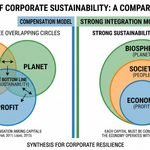
- Comprehensive Purpose (Triple Impact): Sustainable innovation is neither philanthropy nor greenwashing; it is a strategic model that harmoniously balances economic profitability, environmental regeneration, and social equity (a win-win-win approach).
- Sustainability vs. Disruption: While disruptive innovation measures success through gained market share, sustainable innovation is defined by its broader impact on resource life cycles and society—with leading organizations leveraging both forces.
- Three Application Dimensions: It unfolds across eco-designed products and services (51%), clean manufacturing processes and circular economy practices (47%), and circular or servitization-based business models (2%).
- Consolidated Management Frameworks: Key frameworks include the Triple Bottom Line (corporate and ESG reporting), Cradle to Cradle (zero-waste closed-loop design), and the Sustainable Innovation Framework (synergy between Lean Six Sigma and Industry 5.0).
- Overcoming Internal Barriers: The primary hurdles are not solely financial, but rather bureaucratic inertia, leadership gaps, and cultural resistance, all of which are mitigated through knowledge management, coaching, and open innovation.
- Essential Digital Enablers: Digital maturity accelerates sustainability; technologies such as AI, digital twins, big data, additive manufacturing, and blockchain ensure robust traceability, dematerialization, and auditable metrics.
- Orchestration and Public Policy: Large-scale sustainable success hinges on the synergy between dynamic corporate capabilities and a coherent regulatory landscape (green bonds, R&D tax incentives, and harmonized ESG standards).
Sustainable innovation is no longer a fleeting trend, but a strategic imperative for corporate survival. Today, governments, markets, and consumers demand viable solutions that meet present needs without compromising the well-being of future generations; organizations that embed this principle into their operating models not only minimize their environmental footprint, but also enhance profitability, pioneer emerging sectors, and mitigate regulatory risks.
Translating this concept into practice, however, remains a complex endeavor—raising critical questions about how to precisely define sustainable innovation, distinguish it from traditional disruptive innovation, and avoid greenwashing. In this comprehensive guide, we examine key definitions, typologies, management frameworks, emerging technologies, and real-world case studies to deliver a rigorous, actionable, and data-driven roadmap to transform your organization.
What Is Sustainable Innovation? Definition and Scope
Sustainable innovation is defined as the development of products, processes, or business models that deliver measurable environmental and social benefits over conventional solutions while securing economic viability. In this regard, de Almeida Couto and Natário (2023) emphasize that this paradigm embeds all three dimensions of sustainability—environmental, social, and economic—from early-stage R&D through final commercialization.
Unlike traditional innovation, which focuses exclusively on operational efficiency or financial margins, sustainable innovation orchestrates a comprehensive balance among profitability, ecological stewardship, and social equity—a model widely recognized in the literature as a “win-win-win” framework. As Alamandi (2025) highlights, Sustainable Innovation Management (SIM) serves as an essential multidimensional model to align financial performance with corporate responsibility.
The deployment of renewable energy—such as photovoltaic solar systems and wind power generation—illustrates this principle by shrinking carbon footprints, curbing fossil-fuel dependency, and driving job creation. Furthermore, Bieńkowska et al. (2025) reframe sustainable innovation as a decentralized, collaborative process driven by internal talent within the foundational principles of Industry 5.0.
Foundational pillars
The three foundational pillars structuring sustainable innovation comprise:
- Environmental Impact Mitigation: Drastically curbing negative externalities, such as carbon emissions, water pollution, and natural resource overexploitation.
- Economic Viability and Profitability: Ensuring solutions remain commercially competitive and capable of driving long-term financial returns.
- Social Responsibility and Equity: Embedding community well-being, fair labor standards, and inclusive practices across the entire value chain.
When these three dimensions systematically converge, sustainability moves beyond mere marketing expenditure to establish itself as a strategic driver of corporate competitive advantage.
Sustainable Innovation vs. Disruptive Innovation: Differences and Synergies
A recurring question in strategic management is how sustainable innovation interacts with other models, particularly disruptive innovation. While these concepts are not mutually exclusive, they operate under distinct strategic rationales.
Disruptive innovation—a concept introduced by Clayton Christensen—describes solutions that create new markets or transform existing ones by displacing incumbent players, with commercial impact serving as its primary metric. In contrast, sustainable innovation is rooted in holistic impact, generating measurable environmental and social value while safeguarding financial viability. Although both approaches can converge—as seen in electric mobility—technological disruption alone does not inherently guarantee sustainability.
Table 01. Comparison Between Sustainable Innovation and Disruptive Innovation
| Criterion | Sustainable Innovation | Disruptive Innovation |
| Primary Objective | Positive socio-environmental impact alongside financial profitability | Creation or reconfiguration of a market |
| Success Metric | Triple bottom line (ESG criteria) | Market share, scalability, and revenue growth |
| Time Horizon | Long-term focus and life-cycle assessment (LCA) | Variable (short to medium term) |
| Key Driver | Regulatory frameworks, ethical demand, and conscious consumerism | Technological evolution and novel business models |
| Associated Risk | Higher upfront capital investment and gradual ROI | High volatility and adoption uncertainty |
| Representative Example | Biodegradable packaging, advanced biofuels | Streaming platforms replacing physical media formats |
Strategically, sustainability defines the core purpose of innovation, whereas disruption dictates its market-transforming power—leading organizations purposefully integrate both forces.
The Strategic Importance of Sustainable Innovation
Over recent decades, governments and corporations have increasingly prioritized innovations capable of aligning economic, social, and ecological objectives within a “triple-win” framework (Afeltra et al., 2023). In this context, adopting sustainable innovation represents a decisive factor for the global competitiveness and resilience of any business ecosystem (Naveed et al., 2023), particularly amid accelerating climate change, resource scarcity, and social disparity. By placing sustainability at the core of their R&D initiatives, organizations effectively minimize their environmental footprint while securing long-term financial viability.
Furthermore, Adomako and Nguyen (2023) demonstrate that co-innovation practices directly enhance firms’ sustainability performance. Similarly, Taghizadeh et al. (2024) show that successful sustainable innovation within SMEs hinges upon the strategic synergy among organizational learning, process integration, and internal coordination.
Concurrently, in response to rising market demand for responsible solutions, industry-leading enterprises are consolidating a distinct competitive edge. Across pivotal sectors such as energy, agriculture, and manufacturing, these initiatives streamline regulatory compliance, lower operating expenses through resource optimization, and foster enduring loyalty among conscious consumers.
Types of Sustainable Innovation: Strategic Dimensions and Applications
Understanding the typologies of sustainable innovation enables organizations to identify how different productive sectors embed ESG criteria into their core operations across three strategic dimensions:
- Product and Service Innovation: Entails developing new offerings or substantially optimizing existing ones through eco-design principles, exemplified by electric vehicles (EVs) designed to curb greenhouse gas (GHG) emissions.
- Process Innovation: Transforms manufacturing methods via clean technologies, energy efficiency, and circular economy frameworks targeted at byproduct upcycling and zero-waste goals.
- Business Model Innovation: Redefines the corporate value proposition to decouple revenue growth from virgin raw material consumption through shared-economy models and Product-as-a-Service (PaaS) schemes.
Table 02. Types of Sustainable Innovation
| Type | Transformation Scope | Representative Example | Key Environmental Benefit |
| Product / Service | The end good or solution | Electric vehicles, compostable packaging | Direct emission and waste reduction |
| Process | The production and logistics chain | Clean manufacturing, water recirculation | Resource optimization and yield-loss mitigation |
| Business Model | Monetization and utilization logic | Sharing economy, servitization frameworks | Asset life-cycle maximization |
Empirically, Zartha et al. (2024) identified that corporate innovation efforts focus predominantly on sustainable product development (51%) and eco-efficient process optimization (47%), whereas sustainable service innovation accounts for just 2%.
Sustainable Innovation Frameworks: Structural Models and Application
A sustainable innovation framework provides a structured methodology to guide, implement, and evaluate ESG criteria throughout the innovation life cycle—from initial ideation to commercial scaling. Key consolidated approaches include:
- Triple Bottom Line (TBL): The global benchmark model. In this regard, Aldeanueva-Fernández and Contreras (2025) emphasize that its benefits unfold across three dimensions:
- Economic dimension: Stimulates financial growth, skilled job creation, and market competitiveness.
- Social dimension: Elevates workplace standards, safeguards fundamental rights, and enhances workforce engagement.
- Environmental dimension: Optimizes material intensity, curbs energy footprints, and minimizes waste generation.
- Cradle to Cradle (C2C): Prioritizes closed-loop systems design where materials continuously cycle through production flows, emulating biological metabolisms.
- Sustainable Innovation Framework (SIF): Rahardjo et al. (2024) propose a model integrating Lean Six Sigma principles with Industry 5.0 technologies, combining inductive and cross-cutting methodologies.
Table 03. Sustainable Innovation Frameworks
| Framework | Core Focus | Key Strength | Ideal Application |
| Triple Bottom Line (TBL) | Balance among economic, social, and environmental goals | Methodological clarity and corporate disclosure | Corporate strategy and sustainability reporting |
| Cradle to Cradle (C2C) | Zero-waste, closed-loop production cycles | Comprehensive material eco-design | Product development and novel biomaterials |
| SIF (Lean Six Sigma + 5.0) | Human-centric resource efficiency | Quantitative and operational rigor | Advanced manufacturing and process optimization |
Barriers and Drivers of Sustainable Innovation: Key Insights for Change Management
A systematic review of 62 scientific publications (Zartha et al., 2024) revealed that primary internal obstacles extend well beyond purely financial constraints:
- Bureaucracy and structural organizational rigidity.
- Internal friction and interdepartmental conflicts.
- Restricted access to bank financing and commercial credit.
- Prohibitive technology acquisition and R&D costs.
- Executive leadership gaps in cascading knowledge to operational teams.
- Information asymmetry and heightened uncertainty regarding return on investment (ROI).
Against these headwinds, empirical evidence highlights decisive drivers: organizational knowledge management, responsiveness to employee needs, institutional support policies, ongoing executive coaching, and the consolidation of open innovation networks.
Table 04. Barriers and Drivers of Sustainable Innovation
| Barriers (Operational Bottlenecks) | Drivers (Strategic Enablers) |
| Bureaucracy and operational rigidity | Organizational knowledge management and transfer |
| Interdepartmental friction and silo mentality | Active listening and human capital alignment |
| Prohibitive technology access costs | Corporate R&D support policies and protocols |
| Commercial banking and credit constraints | Technical upskilling and executive coaching programs |
| ROI uncertainty and market risk | Internal and external collaborative knowledge networks |
| Deficits in leadership and innovative culture | Strategic intelligence and competitive surveillance |
The executive mandate is clear: prior to launching sustainable initiatives, organizations must audit these internal vulnerabilities and mobilize the appropriate catalysts. In this vein, Paravano et al. (2025) conclude that firms navigate critical hurdles across two core dimensions:
- Take-off phase difficulties: Stemming from technical literacy gaps among end users, sluggish short-term capital payback, and misaligned communication between developers and stakeholders.
- Long-term strategic myopia: Driven by flawed user segmentation, regulatory volatility, and ingrained cultural resistance to technological adoption.
Sustainable Innovation Case Studies: Sector Leaders
Across diverse global industries, sustainability translates into tangible competitive advantages. In apparel, Patagonia stands as a benchmark for its pioneering environmental commitment by leading the integration of recycled fibers and advancing the circular economy through its Worn Wear program, which focuses on repairing, reselling, and extending product life cycles. In mobility, Tesla disrupted the automotive sector by mainstreaming high-performance electric vehicles (EVs) and significantly curbing polluting emissions, expanding beyond transportation to build a holistic decarbonization ecosystem through integrated solar infrastructure and energy storage. Similarly, fast-moving consumer goods (FMCG) multinationals such as Unilever have deployed Zero Waste strategies designed to eliminate manufacturing landfill waste and upcycle industrial byproducts.
Sustainable Transformation in E-Commerce
Within the digital space, Wang and Zhang (2025) demonstrate that sustainable innovation transcends traditional operational paradigms by systematically embedding environmental and social stewardship across the entire value chain. This framework encompasses last-mile logistics decarbonization, certified compostable packaging, ethical AI governance in customer care, and energy-efficient optimization across data centers and digital infrastructure.
Ideas and Trends in Sustainable Innovation: Industrial Transformation Vectors
Looking to catalyze the next major strategic leap in your organization? Below are the cutting-edge concepts gaining significant traction across global markets:
- Circular Economy Initiatives: Comprehensive product and process redesign aimed at zero waste, highlighted by biodegradable packaging and closed-loop recycling frameworks that maximize material lifecycles.
- Carbon Capture and Storage (CCS) Technologies: Systems engineered to intercept industrial CO₂ emissions and securely sequester them within geological repositories, preventing their atmospheric release.
- Smart Grids and Advanced Storage: Deploying smart grids alongside high-density batteries to optimize the integration, grid stability, and distribution of renewable sources such as wind and solar power.
- Climate-Smart Agriculture: Adopting precision and vertical farming techniques to maximize food yields while minimizing water footprints, land intensity, and agrochemical inputs.
- Bio-Based Construction Materials: Integrating recycled aggregate concrete, engineered bamboo structures, and low-embodied-carbon insulation to decarbonize the built environment.
- Advanced Biopolymers: Developing high-performance biopolymers that degrade rapidly and safely, mitigating microplastic accumulation across terrestrial and marine ecosystems.
On the technological front, Ardito (2023) highlights that a firm’s level of digitalization significantly dictates its propensity to deploy sustainable innovations, particularly through the strategic alignment between emerging technologies and corporate business models (Lin and Mao, 2024). Consequently, accelerating this transition demands the integration of critical digital enablers: artificial intelligence, cloud computing, robotics, big data analytics, additive manufacturing (3D printing), and blockchain.
How to Implement Sustainable Innovation in Your Company
Implementing sustainable innovation (SI) is neither a linear process nor merely the passive adoption of technology; rather, it demands an integrative, multidimensional, and continuous learning approach that bridges the organization with its broader ecosystem (Paravano et al., 2025). Grounded in empirical research and management frameworks, effective execution rests on strategic foundational pillars:
Governance, Core Strategy, and Committed Leadership
- Executive Alignment: Sustainability must be embedded directly into the core value proposition, strategic planning, and business vision rather than treated as a peripheral add-on or a mere regulatory compliance exercise (Alamandi, 2025; Bachmann et al., 2025)—a commitment reinforced by tying executive compensation to sustainability key performance indicators (KPIs).
- Assessment and Strategic Prioritization: According to Alamandi (2025), companies should establish a rigorous baseline through energy, waste, and social impact audits to map operational “hotspots,” prioritizing early resource-efficiency quick wins (such as LED retrofits and preventive maintenance) to yield immediate cost savings that fund larger-scale initiatives.
- Circular Business Models: Organizations must evaluate transitioning toward circular models, such as product-service systems (offering leasing models over physical ownership), robust take-back programs, and high-value upcycling schemes.
People-Centric Practices (Bottom-Up Strategy)
- Employee Dynamic Capabilities (EDC) Development: The success of sustainable innovation hinges on frontline personnel rather than solely top-down directives; as Bieńkowska et al. (2025) suggest, organizations must empower employees to sense environmental shifts, adapt agilely, solve complex problems, and actively engage in continuous learning.
- Investment in Human-Oriented Corporate Practices (HOCP): This entails prioritizing workplace safety, physical and mental well-being, diversity, inclusion, and job satisfaction, fostering a high-trust organizational climate that unlocks employee proactivity to champion sustainable practices within their roles.
- Human-Machine Symbiosis: When integrating advanced technologies such as artificial intelligence or automation, the core strategy must focus on augmenting human capabilities rather than replacing them, driving seamless collaborative workflows.
Technological Data Integration and Absorptive Capacity
For digital transformation to catalyze sustainability, digital technologies must be orchestrated across a structured four-stage business model innovation process (Bachmann et al., 2025). As Noer et al. (2025) emphasize, digital tools—particularly social media marketing—serve as open innovation platforms that enable SMEs to co-create sustainable value alongside consumers and business partners, even within resource-constrained environments:
- Initiation (Sensing): Deploying data-collection technologies, such as Internet of Things (IoT) sensors, to accurately track real-time resource utilization and operational emissions.
- Ideation (Seizing): Leveraging Enterprise Resource Planning (ERP) systems and cloud computing to integrate siloed data, manage organizational knowledge, and evaluate sustainable redesign proposals.
- Integration (Seizing): Applying predictive analytics and artificial intelligence for scenario planning and environmental impact modeling, thereby driving eco-efficient product design and optimizing remanufacturing processes.
- Implementation (Transforming): Harnessing digital platforms and blockchain technology to share data transparently and securely across the supply network, bolstering the circular economy and ensuring ethical input traceability (Alamandi, 2025).
- Capability Fit: Acquiring technological platforms is insufficient on its own; a deliberate strategic fit between digital tools and the firm’s absorptive capacity is essential to ensure employees effectively recognize, assimilate, and commercially exploit newly acquired knowledge (Wu et al., 2025).
Finally, Florek-Paszkowska and Ujwary-Gil (2025) determined that digital transformation drives and catalyzes sustainable innovation through five fundamental pathways: efficiency gains, dematerialization, circular economy enablement, innovation acceleration, and digital collaboration.
Relational Approach and Openness to the “Project Ecology”
- Collaborative Openness: Sustainable innovation thrives when organizations transcend conventional boundaries and actively engage surrounding ecosystems—including local beneficiaries, communities, environmental advocacy groups, and customers—to co-design impactful solutions (Paravano et al., 2024).
- Triple Helix Linkages: Fostering robust knowledge transfer through close collaboration with academia, technological incubators, public agencies, and research consortia helps secure strategic funding and bridge technical or capital deficiencies that constrain individual enterprises (Liu et al., 2026).
Implementation Methodology: “Starting Small” and Tangibilizing Benefits
- Deploying Small-Scale Pilot Projects: Designing low-cost, low-risk pilot initiatives mitigates resistance to technological adoption, delivers demonstrable short-term wins for stakeholders, and enables rapid pivoting based on end-user needs prior to deploying capital-intensive investments.
- Making Sustainability Tangible: Utilizing intuitive visual dashboards, interactive simulators, and clear socio-environmental metrics (such as CO₂ mitigation, recycling efficiency, and ROI) clarifies tangible outcomes for stakeholders, thereby counteracting early-stage uncertainty.
The Synergistic Role of Public Policy and a Systems Perspective
Corporate transformation fundamentally depends on an enabling institutional environment. Döme et al. (2025) emphasize that success relies on a coherent public policy mix spanning the entire technology lifecycle—from laboratory R&D and commercial scaling to the phased phase-out of polluting alternatives. Concurrently, Liu et al. (2026) highlight the critical need to strategically sequence these policies by prioritizing open digital infrastructure investments before rolling out relational trust-building initiatives; ultimately, Lehtimäki et al. (2025) conclude that sustainable innovation must be orchestrated as a unified, multidimensional model anchored across organizational transformations, measurable outcomes, and a comprehensive systems view.
Why Sustainable Innovation Is More Critical Than Ever
According to Cillo et al. (2019), aligning with the sustainable development paradigm increasingly requires enterprises to generate solutions capable of harmonizing economic, environmental, and social goals—namely, comprehensive sustainable innovations. This urgency stems from unprecedented global challenges, as governments and corporations recognize that sustainability is no longer an optional add-on, but an indispensable prerequisite for long-term survival and resilience amidst climate change, resource depletion, and demographic pressures. Through sustainable innovation, organizations reduce their environmental footprint, ensure regulatory compliance, and capture conscious consumer loyalty; moreover, Ghobakhloo et al. (2021) and Wang et al. (2023) highlight that Industry 4.0 and digital platform capabilities significantly enhance firms’ capacity to design eco-efficient processes and achieve superior sustainability performance.
Empirically, Adomako and Tran (2024) examined the impact of R&D support on sustainable innovation across 220 Vietnamese firms, revealing key insights:
- R&D support positively stimulates clean technology transfer.
- Clean technology transfer mediates the relationship between R&D investment and sustainable innovation performance.
- The impact of technology transfer on sustainability is maximized when corporate culture is firmly anchored in environmental ethics.
Furthermore, Afeltra et al. (2023) synthesized the scientific literature into five essential thematic axes:
- The orchestrating role of regulation, market dynamics, and technology.
- Determinants of eco-innovation, intra-firm drivers, and the link between environmental performance and corporate profitability.
- Eco-innovation alongside internal and external environmental factors.
- Strategic determinants distinguishing green innovation from traditional models.
- Synergies and interactions between public policy, regulatory frameworks, and clean innovation.
In addition, Paravano et al. (2025) emphasize that effective value capture in sustainable projects depends on dynamic interactions between project actors and their surrounding environment (the project ecology). Ultimately, embedding sustainable practices ensures that innovation not only maximizes financial returns, but also fosters shared value for society and the planet—proving that enduring success lies not merely in what we build, but in how we produce it and whom its impact benefits.
Why Sustainable Innovation Is More Important Than Ever
Through sustainable innovation, organizations can reduce their environmental footprint, comply with regulatory requirements, and attract a growing base of eco-conscious consumers. Likewise, Ghobakhloo et al., (2021) highlight that Industry 4.0 has some functions that improve green process innovation capabilities and the ability to economically and competitively develop or reintroduce green products. Similarly, Wang et al., (2023) concluded that companies with digital platform capabilities perform better in sustainability-oriented innovation.
Adomako y Tran (2024) investigated the impact of R&D support on SI in 220 companies in Vietnam and found the following:
- R&D support positively impacts green technology transfer,
- Green technology transfer mediates the relationship between R&D support and SI, and
- The influence of green technology transfer on sustainable innovation is enhanced by a company’s commitment to environmental ethics.
Conclusion
Sustainable innovation transcends mere trend status to establish itself as a transformative paradigm capable of driving economic value without compromising natural capital. Whether through product evolution, process optimization, or business model reconfiguration under frameworks such as the Triple Bottom Line or Cradle to Cradle, the core strategic mandate remains unchanged: harmonizing financial profitability with ecological stewardship and social equity.
In this regard, Alamandi (2025) concludes that organizations must position sustainability at the very heart of corporate governance, while calling on policymakers to standardize ESG reporting criteria, scale impact-financing instruments (such as green bonds and sustainability-linked loans), and strengthen cross-sector alliances that democratize access to clean infrastructure.
Ultimately, market leadership does not stem from a marketing slogan, but from an organization’s capacity to overcome internal barriers, foster open innovation, leverage digital enablers, and empower human talent—ensuring long-term viability by embedding sustainability directly into the DNA of every business decision.
Frequently Asked Questions About Sustainable Innovation (FAQ)
What is sustainable innovation, and what is its primary objective?
Sustainable innovation refers to the development and implementation of novel products, processes, or business models that deliver quantifiable environmental and social benefits while securing corporate economic profitability. Its overarching objective is to attain a triple-impact balance (a win-win-win framework) across financial growth, ecosystem preservation, and social equity.
How does sustainable innovation differ from disruptive innovation?
The core distinction lies in their primary objective and success metrics:
– Disruptive Innovation: Aims to create or transform markets by displacing incumbent solutions, with success measured primarily through market share and commercial scalability.
– Sustainable Innovation: Evaluates environmental and social life-cycle impacts alongside financial viability, allowing both paradigms to converge effectively in fields like electric mobility and clean energy.
What are the main types of sustainable innovation?
They are classified into three strategic dimensions:
– Product or Service Innovation: Eco-designing solutions with reduced environmental impact throughout their lifecycle (e.g., biodegradable packaging, electric vehicles).
– Process Innovation: Clean manufacturing, closed-loop water recirculation, and energy efficiency targeted at achieving zero waste.
– Business Model Innovation: Servitization schemes (Product-as-a-Service) and sharing-economy models that decouple revenue generation from virgin raw material consumption.
Which frameworks are used to manage sustainable innovation?
The most widely adopted frameworks across the industry include:
– Triple Bottom Line (TBL): A model designed to balance and report performance across economic, social, and environmental dimensions.
– Cradle to Cradle (C2C): A closed-loop design framework in which waste is continuously reintegrated into the production cycle.
– Sustainable Innovation Framework (SIF): An operational methodology that integrates Lean Six Sigma tools with Industry 5.0 technologies.
What are the major internal barriers to sustainable innovation?
Scientific literature demonstrates that obstacles extend far beyond financial constraints, encompassing bureaucratic rigidity, leadership deficits in cascading knowledge, cultural resistance to change, and ROI uncertainty. These challenges are effectively mitigated by fostering an internal learning culture, ongoing professional development, and open innovation partnerships.
How do digital technologies accelerate corporate sustainability?
Digitalization acts as a direct catalyst through five key pathways: efficiency optimization, process dematerialization, circular supply chain enablement, R&D acceleration, and ESG metric traceability leveraging tools such as artificial intelligence, big data, PLM systems, and 3D printing.
References
Adomako, S., & Nguyen, N. P. (2023). Co-innovation behavior and sustainable innovation in competitive environments. Sustainable Development, 31(3), 1735-1747. https://doi.org/10.1002/sd.2479
Adomako, S., & Tran, M. D. (2024). Exploring the effect of R&D support, green technology transfer, sustainable innovation. Sustainable Development, 32(5), 4758-4769. https://doi.org/10.1002/sd.2936
Afeltra, G., Alerasoul, S.A. and Strozzi, F. (2023), “The evolution of sustainable innovation: from the past to the future“, European Journal of Innovation Management, Vol. 26 No. 2, pp. 386-421. https://doi.org/10.1108/EJIM-02-2021-0113
Alamandi, M. (2025). Sustainable Innovation Management: Balancing Economic Growth and Environmental Responsibility. Sustainability, 17(10), 4362. https://doi.org/10.3390/su17104362
Aldeanueva-Fernández, I., Contreras, F. Drivers and Outcomes of Sustainable Innovation in the Business and Management Field: A Systematic Literature Review. Schmalenbach J Bus Res 77, 1141–1168 (2025). https://doi.org/10.1007/s41471-025-00228-3
Ardito, L. (2023). The influence of firm digitalization on sustainable innovation performance and the moderating role of corporate sustainability practices: An empirical investigation. Business Strategy and the Environment, 32(8), 5252-5272. https://doi.org/10.1002/bse.3415
Bachmann, N., R. Harms, K. Gundolf, and T. Oukes. 2026. “ Driving Sustainable Innovation: A Review of Data-Driven Technologies in Sustainable Business Model Innovation.” Business Strategy and the Environment 35, no. 1: 819–847. https://doi.org/10.1002/bse.70182. https://onlinelibrary.wiley.com/doi/full/10.1002/bse.70182
Bieńkowska, A. ., Tworek, K. ., Voropai, O. ., & Zimmer, J. (2025). Human-centric approach to creating sustainable innovation in the context of Industry 5.0. Entrepreneurial Business and Economics Review, 13(3), 115-134. https://doi.org/10.15678/EBER.2025.130306
Cillo, V., Petruzzelli, A. M., Ardito, L., & Giudice, M. D. (2019). Understanding sustainable innovation: A systematic literature review. Corporate Social Responsibility and Environmental Management, 26(5), 1012-1025. https://doi.org/10.1002/csr.1783
de Almeida Couto, J.P., Natário, M.M.S. (2023). Sustainable Innovation. In: Idowu, S.O., Schmidpeter, R., Capaldi, N., Zu, L., Del Baldo, M., Abreu, R. (eds) Encyclopedia of Sustainable Management. Springer, Cham. https://doi.org/10.1007/978-3-031-25984-5_803
Döme, V., Cycak, W., & Matus, K. J. (2025). Variations in innovation strategies for sustainable development: Sustainable innovation policy instrument mixes of ten small OECD countries across five sectors. Research Policy, 54(6), 105234. https://doi.org/10.1016/j.respol.2025.105234
Florek-Paszkowska, A., & Ujwary-Gil, A. (2025). The Digital-Sustainability Ecosystem: A conceptual framework for digital transformation and sustainable innovation. Journal of Entrepreneurship, Management and Innovation, 21(2), 116-137.
Ghobakhloo, M., Iranmanesh, M., Grybauskas, A., Vilkas, M., & Petraitė, M. (2021). Industry 4.0, innovation, and sustainable development: A systematic review and a roadmap to sustainable innovation. Business Strategy and the Environment, 30(8), 4237-4257. https://doi.org/10.1002/bse.2867
Lehtimäki, H., Leppälä, K., Mielonen, N., Piispanen, V. V., Henttonen, K., Sengupta, S., Parkkinen, I., & Liakh, O. Sustainable Innovation Framework: A Review of Organization, Strategic Management, and Entrepreneurship Literature. Sustainable Development, 34, 34-64. https://doi.org/10.1002/sd.70092
Lin, J., & Mao, M. (2024). How does digital transformation affect sustainable innovation performance? The pivotal roles of digital technology-business alignment and environmental uncertainty. Sustainable Development, 32(4), 3163-3181. https://doi.org/10.1002/sd.2830
Liu, L., Zhou, L., Sharma, P., Alzeiby, E. A., & Dash, S. (2026). Triple helix trust and spillovers for sustainable innovation: The role of governance, openness, and digital infrastructure. Technological Forecasting and Social Change, 225, 124548. https://doi.org/10.1016/j.techfore.2026.124548
Naveed, A., Zhuparova, A., Ahmad, N., & FathollahZadeh Aghdam, R. (2023). Sources of information on sustainable innovation: a citation-based systematic literature review and content analysis. Total Quality Management & Business Excellence, 34(9–10), 1126–1151. https://doi.org/10.1080/14783363.2022.2157713
Noer, M. Y., Chan, A., Tresna, P. W., & Purbasari, R. (2025). Digital marketing and sustainable innovation in SMEs through bibliometric and systematic review. Cogent Business & Management, 12(1). https://doi.org/10.1080/23311975.2025.2548953
Paravano A, Locatelli G, Trucco P (2025;), “Projects benefit realisation through sustainable innovation: drivers and challenges“. Management Decision, Vol. ahead-of-print No. ahead-of-print. https://doi.org/10.1108/MD-08-2024-1751
Rahardjo, B., Wang, FK., Lo, SC. et al. A Sustainable Innovation Framework Based on Lean Six Sigma and Industry 5.0. Arab J Sci Eng 49, 7625–7642 (2024). https://doi.org/10.1007/s13369-023-08565-3
Taghizadeh, S.K., Rahman, S.A., Nikbin, D., Radomska, M. and Maleki Far, S. (2024), “Dynamic capabilities of the SMEs for sustainable innovation performance: role of environmental turbulence“, Journal of Organizational Effectiveness: People and Performance, Vol. 11 No. 4, pp. 767-787. https://doi.org/10.1108/JOEPP-04-2023-0166
Wang, N., Wan, J., Ma, Z., Zhou, Y., & Chen, J. (2023). How digital platform capabilities improve sustainable innovation performance of firms: The mediating role of open innovation. Journal of Business Research, 167, 114080. https://doi.org/10.1016/j.jbusres.2023.114080
Wang, S., & Zhang, H. (2025). Artificial intelligence digital employees and sustainable innovation in online retail: The mediating role of ambidextrous green innovation and the moderating role of ethical anxiety. Journal of Retailing and Consumer Services, 84, 104235. https://doi.org/10.1016/j.jretconser.2025.104235
Wu, H., Li, S., Zhang, X., & Hou, W. (2025). Achieving Sustainable Innovation: A Fit Model of Digital Platforms and Absorptive Capacity. Sustainability, 17(19), 8611. https://doi.org/10.3390/su17198611
Zartha, J., Orozco, G., Barreto, D., & García, D. (2024). Sustainable Innovation in Organizations: A Look from Processes, Products, and Services. Sustainability, 16(6), 2503. https://doi.org/10.3390/su16062503

Editor and founder of “Innovar o Morir” (‘Innovate or Die’). Milthon holds a Master’s degree in Science and Innovation Management from the Polytechnic University of Valencia, with postgraduate diplomas in Business Innovation (UPV) and Market-Oriented Innovation Management (UPCH-Universitat Leipzig). He has practical experience in innovation management, having led the Fisheries Innovation Unit of the National Program for Innovation in Fisheries and Aquaculture (PNIPA) and worked as a consultant on open innovation diagnostics and technology watch. He firmly believes in the power of innovation and creativity as drivers of change and development.