Key Points of the Article
- Evolutionary Nature: The Kanban Method does not impose disruptive reengineering; instead, it acts as an evolutionary catalyst by rendering visible and respecting the organization’s current processes, roles, and responsibilities.
- Flow Governance: The core of its operational success resides in three fundamental pillars: the visual materialization of the workflow, the strict establishment of Work-in-Progress (WIP) limits, and the constant monitoring of performance to neutralize bottlenecks.
- Systemic Design (STATIK): To ensure long-term sustainability and prevent the implementation from becoming merely decorative, it is indispensable to ground the board design in a profound diagnosis utilizing the STATIK approach.
- Cultural Dependency: The effectiveness and seamless adoption of the methodology are significantly enhanced within organizations that promote horizontal structures, flat hierarchies, and high levels of mutual trust.
- Path Toward Predictability: For teams experiencing a high rate of task initiation combined with a low completion rate, Kanban constitutes the ideal strategy to transition toward a predictable, healthy, and sustainable flow of value.
The Kanban methodology has transcended its origins in Japanese production lines to establish itself as one of the most efficient management frameworks across sectors such as software development, marketing, logistics, and services. Its value proposition is as direct as it is transformative: rendering the workflow visible, limiting Work-in-Progress (WIP), and optimizing team performance by eliminating bottlenecks at their root.
Although conceived in the manufacturing sector, the adoption of the Kanban method has accelerated globally due to its versatility in optimizing project management across disciplines as diverse as sports science, education, data science (Hamzah et al., 2021), and healthcare services (Lanza et al., 2021).
However, given the saturation of theoretical concepts, generic tutorials, and constant comparisons with Scrum, assimilating the true operational scope of Kanban—and, crucially, its deployment in a real corporate environment—can often prove complex. This article comprehensively articulates the theoretical foundation (origins, principles, and key metrics) alongside practical execution, detailing how to design a board using the STATIK approach, backed by sector-specific examples, strategic advantages, and the limitations of the model.
If you require a guide that moves beyond the basic approach of “moving cards between columns” and seeks to evaluate whether Kanban is the ideal solution for your organization—as well as the roadmap to implement it successfully—we invite you to read on.
What is the Kanban Methodology? Definition and Meaning
Kanban is a visual method designed to manage and control the workflow throughout an operational process. Instead of operating in isolation or through saturated task lists, this system represents each assignment using dynamic cards that move across columns, which faithfully reflect the stages of the flow: to do, in progress, under review, and completed. This structure allows organizations to verify, at a single glance, the current status of projects, identify operational blocks, and monitor completed deliveries.
The term “kanban” originates from Japanese and translates to “card,” “signal,” “symbol,” or visual “signboard” (Castellano, 2019). This etymological origin defines the core of the method: a signaling system that indicates precisely when the team has the available capacity to initiate a new task. Under this approach, work is not arbitrarily “pushed” onto collaborators; instead, it is “pulled” only when the resources and space exist to execute it with quality.
In its most elemental dimension, Kanban establishes itself as a visual infrastructure that empowers organizations to plan, prioritize, and audit the progress of their operations. In this regard, Anderson (2010) notes that the primary objective of Kanban is to catalyze the introduction of Lean principles into technological development and IT operations, optimizing processes with minimal resistance to change and ensuring a sustainable work pace. For their part, Htun et al. (2019) define Kanban as a strategic information system designed to regulate and audit production volumes at each phase of the process.
Consequently, the fundamental goal of Kanban lies in ensuring a balanced and sustainable production rate to mitigate the overstock of finished products, eliminate bottlenecks, and reduce delivery times (Castellano, 2019), all grounded in the Lean philosophy.
For its correct implementation, it is convenient to differentiate between two concepts that are often conflated:
- The kanban system (lowercase): Refers to the primary operational mechanism; that is, the physical or digital use of cards and capacity limits to regulate the flow of materials or tasks, just as it originated in the industrial sector.
- The Kanban Method (uppercase): Represents the management and evolutionary improvement framework adapted to knowledge work and modern corporate environments, formally codified by David J. Anderson along with its principles, methodological practices, and advanced metrics.
This guide addresses both approaches in an integrated manner, given that the true value for contemporary companies resides in efficiently connecting the operational discipline of the factory floor with the strategic agility of the corporate office.
The Pull System
The operational core of the Kanban methodology lies in its functionality as a pull system (Anderson, 2010). In this regard, Castellano (2019) highlights that, unlike traditional push management models—where tasks are forcefully assigned regardless of the collaborators’ workload—in Kanban, new activities are only integrated into the workflow when two critical factors converge: actual customer demand and the team’s available capacity to process them with the necessary quality guarantees.
What is Kanban Used For?
In essence, the Kanban methodology serves three fundamental functions: rendering the workflow visible, regulating operational overload, and promoting continuous improvement. By visually structuring processes, anomalies that previously remained hidden emerge—such as stalled tasks, inefficient rework, and complex dependencies. Furthermore, by establishing strict limits on work in progress, teams mitigate the dispersion of efforts and elevate the completion rate. Finally, the objective measurement of operational performance empowers organizations to make strategic decisions based on empirical data rather than mere intuition.
Specifically, the implementation of Kanban is oriented toward achieving the following strategic objectives:
- Optimize workflow and production: Kanban operates under a “pull” system, which dictates that assignments or inputs advance to the next stage only when there is actual demand and available operational capacity (Anderson, 2010). This mechanism guarantees a sustainable pace of throughput and defines exactly what to produce, when, and in what volume.
- Mitigate inventory and prevent overproduction: In manufacturing, logistics, or healthcare service environments, this method functions as a rigorous inventory control system. According to Castellanos (2019), its application ensures that excess stock is neither generated nor stored, which drastically reduces operational storage costs and prevents resource obsolescence or waste.
- Make operations transparent and identify anomalies: Through analytical boards and cards, Kanban visualizes the project life cycle with total transparency (Ahmad et al., 2026). This clarity allows the entire team—and not just management—to evaluate progress status, locate bottlenecks immediately, and pinpoint exactly where operational disruptions occur.
- Restrict Work in Progress (WIP): Its purpose is to strictly delimit the volume of active tasks running simultaneously. By limiting WIP, human capital burnout is prevented, stress levels decrease, the inefficiencies of constant context switching (multitasking) are neutralized, and the lead time of each delivery is accelerated.
- Enhance collaboration and internal communication: By unifying the visibility of workflows, Kanban transforms communication dynamics. Synchronization meetings (such as daily stand-ups) stop being mere status reports and become collaborative problem-solving sessions focused directly on removing the obstacles evidenced on the board.
- Eliminate operational waste: It enables the systematic detection and elimination of redundant activities or idle times that do not add value to the end user or client, aligning firmly with the Lean management philosophy.
Unlike other disruptive frameworks, Kanban does not impose an immediate restructuring of the organization or abruptly alter pre-existing roles. Its guiding principle consists of starting from the current operating model to drive a progressive and organic evolution, a quality that justifies its robust adoption globally.
Origin and Evolution: From Toyota to Software Development
Understanding the historical trajectory of Kanban enables its application with sound strategic judgment and clarifies one of the most frequent questions in the business world: Who invented this management model?
The Origin at Toyota (1940s–1950s)
Engineer Taiichi Ohno developed the Kanban system within the Toyota Production System in the mid-20th century. Ohno’s purpose was to eradicate various types of operational waste on the factory floor and synchronize production with actual market demand, replacing overestimated stock forecasts. Kanban was formally conceived and applied by Toyota in the 1950s as a scheduling and control mechanism for Just-in-Time manufacturing, integrating synergistically with other optimization methodologies such as the 5S framework.
Interestingly, the inspiration behind this model came from the operation of American supermarkets, where shelves are replenished only as customers remove products. Ohno transferred this principle to the assembly line: each workstation requested components from the preceding stage via physical cards, ensuring parts were manufactured only upon receiving an explicit signal of need. This approach solidified Just-in-Time production, successfully mitigating excessive inventory and preventing overproduction.
The Leap to Knowledge Work (2004–2010)
For decades, the application of Kanban remained exclusively linked to heavy manufacturing. The definitive bridge to corporate environments and software development was built by David J. Anderson. In 2004, while advising a software maintenance team within Microsoft’s IT department, Anderson designed a pull system sustained by work-in-progress limits, demonstrating that the model successfully operated as a virtual Kanban (Weflen et al., 2022).
Between 2006 and 2007, he refined this approach at Corbis—the stock photography agency where he served as senior director of engineering—incorporating components that are now indispensable, such as swimlanes, classes of service, and structured meeting cadences. Finally, in 2010, he published the seminal work Kanban: Successful Evolutionary Change for Your Technology Business, formally codifying the Kanban Method for knowledge work and establishing the global principles and practices that govern organizational agility today.
Types of Kanban: P-Kanban, T-Kanban, and e-Kanban The Kanban methodology has evolved significantly, adapting over time to the dynamics of various industries and operational demands. According to scientific literature, Kanban systems are strategically classified based on their specific function within the workflow, the geographic or physical location of materials, the management of production orders, and their level of technological maturity.
According to their function in the production process (Toyota Production System)
The following are the specific types of Kanban implemented in the production process, based on research by Pereira and de Sousa (2021) and Fernández et al. (2024):
- Supply Kanban: Represents a card variant or digital notification designed to communicate critical replenishment requirements directly and automatically to the organization’s external suppliers.
- Production Kanban (P-Kanban): Functions as an operational signal issued between the finished goods warehouse and the manufacturing line, with the purpose of immediately authorizing and initiating the manufacturing of a new batch or item within the system.
- Movement or Transport Kanban (T-Kanban): Constitutes the mechanism used by operators to request, withdraw, or transfer the exact components required from the storage area to the next phase of the value chain.
- Signaling and Management Kanban: Consists of a visual infrastructure or static board strategically located within the operations area. This houses cards with a dual purpose: transmitting clear instructions to factory floor workers and consolidating control metric data for managerial decision-making.
According to the provenance of materials
Regarding the origin and location of inputs, Pereira and de Sousa (2021) classify Kanban systems into the following categories:
- Internal Kanban: Implemented when the supply units or departments responsible for providing materials operate within the same physical facilities of the organization (for example, a painting section that directly supplies the assembly line).
- External Kanban: Activated when essential components, raw materials, or spare parts are provided by strategic suppliers or manufacturers located outside the company’s perimeter.
According to project management and work order administration standards
Fuentes-del-Burgo et al. (2024) classified Kanban types within the construction sector into the following operational categories:
- Ordering Kanban: Constitutes a formal directive issued from the central office to the field operations manager. This technical document integrates critical specifications such as the nature of the work, the assigned professional, volumes, delivery deadlines, allocated resources, and required safety protocols.
- Receipt Kanban: Linked directly to the ordering Kanban, this report is returned to the office by the field supervisor to audit project compliance. It details the actual completion dates or the technical justifications for any delays that occurred.
- Auxiliary Kanban: Represents an exceptional mechanism used to authorize and coordinate additional work fronts that were not included in the initial planning, as well as to mitigate the impact of unforeseen contingencies.
According to technological evolution
Fuentes-del-Burgo et al. (2024) state that, due to continuous technological advancements, traditional physical cardboard or paper cards have been progressively replaced by E-Kanban systems. In this regard, Papadimitropoulou et al. (2023) highlight that, with the integration of emerging technologies, Kanban ecosystems have segmented into distinct evolutionary generations:
- Kanban 1.0 (Analog or Traditional): Represents the classic model sustained by the manual manipulation of physical paper cards, plastic cards, or containers to signal material demand on the factory floor.
- Kanban 2.0 (Electronic or e-Kanban): Replaces physical media with an automated flow of electronic data interchange through specialized software and web connectivity networks. Its primary value lies in mitigating human error, preventing card loss, and enabling real-time traceability.
- Kanban 3.0 (Digital): Incorporates the complementary use of barcode scanners, QR codes, and wireless signaling devices via Bluetooth Low Energy (BLE) buttons across different operational phases. This approach automates inventory auditing and streamlines replenishment requests.
- Kanban 4.0 (Intelligent System or Smart Kanban): Constitutes a highly automated infrastructure aligned with Industry 4.0 paradigms, aimed at minimizing direct human intervention. It synergistically employs active RFID tags, Internet of Things (IoT) architectures, and Artificial Intelligence (AI) algorithms to optimize and self-regulate supply processes.
Principles and Practices of the Kanban Methodology
The Kanban method is founded upon a robust ecosystem of purpose-oriented principles (the “why”) and execution-applied practices (the “how”). These guidelines do not constitute rigid or immutable rules; rather, they serve as strategic frameworks designed to drive sustainable, evolutionary improvement within the organization.
The 4 Change Management Principles
Instead of immediately imposing radical and disruptive transformations, Kanban promotes an organic transition based on the following fundamental principles (Kanban University, 2023; Kurvinen, 2024):
- Start with what you do now: Kanban does not prescribe a predefined process; instead, it overlays existing workflows. The priority lies in making current operations visible to identify genuine optimization opportunities based on that diagnosis.
- Agree to pursue incremental, evolutionary change: Rather than relying on traumatic corporate restructurings, the method advocates for implementing continuous micro-adjustments. This approach minimizes operational impact and mitigates human capital’s natural resistance to change.
- Respect current processes, roles, and responsibilities: Initiating adoption does not require workforce reorganization, layoffs, or modifications to job titles. This respect for the existing structure neutralizes the fear of uncertainty and fosters psychological safety.
- Encourage acts of leadership at all levels: The capacity to detect an inefficiency and propose a solution is not exclusive to senior management; it belongs to any collaborator on the operational line. This democratization consolidates an authentic culture of continuous improvement (Kaizen).
To these pillars, service-delivery principles are added, which require understanding and firmly focusing on customer needs, strategically managing the workflow (rather than micromanaging people), and regularly auditing the service network to guarantee its constant evolution.
The 6 Fundamental Practices
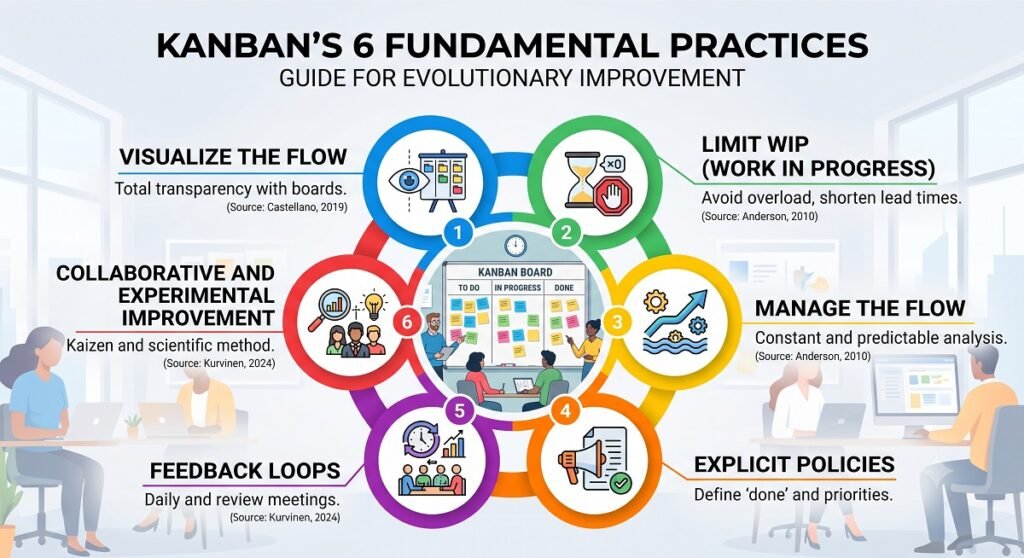
The implementation of Kanban relies on six fundamental practices, which are described below:
- Visualize the workflow: Work is represented by dynamic cards within a physical or virtual Kanban board, which is segmented into columns reflecting the distinct phases of the operational process—commonly: “To Do,” “In Progress,” and “Done” (Villanueva et al., 2025). This infrastructure grants absolute transparency, empowering the entire team to monitor project progress and detect bottlenecks immediately (Castellano, 2019; Hamzah et al., 2021).
- Limit work in progress (WIP): This consists of establishing a strict cap on the number of simultaneous tasks permitted per column. It represents the most counterintuitive and transformative practice of the method: by restricting multitasking, the project completion rate is elevated. This capacity limit prevents human capital burnout and significantly shortens delivery lead times (Anderson, 2010).
- Manage flow: This implies continuously monitoring assignments to ensure they advance in a fluid and predictable manner, intervening strategically in the face of any stagnation. According to Anderson (2010), task mobility is constantly analyzed to ensure a steady, rapid, and predictable operational pace, mitigating wait times and eradicating waste.
- Make operational policies explicit: This involves defining with total clarity and consensus the criteria that determine when a task is formally “completed” (Definition of Done), what priority level each type of requirement possesses, and under what specific conditions the pull of a new card is authorized.
- Implement feedback loops: This requires establishing meetings with structured cadences (daily, replenishment, or review sessions) to inspect and adapt processes. This approach fosters periodic evaluation through objective metrics and regular meetings, oriented toward identifying deviations, adjusting flow, and optimizing quality collaboratively and experimentally (Kurvinen, 2024).
- Improve collaboratively and evolve experimentally: This practice uses empirical data analysis and the scientific method to introduce continuous micro-adjustments into the system, rigorously measuring their actual impact to ensure a sustainable evolution of the business model.
Kanban Success Metrics
Once the board has reached operational maturity, the Kanban methodology empowers the evaluation of flow performance through purely objective metrics. The key performance indicators (KPIs) used to audit the success, efficiency, and productivity of a Kanban ecosystem focus on the quantitative analysis of task mobility across the distinct phases of the process. According to specialized literature, the fundamental metrics comprise:
Work in Progress (WIP)
This metric quantifies the volume of tasks or work items that remain simultaneously active within the system—or in a specific phase of it—at any given time (Kanban University, 2023). Continuous monitoring and tracking of WIP over time are indispensable to guarantee the stability of the operational flow and to ensure that the volume of assignments does not exceed the team’s available capacity (Anderson, 2010).
Lead Time
Lead Time represents the total period required for a task to traverse the entire system, measured from the precise moment a formal commitment is made to its final delivery to the customer. This parameter constitutes a key performance indicator for evaluating organizational agility and operational predictability (Anderson, 2010). In this regard, Weflen et al. (2022) propose an alternative methodological approach for estimating lead time within teams operating under the Agile Kanban framework; this model successfully integrates actual flow dynamics, such as the addition, removal, and reprioritization of assignments in the backlog, alongside the team’s net productivity levels. The equation for its calculation is defined as follows:
Cycle Time
Cycle Time represents the average period invested in the effective execution of a task. From a quantitative perspective, this parameter is calculated by dividing the volume of work in progress (WIP) by the system’s net throughput (Kurvinen, 2024). The equation for its operational estimation is defined as follows:
Throughput / Task Completion Rate (TCR)
According to Anderson (2010), throughput represents the number of tasks or value items formally completed within a specific timeframe (such as assignments per day or features deployed per week). Unlike other methodological frameworks, this parameter is not used punitively in Kanban to enforce rigid time commitments; instead, it functions as a strategic indicator of overall system performance, serving as empirical evidence of continuous improvement.
Flow Efficiency
Anderson (2010) and Kurvinen (2024) highlight that Flow Efficiency constitutes the mathematical proportion between the time a task receives active, effective attention (touch time) and its total Lead Time. This metric is vital for process governance, as it enables the precise identification of waste time—intervals during which an assignment remains in a queue or wait state—and reveals the actual margin for operational optimization available without requiring changes to the team’s technical methods or tools. The equation for its calculation is defined as follows:
Task Addition Rate (TAR)
According to Weflen et al. (2022), the Task Addition Rate is employed in tandem with the completion rate to monitor the speed at which new requirements are incorporated into the backlog. This indicator allows for an accurate evaluation of the equilibrium between external demand and the team’s actual operational capacity.
Blocked Work Items
The Blocked Work Items metric rigorously quantifies the number of tasks that are halted within the workflow. Systematically logging blocked assignments and measuring the average time required to resolve these impediments constitutes a critical process for evaluating organizational resilience and the capacity to resolve obstacles in an agile and timely manner (Anderson, 2010).
Failure Load
This metric quantifies the percentage of operational workload generated due to previous failures, such as production defects, design errors, or usability deficiencies. The success of a Kanban system is evidenced when this indicator progressively decreases over time, freeing up available capacity to refocus efforts on functionalities that deliver real, strategic value.
Initial Quality
According to Anderson (2010), this metric constitutes the systematic logging of operational defects or failures reported throughout the workflow. Given that the presence of anomalies represents a significant opportunity cost, this indicator aims to certify that the error rate progressively decreases until it converges to zero over time.
These metrics transform Kanban into a management tool rather than just a visually appealing board. Without them, determining true operational improvement remains elusive.
Here is the professional, advanced translation and stylistic refinement of your text into English:
Advantages and Disadvantages of Kanban
No management methodology is infallible. This section systematically identifies and analyzes the competitive advantages and operational limitations described in scientific and professional literature regarding the Kanban Method.
Advantages of Kanban
A comprehensive review of the scientific literature identifies the strategic advantages derived from implementing Kanban. A fundamental attribute of this method lies in its high operational efficiency and accessible adoption cost, factors that ensure that the corporate objectives set by senior management are effectively achieved by work teams (Pereira & de Sousa, 2021).
Furthermore, the Kanban model establishes itself as a pull system sustained by the premise that work is integrated into the flow only when the team possesses the actual operational capacity to process it, replacing the traditional, forceful assignment of tasks from higher hierarchical levels (Siderova, 2018). In this regard, Schreier et al. (2025) note that the Kanban approach successfully mitigates the limitations of standard frameworks, such as Scrum, when managing and structuring complex Machine Learning (ML) projects in information technology environments within the manufacturing sector.
Specifically, the primary competitive advantages of Kanban are broken down below:
- Continuous flexibility and adaptability: Kanban constitutes a highly responsive methodology when facing market requirement volatility, empowering teams to readjust their strategic priorities at any time (Villanueva et al., 2025; Dávila-Sandoval, 2025). By dispensing with rigid time cycles or the time constraints characteristic of sprints, this framework drives continuous, agile, and fluid value delivery (Ozkan et al., 2022; Hamzah et al., 2025).
- Absolute process visibility and transparency: According to Villanueva et al. (2025), deploying Kanban boards makes abstract work visible and tangible, clearly showing the exact phase of each assignment for all stakeholders involved. This transparency is key to diagnosing bottlenecks early (Castellano, 2019; Ahmad et al., 2026), simplifying project auditing by the executive line, and drastically optimizing internal communication (Hamzah et al., 2021; Schreier et al., 2025).
- Increased efficiency and reduced delivery times (Lead Time): As described by Ahmad et al. (2026), by grounding itself in pull logic and strictly delimiting Work in Progress (WIP), Kanban neutralizes task saturation and decreases the productivity losses associated with constant context switching (multitasking). This control accelerates completion speed, mitigates idle times, and maximizes overall system throughput.
- Systematic quality optimization: Anderson (2010) highlights that Kanban actively promotes a Kaizen culture (continuous improvement). By making flows and constraints transparent, the method empowers human capital, eliminates barriers of distrust, elevates the company’s social capital, and stimulates spontaneous collaboration to resolve contingencies. Furthermore, Kurvinen (2024) notes that restricting active tasks forces the team to maintain a disciplined focus (“stop starting, start finishing”). This concentration reduces the occurrence of errors from the source, substantially decreasing production defects and software failure rates (Hamzah et al., 2021).
- Inventory reduction and operational cost mitigation: Particularly in sectors such as manufacturing, logistics, and hospital management, Kanban precisely synchronizes supply procurement with the organization’s actual consumption (Castellano, 2019; Yuniar et al., 2023). This prevents overproduction, drastically reduces storage costs, minimizes the risk of material obsolescence or expiration, and frees up strategic cash flows for the company.
- Fostering collaboration and team sustainability: This methodological framework transforms incident resolution from an isolated effort into a proactive, collective dynamic (Ahmad et al., 2026). Kanban enables self-organization and decentralized decision-making, eradicating the inefficiencies of micromanagement (Ozkan et al., 2022). Concurrently, regulating workload, it prevents professional burnout, decreases work-related stress or “human debt,” and consolidates a sustainable, long-term performance pace (Ahmad et al., 2026).
- Ease of implementation and organic transition: Unlike disruptive frameworks such as Scrum, Kanban does not require an immediate organic restructuring, nor does it alter organizational chart roles or positions from day one (Hamzah et al., 2021). Its guiding principle consists of starting from the current operating model, which dissolves cultural resistance, mitigates corporate friction, and introduces progressive evolutionary improvements (Ozkan et al., 2022). As concluded by Villanueva et al. (2025), the method strengthens team adaptability to sudden changes, unifies collaboration through the visual control of assignments, and maximizes efficiency by equitably balancing workloads.
Disadvantages and Limitations of Kanban
Although the Kanban method offers notable strategic advantages, its implementation also poses certain operational limitations and challenges that organizations must carefully weigh. According to specialized literature, the primary disadvantages associated with this methodological framework are as follows:
- Absence of fixed deadlines and constraints on temporal predictability: Unlike traditional predictive approaches or the Scrum framework, Kanban does not prescribe rigid time cycles (sprints) nor does it determine inflexible milestones or delivery dates (Weflen et al., 2022). This flexibility can lead to a perception of uncertainty by the executive line and clients (Dávila-Sandoval, 2025). Furthermore, Weflen et al. (2022) point out that, due to the highly dynamic nature of a backlog subject to frequent reprioritization, chronological projections provided to stakeholders run the risk of becoming immediately obsolete.
- Blurred perception of progress: Given its continuous, seamless flow that lacks explicit temporal boundaries, work teams may experience a sense of operational stagnation. This can induce reactive execution dynamics and dilute both the sense of urgency and the objective perception of project advancement (Ozkan et al., 2022).
- Complexity in defining and enforcing WIP limits: According to Hamzah et al. (2021), establishing and sustaining Work in Progress (WIP) limits constitutes one of the most complex methodological challenges. It demands a high level of collective discipline to prevent overloading the permitted assignments within the system (Villanueva et al., 2025). Deficient management or poor adjustment of these thresholds destabilizes the flow, rendering it irregular and inefficient (Dávila-Sandoval, 2025).
- High dependency on intrinsic motivation and self-management: Lacking rigid structures or predefined organizational chart roles, Kanban demands a high degree of professional maturity, internal motivation, and self-management competencies from collaborators (Ozkan et al., 2022). In teams that lack a natural disposition toward decentralized collaboration, the adoption of the method can accentuate inefficiencies.
- Cultural resistance and friction from transparency exposure: The transition toward Kanban often faces cultural barriers in organizations accustomed to traditional command-and-control workflows (Ozkan et al., 2022). Additionally, while visualizing bottlenecks on the board is constructive, continuous exposure can generate psychological pressure; publicly showcasing a collaborator’s stalled task can make them feel vulnerable or excessively scrutinized (Ahmad et al., 2026).
- Risk of bottlenecks due to competence centralization: The optimal performance of Kanban is achieved in teams with multidisciplinary and cross-functional skills, where members can intervene synergistically to unblock a process (Hamzah et al., 2021). If a critical technical competency resides exclusively in one specialist, that professional inevitably becomes a bottleneck that slows down the value chain.
- Scalability constraints in macro-projects: This method was originally conceived to provide agility to small, autonomous work cells. When attempting to scale the Kanban model to large-scale corporate initiatives, complex difficulties regarding structural alignment and coordination typically emerge (Dávila-Sandoval, 2025).
- Limitations in visual board analytics and physical vulnerability: Deficient administration or an excessive reliance on the visual board can induce misinterpretations by the team (Villanueva et al., 2025). On occasion, the visual medium reflects the status of activities but fails to provide the analytical density or key indicators indispensable for grounding strategic managerial decisions (Hamzah et al., 2021). Likewise, in traditional analog Kanban environments, the operational risk of loss, damage, or improper handling of physical cards persists (Papadimitropoulou et al., 2023).
What is a Kanban Board and How Does It Work?
A Kanban board constitutes a visual management infrastructure, implementable in both physical and digital formats, designed specifically to map, monitor, and govern the workflow of a project or service (Weflen et al., 2022). Its fundamental purpose lies in visualizing the status of planned, in-progress, and completed requirements with absolute transparency, thereby optimizing strategic tracking and synergetic team collaboration in real time (Ahmad et al., 2026).
Structure and Core Components
The board is visually organized through several key elements:
- Cards: Each unit represents a specific task, operational requirement, or user story to be completed (Weflen et al., 2022). According to Kurvinen (2024), these cards synthesize assignment details and typically employ color codes or labels to visually index the type of work, priority level, assigned owner, or whether the item is halted by a technical bottleneck.
- Columns: The board is segmented vertically into columns that reflect the distinct phases or stages of the workflow. An elemental model comprises three basic columns: “To Do,” “In Progress,” and “Done.” However, Hamzah et al. (2021) note that, depending on project complexity, a detailed board can incorporate specific phases such as Backlog, Analysis, Development, Testing, and Deployment.
- Work in Progress Limits (WIP Limits): This restriction constitutes the defining feature of the Kanban Method compared to a conventional task board. It consists of setting a maximum cap on the number of cards permitted simultaneously within active columns, ensuring that no more work is pulled than the team’s actual operational capacity can efficiently process.
- Horizontal Swimlanes: These represent horizontal divisions that cross the columns to classify different workflows, parallel projects, client accounts, or urgent classes of service. Their integration optimizes flow governance and refines the performance distribution of human capital.
How Does the Kanban Board Work?
The operational execution of this board is intrinsically dynamic and functions under the mechanism of a pull system:
- Ingress of requirements: New assignments or value items enter the board from the leftmost side of the workflow, typically positioning themselves within preliminary columns designated as Backlog or “To Do.”
- Left-to-right transit: As team members complete a task and free up operational capacity—strictly respecting the WIP limits of their respective sections—they proceed to “pull” a new card from the preceding phase into their own to initiate execution. Cards move continuously and sequentially until converging in the “Done” column, a milestone that marks the effective delivery of value to the client.
- Visual monitoring and contingency resolution: By rendering the workflow visible on an analog or digital interface, the board immediately highlights operational anomalies such as bottlenecks (e.g., a critical accumulation of cards in the “Testing” phase), process inconsistencies, or stalled assignments. Facing a block, the entire team detects the incident instantly, enabling the coordination of an immediate collaborative effort (known as swarming) to neutralize the impediment and restore flow mobility.
- Style Notes: “Ingreso de requerimientos” was rendered as “Ingress of requirements” to establish an advanced technical tone. The phrase “materializar el flujo de trabajo” was translated as “rendering the workflow visible” to maintain alignment with Lean literature standards, while “esfuerzo colaborativo inmediato” was naturally paired with its agile framework equivalent, “swarming.”
Physical Board vs. Digital Board
The Kanban method constitutes a highly versatile management strategy that successfully adapts to all types of organizations. Startups or smaller-scale enterprises can initiate their transition using physical boards and, as they develop their collaborators’ operational competencies, scale toward digital ecosystems, which entail a specific financial investment and a higher level of technical sophistication.
Comparative Matrix: Analog Solutions vs. Digital Platforms
| Criterion | Physical Board (Analog) | Digital Board |
| Initial Investment | Marginal (vertical space and sticky notes) | Enterprise software subscription (SaaS) |
| Remote Accessibility | None (restricted to face-to-face environments) | Full and synchronous in real time |
| Automated Analytics | Unavailable (requires manual calculation) | Automated (lead time, cycle time, diagrams) |
| Historical Traceability | Restricted or limited over time | Comprehensive, permanent, and auditable |
| Interaction & Culture | Very high (stimulates direct dialogue) | Mediated by tool usability |
| Preferred Environment | Small, co-located teams | Distributed or data-intensive teams |
For those face-to-face work cells starting within this framework, an analog board represents an excellent, low-cost alternative for assimilating methodological fundamentals. However, the moment the organization decentralizes or demands advanced performance metrics, migrating toward a digital infrastructure becomes a virtually imperative step.
How to Build a Kanban Board Step by Step: Corporate Implementation
This section addresses one of the most highly demanded requirements by organizations: how to implement the Kanban Method sustainably, preventing it from turning into an obsolete or abandoned visual infrastructure. The key to success does not lie in the deliberate design of initial columns, but rather in a profound understanding of the current dynamics of your operating system.
Strategic Foundation: The STATIK Approach
STATIK (Systems Thinking Approach to Introducing Kanban) constitutes an exploratory and collaborative method designed to structure a Kanban system that aligns with your company’s operational reality, avoiding the replication of external models. According to Kurvinen (2024), the objective of STATIK is to make both the service delivery system and the existing workflows within an organization visible and understandable. To achieve this, it evaluates the current scenario from the perspective of both internal and external stakeholders, diagnoses major pain points, and generates the motivational traction necessary to catalyze evolutionary change.
The STATIK methodology is deployed iteratively—rather than operating as a single-execution linear sequence—and is executed collectively through co-creation workshops with the professionals responsible for carrying out the daily work (Kanban University, 2023).
The 6 Core Phases of STATIK
According to Kanban University (2023), to correctly structure the board and consolidate the governance of the entire ecosystem, this method proposes following a sequence of fundamental stages:
- Identify sources of dissatisfaction: This consists of diagnosing critical friction, delays, or frustrations affecting the current work system, analyzing both the internal team’s perspective and customer demands.
- Analyze demand (Requirements): Oriented toward understanding with precision the nature of customer requests, the frequency or arrival rate of assignments, and established delivery expectations.
- Analyze system capacity: Quantitatively evaluate the historical throughput and the actual operational capacity of the team to determine its responsiveness against the identified demand.
- Model the workflow: Sequentially map the actual activities and phases through which a requirement transitions from its initial request to its final delivery. This configuration will formally define the columns of the future board.
- Identify classes of service: Classify task typologies based on shared attributes, such as their level of urgency, execution priority, risk of delay, or financial impact.
- Design the Kanban system: Capitalize on the information gathered in the preceding phases to materialize the system infrastructure. This encompasses designing the visual board, setting Work-in-Progress (WIP) limits, parameterizing the cards, and defining explicit flow policies.
Executing this prior systemic diagnosis constitutes the defining factor between a sustainable corporate implementation and a visual board that is prematurely abandoned within a few weeks.
⚠️ Methodological note: The term STATIK was originally formalized by Mike Burrows in his work Kanban from the Inside (2014), formally integrating into the body of knowledge of the Kanban Method developed by David J. Anderson.
Step-by-Step Implementation of the Kanban Methodology
To structure and implement a Kanban board progressively, reference academic literature, such as Anderson (2010) and Kanban University (2023), recommends adopting a systemic and evolutionary process firmly supported by the STATIK (Systems Thinking Approach to Introducing Kanban) framework. The fundamental phases for its operational construction are detailed below:
Phase 1: Preparation and Systemic Analysis
- Human capital training: Before proceeding with the visual design of the board, it is indispensable to instruct the entire work team on the fundamentals of the Kanban methodology, guaranteeing a unified understanding of its strategic objectives and competitive advantages.
- Friction diagnosis and environmental evaluation: This consists of objectively identifying current sources of dissatisfaction, differentiating between internal factors (attributable to the team) and external ones (linked to the client). Concurrently, it requires analyzing both demand behavior (typology and arrival rate of requirements) and the system’s actual operational capacity to fulfill it.
Phase 2: Workflow and Board Design
- Map the current value stream: This consists of outlining the exact steps through which an assignment transitions. The golden rule in Kanban dictates starting strictly with “what you do now”; therefore, the actual process executed by the team in practice must be logged, avoiding ideal projections or theoretically modified workflows.
- Define operational columns: Translate the value stream onto the visual board (whether physical or digital) by structuring vertical columns that represent the activities executed, arranged sequentially from left to right. It is imperative to define and incorporate sections marking the entry points (a queue or backlog) and the exit points (delivery of value).
- Classify work typologies and design cards: Identify the distinct variations of requirements entering the system (such as development, support, incidents, or strategic sessions). Kanban cards are designed to synthesize key information—owners, start dates, and the nature of the requirement—empowering human capital self-organization.
- Structure horizontal swimlanes: To optimize visual management, it is convenient to employ color-coded cards or segment the board using horizontal rows. This division allows teams to differentiate between parallel projects, client typologies, or urgent priority flows.
Phase 3: Establishing System Rules
- 7. Establish Work-in-Progress Limits (WIP Limits): This consists of defining the maximum number of tasks allowed simultaneously in each active column of the workflow. This numerical indicator is typically logged at the top of each section and constitutes an indispensable step for the board to operate as a true pull system, preventing new requirements from being released if the team lacks available capacity. In this regard, Ahmad et al. (2026) demonstrated that by demanding the completion of current assignments before initiating new commitments, the impact of multitasking is mitigated and focus is maximized. This approach decreases technical debt by generating higher quality code with a lower error incidence, stimulates organic collaboration when members cannot take on new tasks, and reduces pressure on the team.
- 8. Make policies explicit: This involves reaching a consensus and transparently visualizing the rules that govern the movement of work on the board. This encompasses specific criteria for a task to transition to the next phase, prioritization mechanisms for new requirements, and the visual signaling of blocked assignments, usually implemented through the overlay of pink or red cards.
Phase 4: Execution and Continuous Improvement
- 9. Focused implementation: This consists of initially deploying the board in work centers, departments, or operational stages that register the highest friction rates. This strategy allows for the timely diagnosis and visualization of hidden bottlenecks in the system.
- 10. Establish periodic meetings (Cadences): Institutionalize regular alignment sessions in front of the visual board. Outstanding within this dynamic is the daily synchronization session (stand-up), whose focus is not oriented toward policing personnel, but rather toward “walking the board” from right to left. The purpose is to examine flow behavior, neutralize detected impediments, and coordinate the support required to complete assignments.
- 11. Governance and evolutionary adaptation: Continuously evaluate and adjust WIP limits and the architecture of the visual board. This calibration process must be rigorously grounded in the performance metrics obtained and team feedback, guaranteeing the continuous improvement of the ecosystem.
Examples of Kanban Method Application by Industrial Sector
Manufacturing and Industrial Sector
Although the origin of this method traces back to the automotive industry at Toyota to govern the flow of components using physical cards (Papadimitropoulou et al., 2023), the system has significantly expanded its scope. Specific applications in this sector range from multi-model assembly lines for engine water and oil pumps (Marialuisa et al., 2023) to plastic injection molding plants, metalworking corporations, and distribution transformer factories (Castellano, 2019). Furthermore, its implementation has been shown to optimize productivity in the manufacturing of industrialized concrete components and the construction of prefabricated wooden housing (Fuentes-del-Burgo et al., 2024).
In this regard, Pekarcikova et al. (2025) evaluated the optimization of logistics processes through Value Stream Mapping (VSM) and the E-Kanban system—applied specifically to the L405 project for luxury automobile seat manufacturing. Their findings demonstrated that the digitalization of the method drastically reduces work-in-progress inventories between operations, successfully stabilizing stock between riveting and welding stations, as well as in the subsequent phases of painting and quality control.
On the other hand, George et al. (2022) highlight the adoption of Kanban in the textile and fashion industries, noting that this approach increases productivity, refines inventory control, ensures supply continuity, and stimulates active staff participation, thereby facilitating the removal of bottlenecks and raising final product quality standards.
Finally, Gauteplass (2020) analyzed the profitability of Lean thinking in product management, using the multinational corporation Puma SE as a case study. The study concludes that the corporation can significantly enhance its profit margins through the adoption of agile operational practices, identifying Value Stream Mapping, the Kanban Method, and the deployment of Key Performance Indicators (KPIs) as strategic management pillars.
Technology and Software Development Sector
Within this ecosystem, the Kanban Method establishes itself as an indispensable virtual framework to delimit Work in Progress (WIP) and govern operational workflows:
- Large IT Corporations: Anderson (2010) reports that Microsoft implemented the first virtual Kanban system in 2004 to optimize software maintenance in its XIT division. Concurrently, Yahoo! became an early adopter of the methodology, successfully scaling it across more than ten engineering teams distributed over three continents.
- Digital and Media Companies: Corbis, a company specializing in stock photography and intellectual property management, integrated this system into its engineering department in 2006 (Anderson, 2010).
- Startups and Telecommunications: Strategic implementations are recorded in technology-based startups to navigate innovation environments characterized by high uncertainty, as well as in the evolutionary support of telecommunications products.
- Video Game Development: The method is actively employed by independent studios and in the governance of online digital entertainment portal development, such as the platform mousebreaker.com.
Healthcare Sector (Hospital and Medical Centers)
The hospital environment has strategically adapted “two-bin” Kanban systems and electronic models (e-Kanban) to optimize logistics management and refine patient care workflows:
- Logistics and Medical Supplies: According to Lanza-León et al. (2021), the literature documents its use in governing ward materials across hospital complexes in Italy (Padua and Turin). Likewise, it has been employed to regulate the supply chain by reducing the operational burden on nursing staff at a hospital in Seville (Spain), manage radiology inventories in a pediatric center, and coordinate supply replenishment in an oncology institute’s outpatient clinic.
- Pharmacy and Medications: Successful cases are recorded in pharmaceutical stock control at a hospital in Ponorogo (Yuniar et al., 2023), supply management within Morocco’s public pharmacy network, the provisioning of an outpatient pharmacy in Porto, and the deployment of systems to optimize vaccine dose ordering (Lanza-León et al., 2021).
- Direct Clinical Care: In a cardiac intensive care unit in Seattle, Kanban was implemented to harmonize healthcare staff workflows, while a rural hospital in India utilized it to drastically mitigate waiting times and reduce cycle time within the outpatient medical records department (Lanza-León et al., 2021).
In this regard, Yuniar et al. (2023) conclude that the Kanban method constitutes a highly viable and beneficial investment management tool for pharmaceutical supply logistics within the hospital sector. Its primary purpose is to decrease storage costs and mitigate the risk of expiration or damage to medical supplies, a critical factor in safeguarding patient health and ensuring an efficient response to medical emergencies.
Construction Sector
The construction industry integrates the Kanban methodology to track material demand in real time and optimize the coordination of field work crews. Below are some of the documented operational experiences outlined by Fuentes-del-Burgo et al. (2024):
- Synchronization with digital ecosystems: The method is commonly merged with the Last Planner System (LPS) and BIM modeling platforms (such as the KanBIM solution). This synergy allows processes to be visualized through digital Kanban cards and enables collaborative project planning governance within 3D and 4D environments.
- On-site construction management: Practical applications range from executing large-scale sports infrastructure macro-projects in Peru to initiatives involving structural masonry technology and advanced engineering for formwork design and assembly.
Communications, Marketing, and Public Relations Sector
In the domain of creative knowledge work, according to Kurvinen (2024), corporations apply the Kanban methodology to make operational processes visible, particularly those involving continuous client interactions:
- Public Relations (PR) and advertising agencies: The PR firm FINN adapted Kanban boards to materialize internal workflows, strategically segmenting columns between agency assignments and client approval phases. Similarly, advertising agencies implement this model to govern resource utilization and the pipeline of complex campaigns.
- Content creation and management: Cross-functional and multidisciplinary teams apply it to streamline production cycles, editorial quality controls, and the systematic publication of articles for corporate blogs and social media platforms, as documented in a financial solutions innovation unit.
Educational and Academic Sector
Villanueva et al. (2025) report that the Kanban methodology is successfully applied in university environments; for instance, by adapting agile frameworks to govern collaboration in asynchronous student research projects. Furthermore, the fundamentals of flow optimization and visual management are actively taught to students through gamified dynamics and specialized simulation games such as GetKanban.
Digital Boards
When the team grows or becomes distributed, a digital board provides automated metrics and remote collaboration. The following are some of the most widely used tools to implement Kanban, mentioned for illustrative purposes (this is neither a ranking nor a paid recommendation):
- Trello: One of the simplest and most intuitive options for getting started with basic boards.
- Jira: Powerful for software teams, offering advanced workflows and performance metrics.
- Asana: Flexible for project management and non-technical teams.
- Miro: Ideal for collaborative visual boards and remote brainstorming sessions.
- Kanban Tool: Specialized in Kanban boards with integrated flow analytics.
- ZenHub: Integrates Kanban boards directly into the GitHub development workflow.
The best tool is the one your team will actually keep updated. Start simple and switch only when you outgrow your current solution.
When to Use Kanban (and When Not To)
The strategic decision to implement the Kanban Method depends directly on the project’s intrinsic characteristics, the nature of the operational environment, and the team’s level of cultural maturity. Below are the optimal scenarios for its adoption, as well as those contexts where caution or alternative methodologies are required.
When to Implement the Kanban Method
The deployment of this methodology is highly effective in the following scenarios:
- Environments with high variability, uncertainty, and frequent changes: According to Ozkan et al. (2022), Kanban is ideal for unstable contexts that demand rapid responses, continuous replanning, and constant reprioritization (such as technical support or bug fixing). Unlike fixed sprints, its continuous flow allows urgent requirements to be incorporated without destabilizing the process.
- Mitigation of operational overload: When a team experiences bottlenecks and unpredictable delivery deadlines, Work in Progress (WIP) limits force a balance between external demand and the actual capacity of the system (Ozkan et al., 2022; Kurvinen, 2024).
- Organizations with cultural resistance to change: It constitutes an excellent alternative if resistance to disruptive frameworks is anticipated (Kurvinen, 2024). By grounding itself in the principle of “starting with what you do now,” it introduces improvements gradually and evolutionarily, reducing initial friction (Kanban University, 2023).
- Continuous delivery projects without peremptory deadlines: It operates with greater efficiency in the development of modular or low-complexity requirements, where no critical completion date exists for large macro-blocks of work (Ozkan et al., 2022).
- Management of remote or distributed teams: Due to its high level of visual transparency and granular process control, it has demonstrated remarkable effectiveness in coordinating geographically dispersed work cells (Ozkan et al., 2022).
When to Avoid or Restrict the Use of Kanban
Scientific and industrial literature suggests evaluating alternatives in the following situations:
- Teams with low discipline or low intrinsic motivation: Kanban demands that the team possess the necessary maturity to self-organize and proactively “pull” work. Without this autonomy, or in the event of non-compliance with WIP limits, the absence of mandatory milestones can lead to disorder (Ozkan et al., 2022).
- Projects with rigid milestones and complex macro-structures: For high-complexity initiatives that must be delivered in massive batches under strict deadlines, deterministic approaches such as Scrum are usually more advantageous, as Kanban manages flow homogeneously and complicates large-scale synchronization.
- Structures with highly specialized and isolated roles: The method preferably requires professionals with cross-functional, complementary skills who are capable of intervening when a blockage occurs (Hamzah et al., 2021). If a critical competency resides solely in a single specialist, that person will inevitably become a bottleneck.
- Need for short-term milestones and psychological closure: According to Ozkan et al. (2022), by proposing a continuous flow without the temporal boundaries of a sprint, teams can experience a sense of operational stagnation. The lack of periodic closures can dilute the perception of progress or short-term urgency.
As a transition strategy, organizations that identify limitations in the pure adoption of these frameworks often choose hybrid models like Scrumban. This synergy allows them to capitalize on the flexibility, visual control, and WIP limits of Kanban while maintaining the iterative structure and defined roles of other management methodologies.
The Future of the Kanban Method: Trends and Technological Horizons
Current trends in the implementation of the Kanban methodology reflect a profound technological evolution and a systematic expansion toward new operational management approaches. According to reference scientific and industrial literature, the main areas of development comprise the following strategic axes:
Evolution Toward “Kanban 4.0” (Smart Kanban) and Industry 4.0
The use of physical cards is being rapidly replaced by Digital Kanban Systems (DKS) or e-Kanban models. The current vanguard is consolidating under the concept of “Kanban 4.0,” whose purpose is to optimize efficiency and reduce human error through the native integration of Industry 4.0 technologies (Papadimitropoulou et al., 2023). This encompasses the intensive deployment of the Internet of Things (IoT), active and passive RFID tags, sensors, and Bluetooth Low Energy (BLE) devices, alongside Digital Twins architecture and Real-Time Location Systems (RTLS). These tools enable synchronous monitoring of material flow and automate replenishment processes in real time.
In this regard, Medhat and Nounou (2025) conclude that the development of the Kanban 4.0 ecosystem—or “Centralized Digital Kanban Board”—significantly mitigates the practical limitations of Industry 4.0. This infrastructure succeeds in making these advanced technologies viable and applicable within real factory environments, a milestone empirically validated through specific case studies.
Finally, Villanueva et al. (2025) report that Kanban has evolved beyond its traditional role as a visual control tool. Today, the method incorporates advanced mechanisms such as Artificial Intelligence (AI)-driven feedback loops and integrated timing tools, which provide real-time analytics, predictive information models, and automation to optimize the value stream.
Convergence with Artificial Intelligence and Machine Learning
Artificial Intelligence is being integrated horizontally across Kanban to provide synchronous analysis, automated traceability, and predictive optimization in decision-making. Among its practical applications, the following stand out:
- Predictive modeling: The use of Bayesian networks and influence diagrams to weigh uncertainties and automate lead time estimation in high-agility projects (Weflen et al., 2022).
- Self-learning systems: The configuration of autonomous e-Kanban platforms that employ machine learning algorithms and sensor networks to forecast and proactively manage purchase orders (Pekarcikova et al., 2025).
- Logistics optimization: The dynamic calibration of supply routes (such as milk-run systems) through AI algorithms—including ant colony optimization and genetic models—governed in real time by Kanban signals (Marialuisa et al., 2023).
Methodological Hybridization and the Rise of Scrumban
There is a robust trend toward the hybridization of frameworks, combining the strengths of Kanban with other agile models, predominantly Scrum, which has given rise to the Scrumban approach (Weflen et al., 2022; Hamzah et al., 2021). Sector metrics indicate that multiple organizations are transitioning from pure Scrum frameworks toward hybrid architectures or the Kanban method to alleviate the constraints of Scrum (such as stress derived from fixed sprint deadlines and the inefficiencies of the push system). According to Ozkan et al. (2022), by fusing both disciplines, teams capitalize on the continuous flow and Work-in-Progress (WIP) limits characteristic of Kanban while safeguarding Scrum’s collaborative ceremonies, such as daily stand-ups or retrospectives.
Conclusion: Project Management Optimization Through the Kanban Method
The Kanban methodology demonstrates its effectiveness precisely because it does not demand a disruptive reinvention of the organization, but rather a profound rendering of its current state visible. By materializing the workflow, bounding the volume of simultaneous assignments, and monitoring performance, work teams successfully mitigate bottlenecks, increase operational transparency, and consolidate sustained evolutionary improvement—whether in manufacturing environments, service firms, logistics centers, or software engineering departments. In the same vein, Ahmad et al. (2026) state that the success of Kanban in this scenario is favored by environments with a corporate culture characterized by horizontal structures, flat hierarchies, and high levels of mutual trust.
However, its greatest virtue—flexibility—simultaneously constitutes its primary risk: without the necessary discipline to audit the board and without the analytics of metrics to guide scaling, Kanban is reduced to a merely decorative component. Conversely, a rigorous implementation, grounded in a systemic co-design (ideally articulated through the STATIK approach) and backed by the appropriate indicators, establishes itself as one of the most efficient and organic strategies to govern knowledge work. If an organization experiences a high rate of requirement initialization but a low index of completion, the Kanban method represents the ideal route toward establishing a predictable and sustainable value stream.
Frequently Asked Questions (FAQ) About Kanban
What does Kanban mean in Japanese?
It means “visual card,” “board,” or “sign.” The name reflects the core of the method: a signal indicating when there is capacity to start new work.
Who invented Kanban?
The original system was created by the engineer Taiichi Ohno at Toyota in the mid-20th century. Its modern adaptation to knowledge work and software is attributed to David J. Anderson, starting in 2004.
What is the difference between Kanban and Scrum?
Scrum operates through sprints (fixed cycles) with defined roles and ceremonies; Kanban is a continuous workflow without mandatory iterations that limits work in progress and adapts to changes at any moment.
What is Kanban in lean manufacturing?
It is a pull system driven by visual cues (cards) that regulates production and material movement based on actual demand, thereby minimizing inventory levels and waste. It stands as one of the core pillars of “Just-in-Time” manufacturing.
What is the primary practice to get started with Kanban?
Visualizing the current workflow on a board. Without rendering what you already do visible, you can neither manage nor improve it; establishing WIP limits follows thereafter.
What is the core philosophy of Kanban?
Continuous evolutionary improvement: starting strictly with what you do now and changing incrementally while respecting current roles, guided entirely by the value stream toward the customer.
When is it appropriate to use Kanban?
When work is continuous and variable, when you intend to improve a process without reorganizing the company, and when you need to control operational overload rather than planning through fixed iterations.
What are the disadvantages of Kanban?
The lack of default deadlines, a heavy dependence on the team keeping the board updated, reduced structural guidance for novice teams, and its limited suitability for projects with fixed scopes and hard completion dates.
What is a WIP limit, and why does it matter?
It is the maximum number of tasks permitted simultaneously within a single workflow phase. It forces completion before initialization, significantly mitigating multitasking and reducing overall cycle time.
Is Kanban an agile methodology?
Yes. Although it originated in manufacturing, it is now considered an agile framework focused on the continuous delivery of value, flexibility, and incremental improvement.
References
Anderson, D. J. (2010). Kanban: Successful evolutionary change for your technology business. Blue Hole Press.
Ahmad, M. O., Al-Baik, O., Al-haija, M. A., & Husein, A. (2026). Kanban Role in Managing Socio Technical Debt: A Nordic Case Study on Team Dynamics and Agile Practices. Procedia Computer Science, 278, 1885-1892. https://doi.org/10.1016/j.procs.2026.03.183
Castellano Lendínez, L. (2019). Kanban. Metodología para aumentar la eficiencia de los procesos. 3C Tecnología. Glosas de innovación aplicadas a la pyme, 8(1), pp. 30-41. doi: http://dx.doi.org/10.17993/3ctecno/2019.v8n1e29/30-41
Dávila-Sandoval, J. A. (2025). Scrum y Kanban en la gestión de proyectos de innovación: Revisión sistemática. Revista de Investigación Sigma, 12(2), 121-144. https://doi.org/10.24133/hggcgt31
Fuentes-del-Burgo, J., Fernandez, J. P. R., & Navarro-Astor, E. (2024). Kanban applied to construction: A literature review. Construction Economics and Building, 24(4/5), 43–57. https://search.informit.org/doi/10.3316/informit.T2025012800005101451098271
Gauteplass, Gard Johannes. 2020. Lean Product Management: Enhancing Puma´s profitability through customer´s needs. Master´s thesis. Norwegian University of Science and Technology (NTNU). 109 p.
George, M., Truc, L.P.T., Tung, V.N.D., Nhi, L.K.Y., Ngoc, N.M., Nayak, R. (2022). Kanban Applications in Fashion and Textile Industries. In: Nayak, R. (eds) Lean Supply Chain Management in Fashion and Textile Industry. Textile Science and Clothing Technology. Springer, Singapore. https://doi.org/10.1007/978-981-19-2108-7_8
Hamzah Alaidaros, Mazni Omar, Rohaida Romli. 2021. The state of the art of agile kanban method: challenges and opportunities. Independent Journal of Management & Production, ISSN-e 2236-269X, Vol. 12, Nº. 8, 2021, págs. 2535-2550
Htun A., Thin Maw, C. Khaing. 2019. Lean Manufacturing, Just in Time and Kanban of Toyota Production System (TPS). International Journal of Scientific Engineering and Technology Research. Volume 08, pages: 469-474.
Kanban University. (2023). Der offizielle Leitfaden zur Kanban-Methode (V.1). Mauvius Group Inc.
Kurvinen, M. (2024). Vaihtoehtoinen reitti ketteryyteen – Kanban-menetelmän soveltaminen viestintäalan asiantuntijayrityksessä [Tesis de maestría, Turku University of Applied Sciences].
Lanza-León, P, Sanchez-Ruiz, L, Cantarero-Prieto, D. Kanban system applications in healthcare services: a literature review. Int J Health Plann Mgmt. 2021; 36( 6): 2062- 2078. https://doi.org/10.1002/hpm.3276
Marialuisa, M., Matteo M., S., & Muhammad, S. (2023). Optimizing milk-run system and IT-based Kanban with artificial intelligence: an empirical study on multi-lines assembly shop floor. Production & Manufacturing Research, 11(1). https://doi.org/10.1080/21693277.2023.2179123
Medhat, I., Nounou, A. The formulation and implementation of Kanban 4.0 for integrated lean digitalized industrial systems. Int J Adv Manuf Technol 141, 3903–3926 (2025). https://doi.org/10.1007/s00170-025-16848-2
Ozkan, N., Bal, S., Erdogan, T. G., & Gök, M. Ş. (2022, September). Scrum, Kanban or a mix of both? A systematic literature review. In 2022 17th Conference on Computer Science and Intelligence Systems (FedCSIS) (pp. 883-893). IEEE.
Papadimitropoulou, C., Amrani, A.Z., Powell, D., Macedo, H., Romero, D. (2023). Digitally Enhancing Kanban Lean Practice in Support of Just-in-Time Reconfigurable Supply: A Case Study. In: Alfnes, E., Romsdal, A., Strandhagen, J.O., von Cieminski, G., Romero, D. (eds) Advances in Production Management Systems. Production Management Systems for Responsible Manufacturing, Service, and Logistics Futures. APMS 2023. IFIP Advances in Information and Communication Technology, vol 689. Springer, Cham. https://doi.org/10.1007/978-3-031-43662-8_6
Pekarcikova, M., Trebuna, P., Kronova, J., & Kliment, M. (2025). E-Kanban application and value stream mapping in the optimisation of logistics processes. Management and Production Engineering Review.
Pereira Daniel y Josiano de Sousa. 2021. Gestão Da Qualidade: A Importância do Método Kanban como Ferramenta Gerencial. Id on Line Rev. Mult. Psic. V.15, N. 55, p. 449-468, Maio/2021 -ISSN 1981-1179
Schreier, U., Reimann, P., & Mitschang, B. (2025). A Kanban-based Approach to Manage Machine Learning Projects in Manufacturing. Procedia CIRP, 134, 109-114. https://doi.org/10.1016/j.procir.2025.03.011
Siderova Sonya. 2018. The Kanban Method: The Ultimate Beginner’s Guide! Nave.
Villanueva, J. C. A. E., Villanueva, L. V. M., Chawag, M. S., Pangan, E. J., Bayani, E. F., & Clemente, J. R. D. (2025). A systematic literature review of workflow efficiency in software development through the Kanban framework. En 2025 The 7th World Symposium on Software Engineering (WSSE 2025). ACM. https://doi.org/10.1145/3779657.3779666
Weflen, E., MacKenzie, C. A., & Rivero, I. V. (2022). An influence diagram approach to automating lead time estimation in Agile Kanban project management. Expert Systems With Applications, 187, 115866. https://doi.org/10.1016/j.eswa.2021.115866
Yuniar, C. R., Riana, W., Maa’idah, U. N., & Rakhmawati, E. A. (2023). Effectiveness of supply chain management using kanban system in hospital pharmacy logistics: A case study. Airlangga Journal of Innovation Management, 4(2), 125-135.

Editor and founder of “Innovar o Morir” (‘Innovate or Die’). Milthon holds a Master’s degree in Science and Innovation Management from the Polytechnic University of Valencia, with postgraduate diplomas in Business Innovation (UPV) and Market-Oriented Innovation Management (UPCH-Universitat Leipzig). He has practical experience in innovation management, having led the Fisheries Innovation Unit of the National Program for Innovation in Fisheries and Aquaculture (PNIPA) and worked as a consultant on open innovation diagnostics and technology watch. He firmly believes in the power of innovation and creativity as drivers of change and development.