Takeways
- Buying AI tools does not inherently transform a business. A global study cited by the World Economic Forum reveals that merely 25% of enterprises report a truly transformative impact from artificial intelligence. Furthermore, a striking 84% of organizations failed to redesign corporate roles or workflows around the newly adopted technology.
- The defining differentiator is not the volume of AI deployed, but rather its strategic placement. High-growth enterprises do not merely bolt AI onto pre-existing processes; instead, they completely re-engineer organizational paradigms—rebuilding how the company thinks, decides, and executes around intelligence models.
- The operational metrics achieved by organizations fully committing to this shift are remarkably profound: insurance claim processing cycle times collapsed from 28 days down to 2.8 hours, new products scaled to $100M in revenue within months rather than years, and team productivity increased by a magnitude of 15×.
- A simple yet definitive litmus test exists to evaluate maturity: If your enterprise were to deactivate its AI infrastructure tomorrow, would operations continue uninterrupted? If the answer is affirmative, the organization has not yet achieved genuine “AI-first” status.
- The window of opportunity is open, but it will not remain so indefinitely. The competitive divide between enterprises that have structurally reorganized around intelligence and those merely experimenting with it is widening at an accelerating pace.
Imagine an operations director reviewing his company’s dashboard on a Monday morning. He has 40 active AI pilots running: one summarizes contracts, another categorizes support tickets, and another drafts sales emails. Each one works. Each one, presented individually, looks like a success. Yet, at the end of the quarter, margins haven’t budged, the team hasn’t scaled, and customers haven’t noticed a thing. Forty minor victories that, combined, failed to move the needle for the business.
This scenario—dozens of experiments demonstrating localized value but never compounding—is the current norm for most enterprises. According to a new World Economic Forum report co-authored with consulting firm Kearney, it is the exact symptom of misunderstanding the technology.
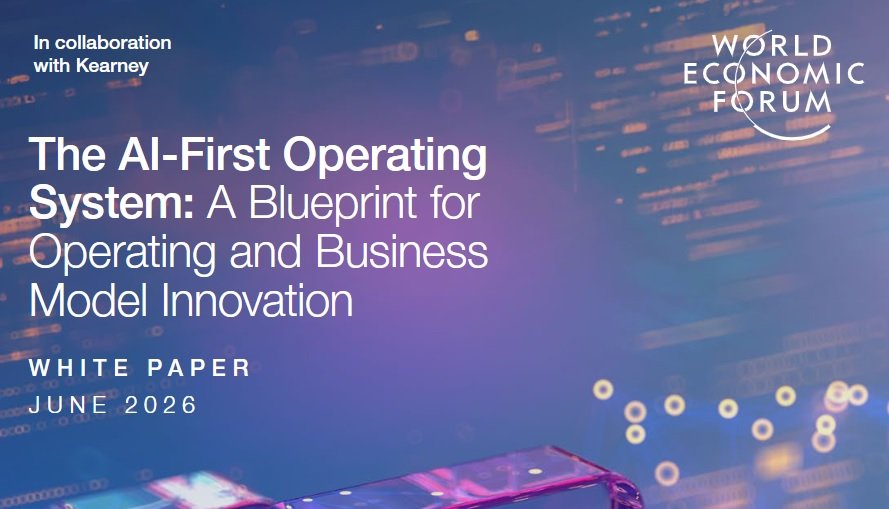
The document, titled ‘The AI-First Operating System,’ stems from an uncomfortable truth: artificial intelligence underperforms when treated as a tool bolted onto existing infrastructure. It delivers when the enterprise is redesigned around it. The distinction may seem subtle, but it defines who is compounding—accumulating an advantage month after month—and who remains trapped in a perpetual ‘experimentation phase’ while a competitor pulls ahead.
Why ‘Deploying AI’ Is Not the Same as Being an AI-First Company
To explain this phenomenon, the authors look back at a scene from a century ago. When electricity first entered factories, early owners did the obvious: they removed the old steam engine from the center of the floor and replaced it with a large electric motor. They kept the same layout, the same belts, and the same workflow. The result? They saved a bit on energy costs, but productivity remained completely stagnant.
The real leap occurred between 1919 and 1926, when pioneers like Henry Ford rebuilt entire factories around electricity. Instead of a giant central engine, they placed small individual motors at every workstation. They re-engineered production lines, decentralized power, and redesigned the manufacturing process from scratch. Only then did the modern factory emerge.
AI is currently experiencing its own ‘electric motor’ moment. For years, most enterprises have merely plugged it into pre-existing workflows, much like replacing a steam engine without changing anything else. It improves margins, but only marginally. What the report describes is a small, growing cohort of organizations doing what Ford did: completely reconstructing their entire operation.
The Forum categorizes these companies into three distinct tiers:
- AI-Enabled: These companies apply AI to isolated tasks within unchanged workflows. If you remove the tools, the corporate structure remains fully intact.
- AI-First: These enterprises redesign workflows, roles, and decision-making around intelligence models. If you deactivate the AI, the business ceases to operate.
- AI-Native: These organizations were built with AI as their core operational capability. Without it, their value proposition simply does not exist.
The ultimate litmus test remains that simple question: if you turned off the AI tomorrow, would your entire operation collapse?
The “Intelligence Engine”: The Piece Almost No One Is Building
At the heart of an AI-first company lies what the report terms the “intelligence engine.” It is neither a single model nor an isolated application; rather, it is an operational flywheel—a compounding system that learns from every interaction, transaction, and decision, becoming increasingly capable with usage.
This engine operates at three distinct speeds:
- Velocity: It accelerates the discovery, experimentation, and validation of concepts before resource allocation. For instance, a drug discovery firm advanced from an initial hypothesis to a validated simulation in a matter of days instead of months.
- Scale: The same architecture is deployed across adjacent business functions without the need for re-engineering. Osmo, a company that developed an “olfactory intelligence” trained on over 3 billion molecules, collapsed fragrance development timelines from six months to just 60 seconds—with every new formula actively feeding the system for the next iteration.
- Scope: Capabilities originally engineered for a specific purpose are systematically recombined to establish entirely new products and market opportunities.
The Missing Link: This is precisely where most organizations fall short. Isolated pilots fail to feed a unified flywheel; they function as disconnected gears that never mesh. Without a centralized engine to capture signals from every operational cycle, the enterprise continuously duplicates effort without accumulating compounding value.
Treating Intelligence as Capital, Not an Expense
One of the report’s most actionable shifts is moving away from viewing AI as a technology cost and instead treating it as capital that must be prudently allocated. You do not digitalize everything simultaneously. Instead, you identify three to five workflows where restructuring around intelligence yields the most significant performance leap, and you begin there.
How are these workflows selected? The strongest candidates share three distinct traits:
- Scale and Repetition: High-volume processes where every optimization is amplified.
- Friction: Processes hindered by cross-departmental handoffs, multi-step coordination, or manual reviews.
- Cognitive Complexity: Decision-making environments where AI substantially enhances judgment and velocity.
Consequently, customer support, procurement, policy underwriting, and claims management are typically the first areas chosen. This is not because they are simple, but because re-engineering them delivers compounding returns.
Gamma, an AI-native presentation platform, illustrates this operational discipline. With a lean team of just 50 people, it surpassed $100 million in annual recurring revenue while its users generated over one million pieces of content daily. The defining factor: they treated every step of creation as an allocation problem. Which tasks belong to an expensive frontier model and which to a cost-effective, specialized one? What requires orchestration and what requires fine-tuning? What still demands human judgment regarding taste and direction? Within six months of launch, their gross margin tied to inference expanded from roughly 31% to 77%. This was not because the technology improved on its own, but because their allocation decisions became structurally deliberate.
The Human Factor: Diminutive Teams with Monumental Results
Perhaps the most provocative signal in the report lies in headcounts. Market pioneers are crossing revenue thresholds with a mere fraction of the staff previously required by legacy software leaders. Anthropic, according to the cited data, achieved a $10 billion annualized revenue run rate with only 2,300 employees. Cursor reached $1 billion with a team of just 150 to 300 people.
This does not imply that human capital is obsolete; rather, it means that the nature of human contribution is shifting. As AI absorbs the “middle layer”—the repetitive technical execution—what gains significant weight is the combination of breadth (knowing how to frame problems and adapt to new tools) and depth (domain expertise and the judgment that AI cannot yet replace). The report even warns of a silent risk: skill atrophy. As AI assumes greater execution responsibilities, human capabilities weaken through disuse, and organizations typically discover how critical that tacit knowledge was only after an AI failure occurs. Skills can be retrained, but lost judgment is far more difficult to reclaim.
To operationalize this talent, the report proposes a federated organizational framework: a centralized team led by executive management provides the shared infrastructure—approved models, data platforms, evaluation tools, and security guardrails—while individual business units determine where to deploy AI and retain full ownership of the returns within their own results. Rakuten, with over 70 business units, operates under this model, utilizing embedded AI leaders in each area who report dual-line to both their specific unit and the core center.
The Cost of Inaction
There is a temptation to dismiss all of this as just another round of tech hype. The report itself is honest: the AI-first wave is in its infancy, it remains unclear which models will prove most resilient, and current labor metrics may not accurately capture the impact of technologies that continue to evolve. No one has a definitive formula.
However, this uncertainty is no excuse for inertia. The practical advice for leaders is to run parallel operating models: developing AI-first workflows, teams, and systems alongside existing ones, and systematically measuring the performance gap. This reveals precisely where intelligence creates a genuine advantage and where traditional models still deliver.
Let us return to the operations director on Monday morning, facing his 40 fragmented pilots. His problem was never a shortage of AI; it was having scattered AI plugged on top of an operation that remained unchanged. The lesson from the high-performers is that the right question is not “which tool should I buy?”, but “which workflow am I willing to rebuild from scratch so that every execution cycle feeds the engine?” to innovate the business model. The day that dashboard stops showing 40 disconnected experiments and displays a single flywheel spinning faster and faster, the company will have stopped merely using artificial intelligence and begun operating through it. And that, the report states, makes all the difference.
Reference (open access)
World Economic Forum. (2026). The AI-first operating system: A blueprint for operating and business model innovation [White paper].

Editor and founder of “Innovar o Morir” (‘Innovate or Die’). Milthon holds a Master’s degree in Science and Innovation Management from the Polytechnic University of Valencia, with postgraduate diplomas in Business Innovation (UPV) and Market-Oriented Innovation Management (UPCH-Universitat Leipzig). He has practical experience in innovation management, having led the Fisheries Innovation Unit of the National Program for Innovation in Fisheries and Aquaculture (PNIPA) and worked as a consultant on open innovation diagnostics and technology watch. He firmly believes in the power of innovation and creativity as drivers of change and development.