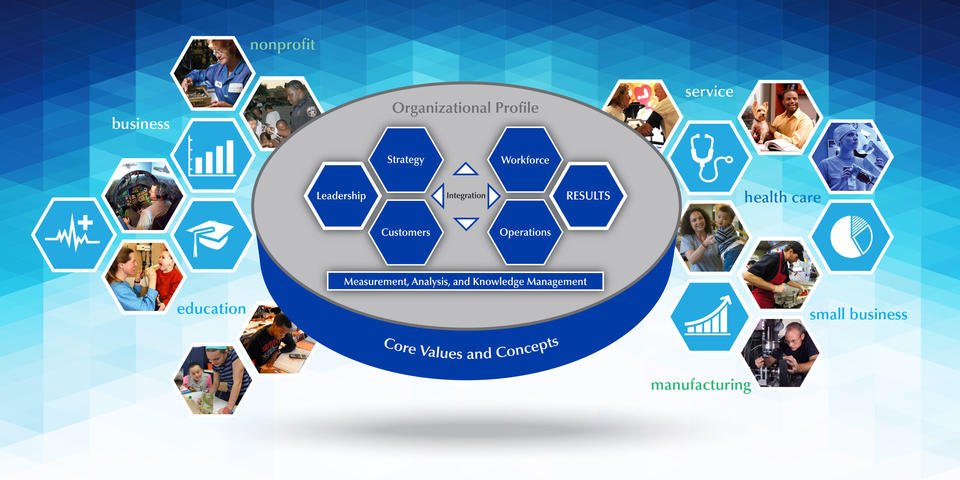
The Malcolm Baldrige Model constitutes a comprehensive management framework, designed by the National Institute of Standards and Technology (NIST) to enhance competitiveness and organizational excellence. Through seven critical criteria—ranging from leadership to results—this model enables companies, healthcare institutions, and educational centers to evaluate their performance in pursuit of superior quality and global sustainability.
In today’s dynamic business environment, compliance certifications alone are insufficient; a robust culture of continuous improvement and resilience is required. The Baldrige Excellence Framework has established itself as the gold standard for organizations pursuing operational excellence. This framework transcends traditional regulations, such as ISO 9001, by focusing on holistic performance and value creation for all stakeholders.
Under this premise, the Malcolm Baldrige Model (MBNQA) is an empirically valid, reliable, and fully compatible benchmark for evaluating and improving quality, as well as achieving excellence in educational organizations (Parast and Safari, 2023), healthcare, businesses, and community organizations.
Key Takeaways: What You Should Remember About the Baldrige Model
- Beyond Quality Management: Unlike compliance standards (such as ISO), the Baldrige Model is a comprehensive excellence framework that bridges the gap between leadership and strategy with tangible business results.
- A 7-Criteria Systems Approach: Success does not rely on isolated departments, but on the synergy of seven key pillars, where the Results category carries the greatest weight (450 out of 1,000 points).
- Universal Adaptability: It is applicable across all sectors. While it optimizes patient safety in Healthcare, it enhances student success in Education and streamlines bureaucracy in the Public Sector.
- Leadership as the Catalyst: Successful implementation cannot be delegated; it demands active and visible commitment from senior management to transform the organizational culture from the ground up.
- Data-Driven Decision Making: The model acts as the organization’s “brain,” promoting the use of KPIs and benchmarks to eliminate subjectivity in strategic decision-making.
- Investment with Returns: Although it requires significant time and capital, its implementation fosters a structural transformation that guarantees long-term sustainability and competitiveness.
What is the Malcolm Baldrige Model, and why is it the gold standard?
The Malcolm Baldrige Model is an excellence management system established in the United States in 1988 to evaluate and enhance organizational performance. Unlike other regulatory frameworks, this model measures the real impact of leadership and strategic planning on business results, cementing its status as the cornerstone of the National Quality Award. Until 2021, the Baldrige Excellence Framework (MBEF) ranked as the second most widely adopted model globally—utilized by 34.5% of excellence-driven organizations—surpassed only by the European EFQM model (Ghafoor et al., 2021).
According to Dhurandhar and Kumar (2024), the Baldrige program offers a structured, results-oriented approach with a rigorous emphasis on process efficiency and customer satisfaction. However, they warn that its implementation requires a significant investment of time and capital, which has historically presented an operational challenge for small businesses.
Fundamentals and Strategic Flexibility
Originally introduced as the foundation for the Malcolm Baldrige National Quality Award (Flynn and Saladin, 2001), this framework was established by the U.S. Congress in honor of the namesake Secretary of Commerce. Far from being a rigid standard, it is defined as a flexible framework aimed at improving competitiveness across any sector. Its key differentiator lies in integrating strategic vision with operational execution, moving beyond the conventional quality management focus centered solely on isolated processes.
History and Evolution: The Reimagined Framework
Over the decades, the model faced criticism due to its complexity and the administrative burden of drafting exhaustive reports. Responding to these demands, in 2024, NIST (National Institute of Standards and Technology) launched a “reimagined” version of the model. This update prioritizes organizational resilience and sustained success, simplifying the criteria to facilitate access for SMEs as well as the healthcare and education sectors. The purpose is clear: to reduce bureaucracy and foster the agility required in the face of today’s technological market disruptions.
The 7 Criteria of the Baldrige Excellence Framework: A Roadmap to Success
The seven criteria of the Baldrige model—Leadership, Strategy, Customers, Measurement/Analysis, Workforce, Operations, and Results—interact systemically to transform organizational culture. These pillars ensure that every process is aligned with the executive vision and the institution’s financial objectives. Dhurandhar and Kumar (2024) argue that the Baldrige model is distinguished by its rigorously defined criteria and its solid focus on leadership, strategic planning, and operational efficiency.
The Seven Fundamental Categories:
- Leadership: Evaluates how senior management guides the organization through an inspiring vision. It transcends mere hierarchical authority, instead fostering ethical conduct and social responsibility. In this regard, Moore et al. (2024) highlight that successful leadership systems positively impact employee engagement and satisfaction, thereby driving global organizational success.
- Strategy: Analyzes the process of establishing objectives and their subsequent conversion into actionable and measurable action plans.
- Customers: Prioritizes the “voice of the customer” to ensure that products and services not only meet immediate needs but also cultivate long-term loyalty.
- Measurement, Analysis, and Knowledge Management: Functions as the model’s “intelligence hub.” It examines how data is leveraged for objective, fact-based decision-making.
- Workforce: Focuses on the engagement, safety, and well-being of staff, recognizing human capital as the primary engine of innovation.
- Operations: Examines the design and management of operational processes to guarantee efficiency and the consistent delivery of value.
- Results: The critical component. This category measures tangible performance across financial indicators, customer satisfaction, and corporate social responsibility.
Evaluation and Scoring Structure
| Criterion | Primary Focus | Suggested Weight |
| 1. Leadership | Ethics, social responsibility, and executive role. | 120 pts |
| 2. Strategy | Planning and deployment of objectives. | 85 pts |
| 3. Customers | Loyalty and market listening. | 85 pts |
| 4. Measurement & Analysis | Knowledge management and use of KPIs. | 90 pts |
| 5. Workforce | Engagement and employee well-being. | 85 pts |
| 6. Operations | Process efficiency and value chain. | 85 pts |
| 7. Results | Financial performance and success metrics. | 450 pts |
Pro-Tip: The Results criterion carries the greatest weight (45%), underscoring that the Baldrige model does not merely reward process design, but rather the ability to demonstrate tangible metrics of sustained success.
Real-World Implementation: From Crisis Diagnosis to Organizational Excellence
The practical utility of the Baldrige model is particularly evident during crisis resolution. According to ACCA Global, organizations can employ these criteria to diagnose critical supply chain failures and high rates of employee absenteeism. By realigning the workforce with delivery strategies, companies are able to recover profitability and operational stability.
Despite its relevance, one of the most common gaps in the literature regarding Malcolm Baldrige Model examples is the management of disruptive scenarios. Consider, for instance, a pharmaceutical company facing legal litigation and a drastic decline in employee morale. Under the Baldrige framework, recovery is addressed through three systemic fronts:
- Leadership: Senior management must adopt ethical and transparent conduct before regulatory bodies. As a successful precedent, Furst-Bowe and Bauer (2007) cite the case of the University of Wisconsin-Stout (UW-Stout), which transformed its organizational structure and reduced bureaucracy by creating the Chancellor’s Advisory Council. This initiative fostered participatory decision-making and multidirectional communication, mitigating risks prior to implementing structural changes. In alignment with this, Parast and Golmohammadi (2019) emphasize that leadership is the primary driver of the system, having a decisive impact on all quality practices, especially in critical sectors such as healthcare.
- Operations: Production bottlenecks causing market shortages are identified and eliminated.
- Workforce: Incentive programs and mental health support are established to reduce absenteeism that compromises plant operations.
This holistic approach ensures that recovery is not a temporary “patch,” but a structural transformation toward resilience and sustained organizational excellence.
Sectoral Applications: Healthcare, Education, and Vocational Rehabilitation
The Baldrige model transcends industrial boundaries thanks to NIST’s adaptation guides. While the healthcare sector prioritizes patient safety, education focuses on student success; meanwhile, in Vocational Rehabilitation (VR), the framework acts as a catalyst for reducing bureaucracy and centering efforts on effective job placement.
It is a common misconception to assume this system is exclusive to manufacturing. Purba (2021) reports that the model is applied across a vast range of sectors, with education being the most studied (22%), followed by comparative research (18%), manufacturing (18%), and healthcare (16%). Furthermore, Rangsungnoen et al. (2024) reveal that the Baldrige Criteria (BCPE) drive excellence in “Global South” organizations at the community level, based on five pillars: customer-focused excellence, social responsibility, systems perspective, visionary leadership, and a focus on success.
The Baldrige Model in Education
Higher education has found this framework to be a tool for profound transformation:
- Systematic Evaluation: Furst-Bowe and Bauer (2007), analyzing the case of the University of Wisconsin-Stout, conclude that the model offers a proven framework for initiating systematic improvement processes.
- Human Capital: In university management (such as at Universiti Teknologi MARA), Mohamed and Anuar Yusoff (2021) identified that the Workforce Focus is the most determining factor for organizational effectiveness, followed by data measurement and process focus.
- Clinical Diagnosis: Niroumand et al. (2026) demonstrate that the model is effective for systematically diagnosing strengths and performance gaps in hospital clinical education systems.
- Empirical Robustness: Parast and Safari (2022) ratify that the model is a reliable and robust tool for achieving excellence in any educational organization.
Impact on the Healthcare Sector
In the healthcare field, the Baldrige model is synonymous with operational efficiency and quality of care:
- Reliability: Parast and Golmohammadi (2019) validate this framework as a highly reliable quality evaluation system for healthcare institutions.
- Tangible Metrics: According to Strahan et al. (2022), hospital leaders achieve critical improvements by adopting the framework, optimizing the average length of stay, enhancing the patient experience, and strengthening the return on net assets.
Vocational Rehabilitation (VR)
For public rehabilitation agencies, the VRTAC-QM documentation highlights that the model prevents organizations from getting lost in administrative management. Its implementation ensures that efforts remain focused on the outcome: enabling citizens to achieve dignified and successful job placement.
Implementation Guide: How to Successfully Adopt the Baldrige Model
According to Arif (2007), the effective implementation of the Baldrige Model in any institution should follow a logical eight-stage path: stakeholder identification, objective setting, proposal of Key Performance Indicators (KPIs), goal establishment for those KPIs, process design, resource allocation, metric monitoring, and periodic review of objectives.
For this transition to succeed, bibliographic sources agree that it is not necessary to reinvent the organization overnight. The Baldrige Excellence Framework is inherently adaptable; its implementation must be a strategic, systematic effort oriented toward continuous improvement. The following are the key pillars for execution:
- Active and Visible Leadership: Change cannot be delegated to an external committee; it must be driven by senior management (CEOs, directors, or deans). Leaders must model collaborative decision-making and establish strategic goals aligned with excellence principles. It is recommended to integrate executive training programs focused on strategic planning to ensure genuine commitment.
- “Small Wins” Strategy: Since the model is non-prescriptive, organizations can modularize their initial depth. An effective strategy consists of focusing on one or two critical areas to resolve a specific problem. These “small wins” build credibility, boost motivation, and reduce natural resistance to change among staff.
- Planning and Operational Optimization: It is imperative to develop a long-term strategic plan that positions business excellence as the central axis. To operationalize this, the organization must standardize workflows, create clear operating guidelines, and implement continuous improvement methodologies that optimize key value-delivery processes.
- Participatory Culture and Multidirectional Communication: Excellence requires open communication and participatory processes. Involving employees at all levels through quality circles, recognition systems, and constant training is vital. Investing in human capital development ensures that the new culture is adopted and championed throughout the organization.
- Evidence-Based Decision-Making: Robust metrics and benchmarks must be established to monitor progress. The use of digital systems for real-time data collection and performance evaluation is highly recommended. This allows for evidence-based adjustments and provides transparency, turning the Baldrige framework into a cyclical and constant evaluation tool.
- Relentless Customer Focus: Finally, feedback mechanisms must be strengthened to foster innovation in product or service delivery, ensuring the organization responds with agility to changing market needs.
Strategic Challenges: When implementing this model, organizations must anticipate and manage common barriers, such as cultural inertia, alignment with existing processes, and the significant investment of time and financial resources required for a profound transformation.
Criticisms and Challenges: An Objective Perspective on the Baldrige Model
Despite its prestige, the Baldrige Model is not without controversy. Recurring criticisms point to its high complexity, the implementation costs for small and medium-sized enterprises (SMEs), and the lack of a guaranteed correlation between high scores and immediate stock market success. Nevertheless, its strategic value lies in the profound internal diagnosis it provides—a competitive advantage that few management frameworks can match.
According to Dhurandhar and Kumar (2024), one of the most critical limitations is the intensive demand for financial and temporal resources. This factor can constitute a substantial obstacle for organizations with lean structures or limited capacity to execute far-reaching systemic reforms.
While authoritative institutions such as the ASQ (American Society for Quality) endorse the model, industry experts warn of three fundamental challenges:
- Documentary Density and Bureaucracy: The rigor required to apply for the National Award can result in an administrative burden that distracts senior management from essential daily operations.
- Capital Investment: The need for specialized consultancy and exhaustive internal audits requires a budget that is not always accessible to the SME ecosystem.
- The Dichotomy Between Rigor and Agility: In technological sectors where change occurs daily, the Baldrige annual evaluation cycle may be perceived as rigid or slow when compared to rapid-response methodologies such as Agile or Lean Management.
Conclusion: Where Is Your Organization Headed?
The Malcolm Baldrige Model should not be understood as a final destination, but rather as a perpetual journey toward continuous improvement. The 2024 update underscores a fundamental premise: excellence is not a static state; on the contrary, it demands agility, resilience, and an unwavering ethical vision.
For leaders and innovators, this framework provides the necessary structure to scale disruptive ideas without compromising quality control. Whether your company faces rapid growth challenges or operational crises, the Baldrige criteria function as the strategic mirror required to identify weaknesses and transform them into competitive advantages. In today’s market, having a robust management system has ceased to be optional: it is the indispensable foundation for fulfilling the promise of innovation and sustainable prosperity.
Frequently Asked Questions (FAQ) About the Malcolm Baldrige Model
What is the primary difference between the Baldrige Model and ISO 9001?
While ISO 9001 is a prescriptive standard that certifies an organization meets the minimum requirements of a Quality Management System (QMS), the Baldrige Model is a holistic excellence framework. ISO focuses on process compliance, whereas Baldrige centers on business results, strategic leadership, and value creation for stakeholders. Many experts consider ISO to be the foundational step toward the “gold standard” represented by Baldrige.
What changed in the “reimagined” 2024 version?
The 2024 NIST version simplified the criteria to make them more accessible. The primary shift focused on organizational resilience and the capacity to respond to global disruptions. Administrative burdens for SMEs were reduced, and more agile metrics were integrated to reflect success within digital and volatile environments.
Can a small business (SME) implement this model?
Yes. Although it was historically perceived as a model for large corporations, the current structure is scalable. SMEs can apply the criteria gradually through a “small wins” strategy, focusing first on critical areas such as Leadership or Customer Satisfaction before pursuing a full 1,000-point evaluation.
How long does it take to see tangible results?
Implementing the Baldrige Model is a long-term commitment. However, organizations typically report improvements in operational efficiency and staff morale within the first 6 to 12 months. Full cultural transformation and sustained financial results generally consolidate over a period of 3 to 5 years of cyclical evaluations.
Is the Baldrige model compatible with Agile or Lean methodologies?
Absolutely. In fact, Baldrige acts as the strategic “umbrella” that provides purpose to tools such as Lean, Six Sigma, or Agile. While these methodologies optimize specific processes, the Baldrige model ensures that such optimizations are aligned with the organization’s global strategy and bottom-line results.
References
Arif M (2007), “Baldrige theory into practice: a generic model“. International Journal of Educational Management, Vol. 21 No. 2 pp. 114–125, doi: https://doi.org/10.1108/09513540710729917
Dhurandhar, F. K., & Kumar, H. (2024). A Review on Business Excellence Models and its impact on Industries. Asian Journal of Management, 15(2), 196-204. https://doi.org/10.52711/2321-5763.2024.00031
Flynn, B. B., & Saladin, B. (2001). Further evidence on the validity of the theoretical models underlying the Baldrige criteria. Journal of Operations Management, 19(6), 617-652. https://doi.org/10.1016/S0272-6963(01)00072-9
Furst-Bowe, J. A., & Bauer, R. A. (2007). Application of the Baldrige model for innovation in higher education. New directions for higher education, 2007 (137).
Ghafoor, S., Mann, R. S., & Grigg, N. (2021). The strengths and opportunities for improvement of the Baldrige Performance Excellence Program. Quality Management Journal, 28(3), 128–144. https://doi.org/10.1080/10686967.2021.1920867
Mohamed, Z., & Anuar Yusoff, M. S. (2021). Malcolm Baldrige Approach in University Management: An Importance–Performance Matrix Analysis (IPMA). Asian Journal of University Education (AJUE), 7(2), 273-283.
Moore, N., Weger, K., Gholston, S., Menon, V. (2024). The Baldrige analysis of performance and leadership. Journal of Management & Engineering Integration, 17(2), 34-42. https://doi.org/10.62704/10057/28463
Niroumand, E., Qaderi, K., Khazaei, M.R. et al. Assessment of clinical education quality in teaching hospitals of Kermanshah University of Medical Sciences based on the Malcolm Baldrige model. Discov Educ 5, 127 (2026). https://doi.org/10.1007/s44217-026-01124-6
Parast, M. M., & Golmohammadi, D. (2019). Quality management in healthcare organizations: Empirical evidence from the baldrige data. International Journal of Production Economics, 216, 133-144. https://doi.org/10.1016/j.ijpe.2019.04.011
Parast, M.M., Safari, A. Do quality and business excellence models improve quality and operational results in educational organizations? A repeated cross-sectional analysis. Oper Manag Res 16, 868–886 (2023). https://doi.org/10.1007/s12063-022-00332-1
Purba, H. H. (2021). A systematic literature review of Malcolm Baldrige national quality award (MBNQA). Journal of Technology Management for Growing Economies, 12(1), 1-12.
Rangsungnoen G, Sroypetch S, Caldicott RW (2024), “Extending the Baldrige excellence model for managing community-based social enterprise“. Social Enterprise Journal, Vol. 20 No. 1 pp. 1–31, doi: https://doi.org/10.1108/SEJ-01-2023-0001
Strahan, Jennifer O., FACHE; Hearld, Larry R.; Carroll, Nathan W.; McWhorter, John; Szychowski, Jeff M. 2022. Assessing the Performance Value of the Baldrige Journey: A Comparison of Baldrige Applicants and Nonapplicants. Journal of Healthcare Management 67(4):p 266-282, July-August 2022. | DOI: 10.1097/JHM-D-21-00045

Editor and founder of “Innovar o Morir” (‘Innovate or Die’). Milthon holds a Master’s degree in Science and Innovation Management from the Polytechnic University of Valencia, with postgraduate diplomas in Business Innovation (UPV) and Market-Oriented Innovation Management (UPCH-Universitat Leipzig). He has practical experience in innovation management, having led the Fisheries Innovation Unit of the National Program for Innovation in Fisheries and Aquaculture (PNIPA) and worked as a consultant on open innovation diagnostics and technology watch. He firmly believes in the power of innovation and creativity as drivers of change and development.