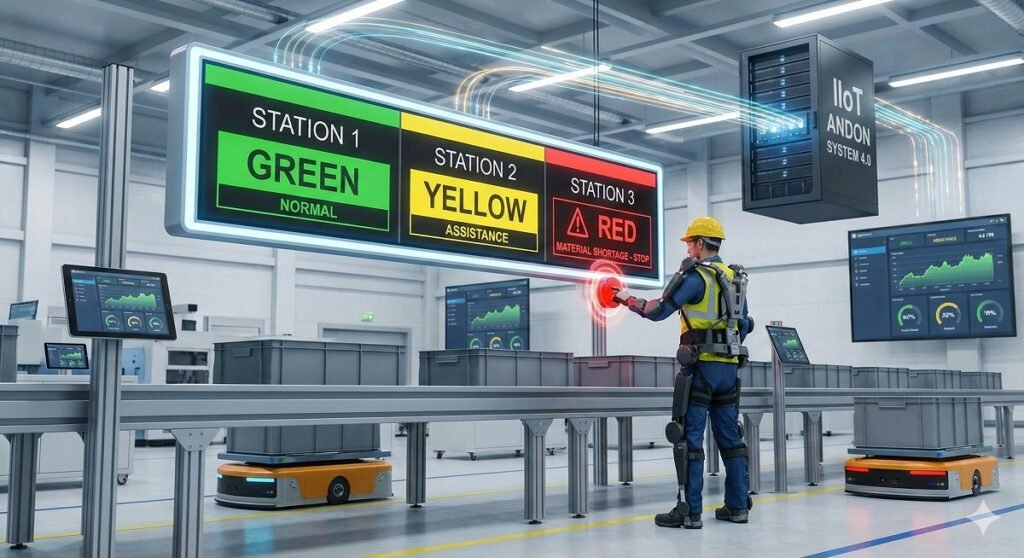
In today’s Lean Manufacturing ecosystem, the ability to identify and resolve incidents in real time has shifted from a competitive advantage to a necessity for survival. The Andon system serves as the central nervous system of the “visual factory,” allowing critical information to flow instantaneously from the production line to management levels. Indeed, facilities implementing this methodology report an increase in productive efficiency of 10% to 25% (Wojakowski, 2017).
As a cornerstone of visual management, the Andon system facilitates the immediate detection and mitigation of operational anomalies. From its evolution—originating with the classic physical “Andon cord” and moving toward modern IoT digital ecosystems—its primary function remains halting the flow to prevent defects, thereby ensuring quality at the source and driving Kaizen (continuous improvement). Consequently, it has established itself as one of the most effective and recognized tools within contemporary Lean practices (Hąbe et al., 2023).
In this article, we will analyze the manufacturing Andon system in depth, its transition toward Andon 4.0, and its critical impact on optimizing OEE (Overall Equipment Effectiveness). According to Florescu and Catana (2025), the integration of advanced technologies into the Andon 4.0 concept is the engine modernizing production management toward total interconnectivity.
Key Takeaways
- Catalyst for Operational Efficiency: The Andon system is not an accessory but a driver of profitability. Its technical implementation can increase production system efficiency by 10% to 25% (Wojakowski, 2017), transforming plant “blind spots” into opportunities for immediate improvement.
- Evolution Toward Proactive Intelligence: The transition from the traditional Andon Cord to Andon 4.0 marks a paradigm shift: moving from reacting to failures to data-driven prediction. Through IIoT and Deep Learning, modern plants can mitigate anomalies before they disrupt the flow (Fan et al., 2024).
- The Pillar of Quality at the Source (Jidoka): Beyond lights and software, Andon embodies the Jidoka philosophy. By empowering operators to stop the line at any deviation, it ensures that quality is not inspected at the end but built into every stage of the value chain.
- OEE Optimization via Real-Time Data: Integration with MES and ERP systems allows Andon to serve as the single source of truth for OEE calculations. This visibility eliminates ambiguity and provides a solid statistical foundation for strategic decision-making and the application of effective Kaizen cycles.
- Synergy Between Technology and Culture: The success of an intelligent Andon system depends not only on hardware (sensors or PLCs) but on a clear escalation matrix and standardized processes. As noted by Mohamad et al. (2019), technology is the means, but operational discipline is what guarantees continuous improvement toward industrial excellence.
What is the Andon System? Definition and Historical Evolution
The term Andon (Japanese: アンドン or 行灯) possesses an evocative etymological origin, referring to traditional Japanese paper lanterns. In contemporary industry, the concept of Andon in manufacturing translates into a dynamic visual control system that monitors production status, alerts for anomalies, and empowers operational personnel to intervene or halt the process if quality is compromised. As an essential visual management tool within Lean Manufacturing, the Andon system is pivotal in reducing waste (Muda). Its value lies in its capacity to streamline internal communication, optimize incident response times, and drastically prevent the propagation of defects across the supply chain.
The Origin: The Toyota Production System (TPS)
This methodology was refined by Toyota as a vital component of its production ecosystem. Historically, the system materialized through the renowned Andon cord (pull cord) that ran along the assembly line. If a worker detected an error, they would pull the cord to alert supervisors or stop production. This mechanism introduced a philosophical revolution: errors were no longer concealed to prioritize throughput; instead, they were immediately exposed for analysis and resolution at their root cause.
Synergy with Jidoka: Autonomation with a Human Touch
To understand the role of Andon in lean manufacturing, it must be linked to the concept of Jidoka (autonomation). Jidoka is the pillar that provides machines and processes with a “human touch” to detect irregularities autonomously. Within this framework, the Andon system acts as the alerting mechanism that ensures no defective unit advances to the next stage of the value chain.
Fundamental Components of an Andon Manufacturing System
A rapid response system requires physical and logical elements that guarantee the message reaches the right person at the right time.
The Andon Board
This is the central visual component. Traditionally, it was a physical board with numbered lights corresponding to workstations. Today, Andon boards are LED displays or industrial monitors showing real-time metrics such as:
- Line status (Running, Stopped, Changeover).
- Production pace vs. Target (Takt Time).
- Exact incident location.
Signal Lights (Andon Lights / Stack Lights)
Positioned atop machines or stations, these light towers use a standardized color code to communicate status at a glance:
- Green: Normal operation, continuous flow.
- Yellow: Issue detected. Assistance is required, but the line remains operational (alert phase).
- Red: Critical problem. Line stopped (resolution phase).
- White/Blue: Often used for material requests or preventive maintenance.
The Activation Mechanism
This can be manual (a button or pull cord) or automatic (sensors integrated into the machine’s PLC that trigger the alert upon detecting a technical failure or quality deviation).
Types of Andon Systems: From Analog Management to Industry 4.0
Technological evolution has radically transformed the implementation of the Andon system. Currently, these solutions can be classified into three critical categories based on their digital maturity:
- Traditional Manual Andon: Based on simplified physical components, this model is ideal for small-scale workshops or low-automation processes. Its primary competitive advantage is the low initial Andon system cost; however, its limitation lies in the inability to harvest structured data for subsequent analysis.
- Digital Andon System: At this stage, software takes center stage. Specialized Andon system software collects signals and distributes them via Wi-Fi or Ethernet networks. Communication transcends the physical environment: alerts transition from mere visual signals on a board to intelligent notifications on mobile devices, smartwatches, and emails.
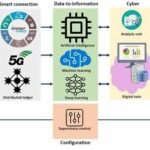
- Andon System 4.0 (IIoT and MES Integration): At the pinnacle of modernization lies Andon 4.0. This ecosystem integrates natively with the MES (Manufacturing Execution System) and corporate ERP. Recent research by Fan et al. (2024) concludes that implementing intelligent systems based on Deep Learning and data fusion drastically improves efficiency, overcoming the limitations of systems strictly dependent on manual intervention.
This evolution provides three strategic pillars:
- Predictive Analytics: The ability to alert for potential failures before they occur, utilizing historical data and smart sensors.
- Enterprise-wide Visibility: Allowing management to monitor the operational status of multiple intercontinental plants from a centralized interface.
- End-to-End Traceability: Every activation of the “digital cord” generates an immutable record of response time, root cause, and the executed solution.
As noted by Purnomo et al. (2024), Smart Andon based on the Industrial Internet of Things (IIoT) is the definitive tool for real-time production optimization. Furthermore, Mohamad et al. (2019) validated a framework for the Andon Support System (ASS), integrating cyber-physical systems (CPS) under Industry 4.0 excellence standards.
Table 01. Comparison: Traditional vs. Digital Andon.
| Feature | Traditional Andon (Analog) | Digital Andon System (IIoT) |
| Data Collection | None or manual (paper-based). | Automated and real-time. |
| Notification | Local (visual/auditory). | Omnichannel (Displays, Apps, SMS). |
| Root Cause Analysis | Difficult to track historically. | Integrated (5 Whys, Diagrams). |
| Flexibility | Requires physical wiring. | Scalable software configuration. |
| Investment and ROI | Low cost / Limited ROI. | Medium-high cost / High ROI. |
| Integration | Standalone system. | Connected to ERP / MES / OEE. |
Benefits of Implementing Andon in Lean Manufacturing
The adoption of an Andon system transcends mere industrial signage; it represents a strategic investment in operational efficiency. Its benefits directly impact financial indicators and the plant’s operational health:
- Minimization of Downtime: By generating instantaneous alerts, technical teams drastically reduce diagnostic and response times.
- Quality Assurance and Cost Reduction: It prevents errors from propagating through the value chain, significantly reducing scrap and costly rework processes.
- Real-Time Operational Transparency: It eliminates uncertainty, providing all levels of the organization with total visibility of ongoing events.
- Frontline Empowerment: It fosters a culture of accountability where the worker becomes the primary steward of quality.
- OEE Optimization: By mitigating minor stoppages and elevating quality standards, the Overall Equipment Effectiveness index experiences a substantial increase.
Empirical evidence supports these findings. Huayra-Mendoza and Ticlavilca-Arias (2024) documented that integrating Andon with tools such as Poka-Yoke and Standardized Work was decisive in reducing the defect rate from 12.70% to 6.71% in the textile sector. Furthermore, Xie et al. (2023) highlight that a robust Andon system must cover critical scenarios such as technical machinery failures, stockouts, and deviations in quality or safety protocols.
Finally, experts such as Hąbe et al. (2023) position Andon as a fundamental pillar alongside Kaizen and 5S to drive excellence. Likewise, Kiukkonen (2025) underscores its analytical value: by functioning as a data collection tool, it enables a precise distinction between internal and external errors, necessitating an in-depth root cause investigation for every flow interruption.
Technical Architecture: How a Digital Andon System Functions
For professionals seeking to design and implement a modern Andon system, the architecture typically follows this logical flow:
- Acquisition Layer (Hardware): Comprised of proximity sensors, computer vision cameras, or direct signals from the PLC (utilizing protocols such as Modbus or OPC UA).
- Communication Layer: Data is transmitted via a local network (Wireless or PoE) to a central server or the cloud.
- Processing Layer (Software): The Andon system software processes the signal. If a machine stops, the software triggers a “response time” timer.
- Visualization Layer: Information is displayed on the Andon panel, and push notifications are dispatched to shift supervisors.
- Analysis Layer: Data is stored in a SQL database to generate weekly performance reports and identify bottlenecks.
Implementation Challenges: The Human Factor
A prevalent mistake when deploying an Andon system is focusing exclusively on technology while neglecting organizational culture.
Critical Note: The success of Andon hinges on psychological safety. If an operator fears being penalized for halting the line (triggering the red light), the system will fail.
Strategies to Overcome Resistance
- Cultural Training: Emphasize that “stopping the line is a proactive contribution” that protects the company from delivering defective products.
- Clear Response Protocols: The system is ineffective if a yellow light is ignored. A well-defined Escalation Matrix must specify who responds and the required timeframe.
- Supportive Leadership: Supervisors must act as facilitators rather than judges when an Andon alert is activated.
Case Studies and Andon System Examples
Automotive Manufacturing (The Gold Standard)
In assembly plants, the Toyota Andon System remains the industry benchmark. Each station features a display showing the Takt Time. If an operator is unable to complete a task within the allotted timeframe, they activate the Andon signal, prompting a team leader to provide immediate assistance without disrupting the overall flow, unless strictly necessary.
Amazon (Andon in Service Environments)
Amazon utilizes a “Customer Service Andon” protocol. If a support agent identifies a product receiving recurring complaints due to defects, they have the authority to “pull the cord” and delist the item from the website until a root cause investigation is conducted. This is a prime example of Lean Andon principles applied beyond the factory floor.
Software Development (DevOps)
In IT environments, Andon translates to the “Stop the Build” philosophy. If an automated test fails, the Continuous Integration (CI) pipeline is immediately halted, and the entire team prioritizes fixing the code before proceeding.
Cost Analysis and Return on Investment (ROI)
The cost of implementing an Andon system scales with complexity:
- DIY Systems: Utilizing microcontrollers such as Arduino or Raspberry Pi, basic light towers can be developed for under $500 USD per station.
- Industrial Plug-and-Play Solutions: Providers of IIoT hardware offer complete systems ranging from $3,000 to $5,000 USD per line.
- Enterprise SaaS Platforms: Costs typically follow a subscription model, integrating advanced analytics and dedicated support—ideal for multinational corporations.
Strategic Roadmap: A Step-by-Step Guide to Successful Implementation
The transition toward a visual and intelligent plant requires a rigorous methodology. For organizations seeking to determine when to utilize the Andon system and how to initiate its deployment, this roadmap—aligned with Industry 4.0 standards—is key. The implementation of an Andon ecosystem requires a structured approach that harmonizes hardware and software installation with process re-engineering, divided into four critical phases:
1. Technical Architecture and Hardware Layer
The physical infrastructure is the system’s foundation. Depending on digital maturity, three levels must be considered:
- Perception Level (Devices):
- Manual Systems: Installation of stations with wireless buttons (Z-Wave technology) and LED light towers. To avoid latency, the use of universal sensors with a constant power supply is recommended (Hirvonen, 2018).
- Automated Systems: Integration of industrial cameras and Deep Learning models (Convolutional Neural Networks) for autonomous detection of defects or acoustic anomalies (Fan et al., 2024). Furthermore, PLCs allow for direct data extraction from machinery (Mohamad et al., 2019).
- Control and Processing Level: Data is centralized in master units. Successful implementations use Raspberry Pi as a central node, communicating with slave nodes (Arduino Nano) to manage the wireless network (Purnomo et al., 2024). Connectivity relies on industrial protocols such as MQTT, HTTP, and CoAP, ensuring encrypted transmissions (Xie et al., 2023).
- Visualization Level: Deployment of digital dashboards and mobile applications reflecting real-time line status, alerts, and OEE (Purnomo et al., 2024).
2. Data Flow and Notification Configuration
Once the hardware is consolidated, the system logic must be programmed:
- Data Structure: Creation of structured databases (SQL/MySQL) to log timestamps, alert identifiers, and resolution statuses (Mohamad et al., 2019).
- Communication Protocols: The use of Websockets is fundamental for instantaneous bi-directional communication, ensuring floor-level state changes are reflected in under 2 seconds (Hirvonen, 2018).
- Escalation Matrix: Programming of omnichannel alerts (Email, WhatsApp, SMS). If an incident persists beyond a predefined threshold, the system automatically escalates the notification to management levels (Mohamad et al., 2019).
3. Operational Integration and Standardization
Technology is only effective if integrated with the human factor and Lean philosophy:
- Action Protocols: Definition of clear rules. For example, in textile environments, red alarms are triggered upon detecting a specific number of accumulated defects or scheduled downtime for preventive maintenance (Huayra-Mendoza & Ticlavilca-Arias, 2024).
- Standardized Work: Use of swimlane flowcharts to define responsibilities: who reports, who investigates, and who executes the solution (Kiukkonen, 2025).
- Lean Synergy: The system must operate in conjunction with tools like Poka-Yoke and TPM to maximize defect reduction.
4. Validation, ROI, and Continuous Improvement (Kaizen)
Finally, the system must be audited through:
- Black Box Testing: Validation of OEE calculation accuracy and digital dashboard integrity before full-scale deployment.
- Data Analysis for Kaizen: Generation of historical reports to identify “Top 3” downtime causes. This allows management to make data-driven decisions, achieving response time improvements of over 60% and drastic optimization of spare parts inventory.
Conclusion
The Andon system has evolved from its humble origins as a simple “lantern” to become the bedrock of operational intelligence. Whether deploying traditional physical boards or cutting-edge Andon 4.0 software solutions, the objective remains steadfast: achieving total visibility to ensure an instantaneous response. In an industrial landscape where every second of downtime translates into substantial financial loss, operating without a visual alert system is, quite simply, manufacturing in the dark.
Frequently Asked Questions (FAQ)
What exactly is the Andon system, and what is its primary objective?
The Andon system is a visual management tool integral to the Lean Manufacturing methodology. Its core purpose is to serve as the facility’s “nervous system,” enabling the instantaneous detection of process anomalies. By providing real-time alerts, it empowers operators to halt production when necessary, thereby guaranteeing quality at the source and eliminating waste (Muda).
What is the fundamental difference between traditional Andon and Andon 4.0?
While traditional Andon relies on physical devices—such as stack lights and pull cords—with limited analytical capacity, Andon 4.0 integrates disruptive technologies like IIoT, Big Data, and Cloud Computing. This 4.0 iteration goes beyond simple alerting; it automatically harvests operational data, integrates seamlessly with ERP/MES systems, and enables both remote and predictive monitoring.
Is it possible to implement an Andon system in companies with low automation levels?
Absolutely. The Andon system is exceptionally scalable, allowing organizations to begin with manual or analog setups—utilizing physical lights and push-buttons—to cultivate a culture of transparency and rapid response. As operational maturity increases, these systems can seamlessly transition into digital or Smart Andon solutions while preserving the core Kaizen philosophy of continuous improvement.
What role does Artificial Intelligence play in modern Andon systems?
Within the Industry 4.0 framework, AI is leveraged for predictive analytics. According to recent research, the integration of Deep Learning enables Andon systems to identify failure patterns preemptively, shifting the paradigm from a reactive to a proactive response and streamlining maintenance scheduling.
What is the distinction between Andon and Jidoka?
Jidoka is the philosophical pillar of “autonomation,” which entails endowing machinery with a “human touch” to detect errors autonomously. In this framework, Andon serves as the visual manifestation that renders Jidoka tangible, acting as the communication interface where both humans and machines signal the real-time status of the production flow.
References
Fan, J., Hao, H., & Xu, Y. (2024). Application and optimization of deep learning-powered intelligent Andon system in lean manufacturing. En CAICE ’24: Proceedings of the 3rd International Conference on Computer, Artificial Intelligence and Control Engineering. ACM. https://doi.org/10.1145/3672758.3672786
Florescu, A., & Catana, A. E. (2025). Lean-based management in process improvement projects in Industry 4.0. RECENT, 26(3), 354–362. https://doi.org/10.31926/RECENT.2025.77.354
Habek, P., Lavios, J. J., & Grzywa, A. (2023). Lean manufacturing practices assessment case study of automotive company. Production Engineering Archives, 29, 311-318.
Hirvonen, J. (2018). Design and implementation of Andon system for Lean manufacturing. Master’s Programme in Automation and Electrical Engineering, Aalto University. 58 p.
Huayra-Mendoza, G. F., & Ticlavilca-Arias, K. C. (2024, October). Comprehensive Lean Production Model Implementation for Quality and Efficiency Enhancement in Textile SMEs: A Case Study. In 1st World Congress on Industrial Engineering and Operations Management (pp. 102-116).
Kiukkonen, R. (2025). Improving internal material flow between warehouse and production with lean principles [Tesis de maestría, Lappeenranta–Lahti University of Technology LUT]. 69 p.
Mohamad, E., Abd Rahman, M. S., Ito, T., & Abd Rahman, A. A. (2019). Framework of andon support system in lean cyber-physical system production environment. In The Proceedings of Manufacturing Systems Division Conference 2019 (p. 404). The Japan Society of Mechanical Engineers. https://doi.org/10.1299/jsmemsd.2019.404
Purnomo, W., Maulana, G. G., Suryatini, F., & Sunarya, A. S. (2024). Smart Andon system based on Industrial Internet of Things (IIOT). Jurnal Rekayasa Mesin, 15(2), 771–781. https://doi.org/10.21776/jrm.v15i2.1532
Xie, H., Xiao, L., Ming, X., Tan, S., & Bao, Y. (2023, January). Driving intelligent manufacturing: An application study on digital twin in factory digitalization. In Proceedings of the 2023 10th International Conference on Industrial Engineering and Applications (pp. 309-317).
Wojakowski, P. (2017). Realizacja projektów wdrozeniowych systemu Andon w zakladach produkcyjnych [Implementation projects of Andon system in industrial plants]. Przedsiebiorstwo we wspólczesnej gospodarce / Research on Enterprise in Modern Economy, 21(2), 179–188. https://doi.org/10.19253/reme.2017.02.015

Editor and founder of “Innovar o Morir” (‘Innovate or Die’). Milthon holds a Master’s degree in Science and Innovation Management from the Polytechnic University of Valencia, with postgraduate diplomas in Business Innovation (UPV) and Market-Oriented Innovation Management (UPCH-Universitat Leipzig). He has practical experience in innovation management, having led the Fisheries Innovation Unit of the National Program for Innovation in Fisheries and Aquaculture (PNIPA) and worked as a consultant on open innovation diagnostics and technology watch. He firmly believes in the power of innovation and creativity as drivers of change and development.