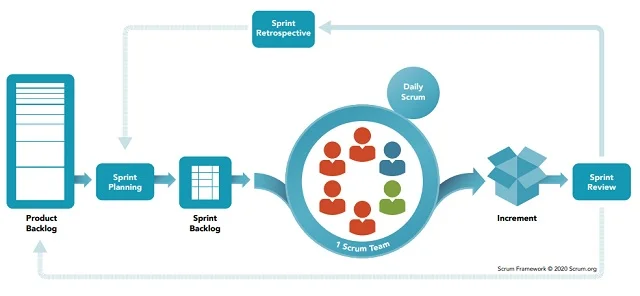
The Scrum framework is arguably the most prevalent and efficient Agile methodology for managing and developing complex products. Currently, it is utilized across a vast array of sectors and for diverse purposes (Hron & Obwegeser, 2022). Its foundation lies in the theory of empiricism, which asserts that knowledge stems from experience and that decision-making must be based on observed data. Consequently, Scrum has been adopted in multiple domains facing inherently complex work environments (Schwaber & Sutherland, 2020).
Unlike traditional management models, Scrum enables teams to deliver value rapidly, iteratively, and incrementally. This is achieved through a continuous cycle of planning, development, review, and adaptation.
This dynamic positions Scrum not merely as a technical tool, but as a strategic competitive advantage. In a world characterized by constant change, it enables organizations to deliver value continuously and efficiently (Lawong & Akanfe, 2025). If you are seeking to understand how Scrum transforms project management, how it distinguishes itself from other methodologies, and which tools are essential to get started, you are in the right place.
Key Takeaways
- Scrum is Grounded in Empiricism: Its success relies on the three pillars (Transparency, Inspection, and Adaptation) and the five core values (Commitment, Courage, Focus, Openness, and Respect).
- Defined Roles: Scrum’s efficacy depends on the proper application of its roles: the Product Owner (maximizes value), the Scrum Master (guides the framework), and the Developers (build the Increment).
- Visible Technical Debt: To maintain project health, work required to service Technical Debt must be prioritized and visible within the Product Backlog.
- Framework Contrast: To select the appropriate methodology, one must understand the difference between Scrum’s fixed cadence and Kanban’s continuous flow, as well as when a predictive (Waterfall) approach is suitable.
What is Scrum?
Scrum is a project management framework that emphasizes teamwork, accountability, and iterative progress toward a well-defined goal (Lutkevich, 2021). In practice, it functions as a strategic tool for organizing innovation project portfolios.
Schwaber and Sutherland (2020) define it as an Agile framework that assists individuals, teams, and organizations in generating value through adaptive solutions for complex problems. Consequently, Scrum facilitates the resolution of productive challenges and the efficient development of new products.
This approach is underpinned by two intellectual pillars (Schwaber & Sutherland, 2020):
- Empiricism: Asserts that knowledge stems from experience and decision-making based on observed data.
- Lean Thinking: Focuses on waste reduction and prioritizing essentials.
The Pillars of Scrum: Transparency, Inspection, and Adaptation
According to Lawong and Akanfe (2025), the practical application of empiricism manifests through three fundamental pillars:
- Transparency: Both the process and the work must be visible to those performing the task and those receiving the outcome.
- Inspection: Artifacts and progress toward the Product Goal must be frequently inspected to detect undesirable variances.
- Adaptation: If a process deviates beyond acceptable limits or the product proves inadequate, the team must adjust the process or materials as soon as possible.
Scrum Values
For the pillars of the Scrum methodology to come to life, the team must become proficient in embodying five core values (Schwaber & Sutherland, 2020):
- Commitment: Members commit to achieving their goals and supporting one another.
- Focus: The primary interest is the work of the Sprint to achieve the best possible progress.
- Openness: The team and its stakeholders agree to be open about the work and the challenges they face.
- Respect: Members respect each other as capable, independent individuals.
- Courage: Members dare to do the right thing and tackle difficult problems.
Advantages and Disadvantages of Scrum
While Scrum is highly valued for its ability to manage uncertainty, its success is not automatic; it requires a delicate balance between technical structure and team maturity. Below is a summary of the implications of implementing this framework:
| Category | Advantages (Benefits) | Disadvantages (Challenges) |
| Team Dynamics | Constant collaboration and alignment. | Risk of dominant personalities. |
| Project Management | Flexibility and rapid market response. | Risk of Scope Creep (uncontrolled growth of requirements). |
| Quality & Risk | Early identification of failures. | Subjective estimations that may cause delays. |
| Human Factor | High customer satisfaction. | Risk of burnout due to high meeting frequency. |
| Capacity & Scale | Resource optimization within Sprints. | Limited scalability for massive teams. |
| Critical Requirement | Promotes autonomy and self-management. | Difficulty for teams lacking prior experience. |
Key Benefits of the Iterative Model
The adoption of Scrum has expanded across various industrial and academic sectors due to its ability to replace rigid planning with a flexible, incremental approach (Lawong & Akanfe, 2025). According to experts such as Lutkevich (2021), Azanha et al. (2017), and Yakut and Çerasi (2024), the primary benefits include:
- Superior Product Quality: Continuous improvement and constant feedback loops ensure products with fewer defects.
- Reduced Time-to-Market: Thanks to Sprints, functional features are delivered without waiting for the entire product to be finalized.
- Higher Return on Investment (ROI): Early error detection prevents unnecessary expenditures at the end of the development process.
- Professional Motivation and Satisfaction: Cohesive teams built on mutual trust and respect report completing projects faster and with higher levels of fulfillment.
The Role of Management in Scrum
For these benefits to materialize, a fundamental shift in mindset is vital. As Maximini (2018) points out, management must abandon micro-monitoring and instead focus on defining strategy and removing impediments, trusting in their teams’ capacity for self-management.
However, it must be noted that Scrum still presents certain weaknesses, such as the lack of a formal description for risk management and a critical dependency on team cohesion (Sassa et al., 2023).
The Scrum Team
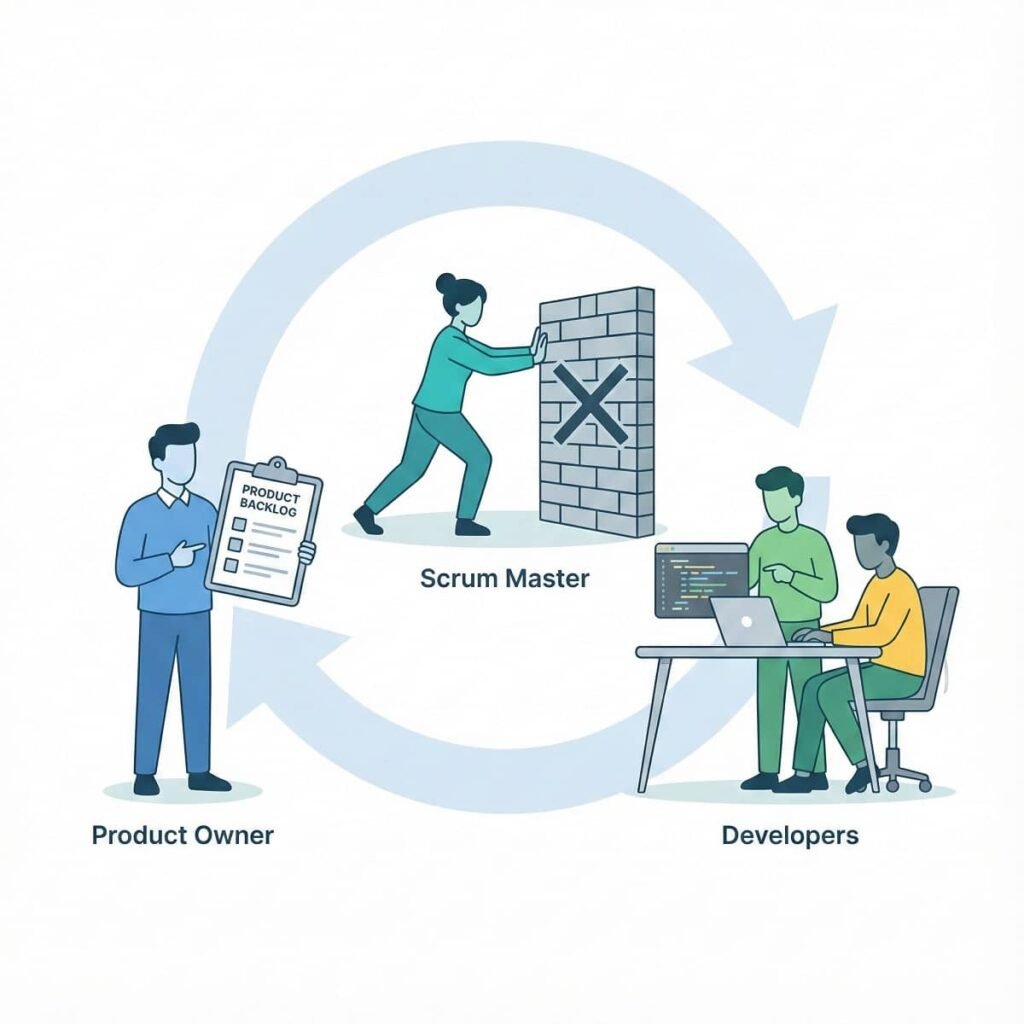
The fundamental unit of this framework is the Scrum Team: a small group of professionals consisting of one Scrum Master, one Product Owner, and Developers. According to Schwaber and Sutherland (2020), there are no sub-teams or hierarchies; it is a cohesive unit focused on a single objective at a time.
These teams are:
- Cross-functional: The team possesses all the necessary technical skills to create value in every Sprint.
- Self-managed: They internally decide who does what, when, and how.
- Balanced: Beyond technical expertise, members must develop soft skills to collaborate effectively (Maximini, 2018).
1. Product Owner
The Product Owner is responsible for maximizing the value of the product resulting from the team’s work. This role is not generic; it adapts to each company’s culture but requires a strong mandate to prioritize work (Kadenic et al., 2023a). Key responsibilities include:
- Managing the Product Backlog: Creating, communicating, and ordering the items in the worklist.
- Defining the Product Goal: Ensuring the team understands the project’s direction.
- Transparency: Guaranteeing that the pending work is visible and understood by everyone.
2. Scrum Master
The Scrum Master is the facilitator who helps the team and the organization reach their full potential. They are considered a “servant leader” (Shastri et al., 2021) who utilizes coaching, teaching, and mentoring to remove obstacles (Lawong & Akanfe, 2025). Their service is divided into three key areas:
- To the Scrum Team: Guiding self-management, removing impediments, and ensuring work meets the Definition of Done (DoD).
- To the Product Owner: Assisting in finding effective techniques for Backlog management and facilitating stakeholder collaboration.
- To the Organization: Leading Scrum adoption, advising on its implementation, and removing barriers between stakeholders and teams.
3. Developers
Developers are the professionals committed to creating any aspect of a usable increment each Sprint. Their success lies in the ability to adapt their plans daily toward the Sprint Goal (Kadenic et al., 2023b). They are responsible for:
- Creating the Sprint Backlog (the plan for the Sprint).
- Ensuring quality by adhering to the Definition of Done.
- Adjusting their plan daily during the Daily Scrum.
- Holding each other accountable for the team’s success.
Scrum Events: The Framework’s Pulse
The guide developed by Schwaber and Sutherland (2020) outlines the essential events that structure the Scrum process. Each event is designed to facilitate critical inspection and adaptation.
1. The Sprint: The Heart of Scrum
Sprints are fixed-length events (one month or less) where ideas are transformed into value. A new Sprint commences immediately upon the conclusion of the previous one. During a Sprint:
- No changes are made that would jeopardize the Sprint Goal.
- Quality does not diminish.
- The Product Backlog is refined as necessary.
- Scope may be clarified and renegotiated with the Product Owner as more is learned. Teams often utilize tools such as burn-down charts, burn-up charts, or cumulative flow diagrams to monitor progress.
2. Sprint Planning
This event initiates the Sprint by defining the work to be performed. According to Žáček et al. (2025), employing scientific and mathematical methods at this stage is vital for navigating the complexity of modern projects and ensuring success through precise task selection. The session must address three key questions:
- Why is this Sprint valuable? (Sprint Goal).
- What can be done this Sprint? (Backlog item selection).
- How will the chosen work get done? (Execution plan).
3. Daily Scrum
This is a 15-minute event specifically for Developers. To minimize complexity, it is held at the same time and place every day. Its objective is to inspect progress toward the Sprint Goal and adapt the plan for the forthcoming 24 hours.
4. Sprint Review
Held at the end of the Sprint to inspect the resulting Increment and adapt the Product Backlog if necessary. It is a collaborative working session where the team and stakeholders review achievements and environmental changes.
5. Sprint Retrospective
The purpose is to plan ways to increase quality and effectiveness for the next cycle. The team analyzes the previous Sprint regarding individuals, interactions, processes, and tools, implementing the most impactful improvements immediately.
Summary Table of Scrum Events.
| Event | Primary Objective | Frequency |
| Sprint | Fixed-length container to create an Increment. | Constant cycle (1-4 weeks). |
| Sprint Planning | Define the “What” and “How” of the work. | At the beginning of each Sprint. |
| Daily Scrum | Inspect progress and adapt the daily plan. | Daily (15 min). |
| Sprint Review | Inspect the Increment and adapt the Backlog. | At the end of the Sprint. |
| Retrospective | Improve team quality and effectiveness. | At the end of the Sprint (post-Review). |
Scrum Artifacts: Transparency and Value
Scrum artifacts represent work or value and are meticulously designed to maximize the transparency of key information. According to Bisikirskienė et al. (2025), a rigorous analysis of these artifacts is fundamental for enhancing risk management in Agile environments. Each artifact includes a specific commitment to ensure focus and progress measurement:
1. Product Backlog
This is an emergent, ordered list of everything needed to improve the product; it serves as the sole source of work for the team.
- Refinement: The ongoing activity of breaking down and defining Backlog items into smaller, more precise pieces, adding detail, order, and estimation.
- The Commitment: The Product Goal. It describes a future state of the product that serves as a long-term target for the team.
2. Sprint Backlog
A detailed plan created by and for the Developers, providing a real-time picture of the work necessary to achieve the current cycle’s goal. It comprises:
- Why: The Sprint Goal.
- What: The set of items selected from the Product Backlog.
- How: The actionable plan for delivering the Increment.
- The Commitment: The Sprint Goal. This is the singular purpose of the Sprint, creating coherence and preventing the team from working on disconnected initiatives.
3. Increment
An Increment is a concrete stepping stone toward the Product Goal. It is the sum of all work completed during the Sprint, which must be thoroughly verified to ensure all components function together seamlessly.
- The Commitment: Definition of Done (DoD). The formal description of the state of the Increment when it meets the required quality measures. An item cannot be considered part of an Increment unless it adheres to this definition.
- Multiple Increments: Several increments may be created within a single Sprint, the sum of which is presented at the Sprint Review.
Scrum Project Management: Beyond the Fundamentals
To master Scrum, one must look beyond basic mechanics and understand the critical factors driving performance. According to Lawong and Akanfe (2025), the success of modern teams lies in integrating technical practices—such as Behavior-Driven Development (BDD)—with minimal yet effective measurement systems that guide continuous improvement.
Furthermore, Verwijs and Russo (2023) identify five high-level dimensions that determine team success:
- Responsiveness: Speed and effectiveness in the face of change.
- Stakeholder Focus: Alignment with actual customer needs.
- Continuous Improvement: The habit of inspecting and adapting processes.
- Team Autonomy: Decision-making capacity without external interference.
- Management Support: An organizational culture that champions agility.
Managing Technical Debt
Technical Debt is the implicit cost of future rework caused by choosing a quick, simple solution today instead of an optimal approach that would require more time. Ignoring this debt can compromise long-term agility.
Types of Technical Debt:
- Unintentional Debt: Arises from low-quality work, lack of experience, or undetected design flaws.
- Intentional Debt: A strategic decision where the team consciously takes a shortcut to meet a critical deadline, with a commitment to address it later.
How to Manage it in Scrum
To prevent debt from becoming unmanageable, the team must ensure transparency:
- Visibility: It should be treated as an additional User Story within the Product Backlog.
- Amortization: Mature teams allocate a percentage of each Sprint’s capacity to resolve this debt.
- Prevention: Avoid letting “interest” (the cost of accumulated inefficiency) hinder the team’s delivery capacity.
Scrum vs. Kanban: Which One to Choose?
While Scrum is the most widely adopted Agile framework, Kanban offers an excellent alternative for specific environments. The choice does not depend on which is “better,” but rather on the nature of your project and your team’s dynamics.
Comparative Table: Scrum vs. Kanban.
| Feature | Scrum | Kanban |
| Cadence | Fixed-length cycles (Sprints). | Continuous workflow. |
| Roles | Specific roles (PO, SM, Developers). | No predefined roles required. |
| Key Metrics | Velocity and Burndown Charts. | Lead Time, Cycle Time, and CFD. |
| Change Management | Changes are restricted during the Sprint. | Changes are permitted at any time. |
| Ideal For… | Products with high uncertainty and clear short-term goals. | Support, maintenance, or operations teams with shifting priorities. |
Contrast with the Waterfall Model
In contrast to Agile frameworks (Scrum and Kanban), the Waterfall model is a predictive approach. In this system, requirements are fully defined at the project’s outset, and any subsequent changes become extremely costly.
This model is appropriate only for projects characterized by:
- Fixed Requirements: Those that will not change during execution.
- Low Uncertainty: Where the process is known and repeatable (e.g., civil construction or physical infrastructure).
- Stable Environments: Where constant customer feedback is not required to define the product.
Certifications and Tools
If you wish to demonstrate your proficiency in the Scrum framework and its practical application, you may opt for the following certifying bodies:
Scrum Master Certification Comparison: PSM vs. CSM
For those seeking to professionalize their Scrum Master skills, there are two primary paths. The choice often comes down to a preference for training validation versus rigorous knowledge validation:
| Feature | PSM (Professional Scrum Master) | CSM (Certified ScrumMaster) |
| Issuing Body | Scrum.org | Scrum Alliance |
| Key Founder | Ken Schwaber (Scrum Co-creator) | Scrum Alliance |
| Rigor | Knowledge Validation (Rigorous exam). | Training Validation (Mandatory course). |
| Required Course | No, but highly recommended. | Yes, 16 hours with a CST. |
| Approx. Cost | $200 (PSM I exam only). | $1,000 – $1,400 (Includes course). |
| Validity | Lifetime. | 2 years (requires renewal and fee). |
The Agile Management Tool Ecosystem
Modern Scrum project management relies on a robust software ecosystem. Beyond simple tools, organizations utilize integrated solutions to enhance collaboration:
- Loom: Highly effective for the Scrum Team to provide asynchronous video updates on their progress, maintaining transparency efficiently.
- Jira: The most prevalent tool for Sprint and Backlog management, allowing for the precise configuration of Scrum and Kanban boards.
- Confluence: A collaborative workspace essential for documenting the Definition of Done, internal Scrum guidelines, or the product knowledge base.
- Trello: Ideal for visualizing Work in Progress (WIP) and maintaining high levels of transparency.
Conclusion
Scrum is far more than a framework; it is an organizational philosophy that prioritizes incremental value delivery and responsiveness to change. By mastering its foundations and integrating advanced concepts—such as technical debt management and modern success factors—you will not only optimize your projects but also position yourself as a thought leader in Agile management.
Frequently Asked Questions (FAQ)
Key Differences: Sprint vs. Daily Scrum
The Sprint is a fixed-length container (lasting 1 to 4 weeks) that encompasses all the work and all other events. In contrast, the Daily Scrum is a focused, 15-minute event held within the Sprint specifically for the Developers to inspect progress toward the Sprint Goal and adapt the plan for the next 24 hours.
The Definition of Done (DoD)
The Definition of Done (DoD) is a formal description of the state of the Increment when it meets the quality measures required for the product. It establishes the necessary transparency to ensure that all stakeholders and team members have a shared understanding of what constitutes “completed” work.
Can one person be both Product Owner and Scrum Master?
No. The Scrum Guide strongly advises against this because it creates a fundamental conflict of interest: the Product Owner focuses on maximizing product value, whereas the Scrum Master focuses on process integrity and impediment removal. Merging these roles compromises the necessary checks and balances that drive team effectiveness.
The Scrum Artifacts: Transparency and Value
Scrum artifacts represent work or value and are designed to maximize the transparency of key information. There are three primary artifacts: the Product Backlog, the Sprint Backlog, and the Increment.
Metrics: Scrum Velocity vs. Kanban Flow
In Kanban, key metrics focus on flow efficiency rather than the amount of work completed in a fixed cycle. The primary metrics are Lead Time—the total time from request to delivery—and Cycle Time—the duration from the moment work begins until it is completed.
References
Azanha, A., Argoud, A.R.T.T., Camargo Junior, J.B.d. and Antoniolli, P.D. (2017), “Agile project management with Scrum: A case study of a Brazilian pharmaceutical company IT project“, International Journal of Managing Projects in Business, Vol. 10 No. 1, pp. 121-142. https://doi.org/10.1108/IJMPB-06-2016-0054
Bisikirskienė, L., Čeponienė, L., Vilutis, G., & Nečionytė, A. (2025). Software Project Risk Identification Based on Scrum Artifacts. Applied Sciences, 15(2), 824. https://doi.org/10.3390/app15020824
Hron Michal, Nikolaus Obwegeser. 2022. Why and how is Scrum being adapted in practice: A systematic review, Journal of Systems and Software, Volume 183, 2022, 111110, ISSN 0164-1212, https://doi.org/10.1016/j.jss.2021.111110.
Kadenic, M. D., De Jesus Pacheco, D. A., Koumaditis, K., Tjørnehøj, G., & Tambo, T. (2023a). Investigating the role of Product Owner in Scrum teams: Differentiation between organisational and individual impacts and opportunities. Journal of Systems and Software, 206, 111841. https://doi.org/10.1016/j.jss.2023.111841
Kadenic, M. D., Koumaditis, K., & Junker-Jensen, L. (2023b). Mastering scrum with a focus on team maturity and key components of scrum. Information and Software Technology, 153, 107079. https://doi.org/10.1016/j.infsof.2022.107079
Lawong, D. A., & Akanfe, O. (2025). Overcoming team challenges in project management: The scrum framework. Organizational Dynamics, 54(1), 101073. https://doi.org/10.1016/j.orgdyn.2024.101073
Lutkevich Ben. 2021. Scrum. TechTarget.
Maximini Dominik. 2018. The Scrum Culture: Introducing Agile Methods in Organizations. Springer
Sassa, A. C., Almeida, I. A., Pereira, T. N. F., & Oliveira, M. S. (2023). https://thesai.org/Publications/ViewPaper?Volume=14&Issue=4&Code=IJACSA&SerialNo=20. International Journal of Advanced Computer Science and Applications (IJACSA) 14.4. http://dx.doi.org/10.14569/IJACSA.2023.0140420
Shastri, Y., Hoda, R. & Amor, R. Spearheading agile: the role of the scrum master in agile projects . Empir Software Eng 26, 3 (2021). https://doi.org/10.1007/s10664-020-09899-4
Schwaber Ken & Jeff Sutherland. 2020. La Guía Definitiva de Scrum: Las Reglas del Juego. 16 p.
Verwijs, C., & Russo, D. (2023). A Theory of Scrum Team Effectiveness. ACM Transactions on Software Engineering and Methodology, 32(3), Artículo 74, 1-51. https://doi.org/10.1145/3571849
Yakut, B., & Çerasi, C. Ç. (2024). The Relationship between the Scrum Method and Employee Satisfaction. WSEAS Transactions on Business and Economics, 21, 2277-2290.
Žáček, M., Hamplová, A., Tyrychtr, J., & Vrana, I. (2025). Improvements for the Planning Process in the Scrum Method. Applied Sciences, 15(1), 202. https://doi.org/10.3390/app15010202

Editor and founder of “Innovar o Morir” (‘Innovate or Die’). Milthon holds a Master’s degree in Science and Innovation Management from the Polytechnic University of Valencia, with postgraduate diplomas in Business Innovation (UPV) and Market-Oriented Innovation Management (UPCH-Universitat Leipzig). He has practical experience in innovation management, having led the Fisheries Innovation Unit of the National Program for Innovation in Fisheries and Aquaculture (PNIPA) and worked as a consultant on open innovation diagnostics and technology watch. He firmly believes in the power of innovation and creativity as drivers of change and development.