In today’s dynamic business ecosystem, competitiveness is not always guaranteed through incremental progress. While the philosophy of continuous improvement has dominated corporate discourse for decades, a more disruptive and vital concept exists for overcoming periods of stagnation or crisis: Kaikaku.
Unlike Kaizen, Kaikaku remains less explored in organizational literature (Yamamoto, 2017); however, although the Kaizen approach is exceptional for steady progress through progressive adjustments, processes eventually reach an optimization limit. In such scenarios, when minor changes prove insufficient, the implementation of Kaikaku becomes imperative (Helmold et al., 2022).
This article provides an in-depth analysis of the essence of Kaikaku, its contrasts with traditional Kaizen, and why it has established itself as the engine behind the most profound transformations in modern industry. If your organization has hit a performance plateau, it is time to transcend the improvement of the status quo and commit to total reengineering.
Key Takeaways: Mastering Kaikaku
- Disruption vs. Incrementalism: While Kaizen polishes existing frameworks through minor steps, Kaikaku dismantles the obsolete to build a superior system from the ground up. It is not about process improvement; it is about process reformulation.
- The 120-Day Window: Radical transformation is not indefinite; it possesses a defined lifecycle, typically spanning 60 to 180 days. Success hinges on the ability to compress time and execute drastic changes with surgical precision.
- Creativity over Capital: Adhering to Hiroyuki Hirano’s commandments, human ingenuity and process reengineering must precede massive investment. Capital is no substitute for innovative thinking.
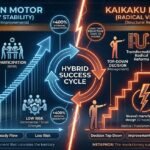
- The Japanese Triad: Leading organizations master three pillars: Kaizen (daily stability), Kaikaku (structural reform), and Kakushin (disruptive product or business model innovation). To ignore one is to stifle growth.
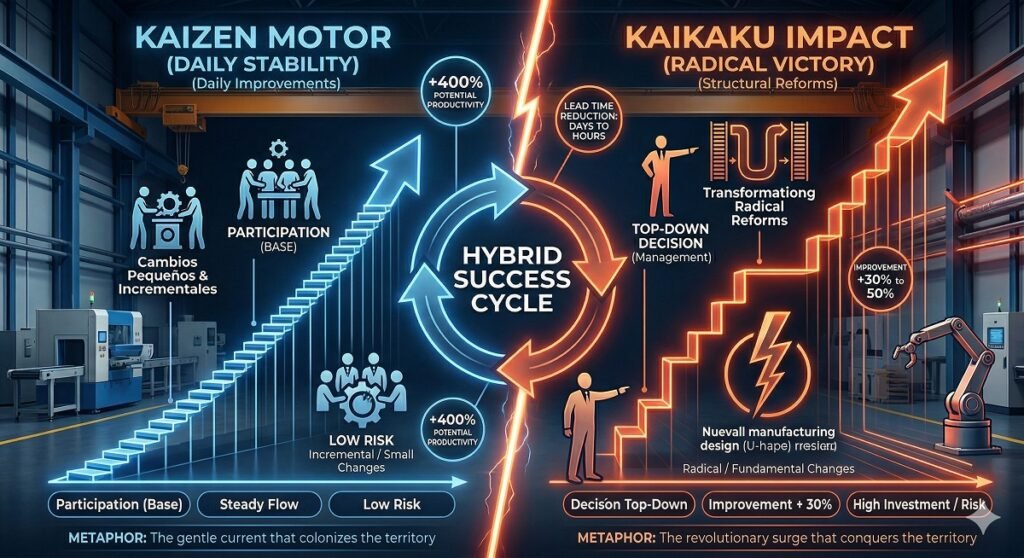
- The Victory Cycle: Kaikaku is deployed to conquer a “new peak” of efficiency. Once this new standard is established, Kaizen intervenes to stabilize and refine it. Kaikaku sets the benchmark; Kaizen sustains it.
- Unwavering Leadership: The primary threat is cultural resistance. Success demands a leadership team willing to tolerate initial operational chaos in exchange for long-term record gains. Without top-down backing, the project is destined to fail.
What is Kaikaku? Meaning and Philosophy
The Japanese term Kaikaku (改革) literally translates to “radical change” or “reform.” Within the Lean Manufacturing ecosystem, this concept represents a deliberate break from the status quo to establish a completely new operating system. While Kaizen functions as a steady stream of incremental improvements, Kaikaku is the disruptive force that dismantles obsolete processes to rebuild efficiency from its foundations.
Definition and Strategic Scope
Unlike other optimization methodologies, Kaikaku does not seek to polish a flawed process but rather to replace it with a superior one. This effort is typically executed over a period of 60 to 180 days, achieving performance gains between 30% and 50%. According to academic literature, this phenomenon is defined through two key perspectives:
- Innovation and Aggressive Goals: Gåsvaer and von Axelson (2011) describe it as a process that demands ambitious targets and innovative thinking to facilitate radical change.
- Operational Transition: Shirai et al. (2011) define it as the comprehensive transformation required to mobilize a corporation from its current operating state (“AS-IS”) toward an ideal future state (“TO-BE”).
For Yamamoto (2017), Kaikaku serves a dual purpose: reaching critical performance metrics upon completion while simultaneously strengthening the organization’s capacity for both the exploration of new opportunities and the exploitation of its current resources.
The Origin of the Concept
Although popularised by the Toyota Production System (TPS), its formal structure is attributed to experts such as Hiroyuki Hirano. He contended that true competitiveness does not emanate solely from small steps; it requires technological and organisational “quantum leaps.” In line with this, Jebbouri et al. (2026) note that within the TPS, Kaikaku is a revolutionary process that fundamentally transforms the logic, roles, and internal mechanisms of manufacturing.
The Japanese Triad of Continuous Improvement: Kaizen, Kaikaku, and Kakushin
To master Lean Management, it is essential to place Kaikaku within its natural context alongside its sister concepts. Although frequently conflated, their scopes are drastically different. Yamamoto (2017) notes that, in the Japanese corporate environment, Kaikaku (radical reform) is often intertwined with Kakushin (innovation).
Furthermore, Yücel and Oskaloğlu (n.d.) emphasise that these three approaches are complementary and vital for sustainable development. A truly competitive and “Lean” organisation must execute this triad in tandem; focusing on a single pillar is insufficient for long-term success.
Kaizen: The Vital Element (Continuous Improvement)
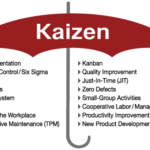
Derived from the Japanese Kai (change) and Zen (good), Kaizen represents the philosophy of “change for the better” through small, incremental steps.
- Focus: Centers on existing processes in the short term. It is a daily, bottom-up activity involving everyone from shop-floor operators to management.
- Impact: Requires low financial investment and carries minimal risk. Its success lies in cumulative efficiency and the systematic elimination of waste (muda).
Kaikaku: The Structural Leap (Radical Change)
This is the “elder brother” of Kaizen. While the former is a gentle stream, Kaikaku is a tidal wave that transforms the operational landscape within weeks or months.
- Focus: Seeks drastic performance improvements (30% to 50%) through the reengineering of production systems or the adoption of new technologies. It is driven top-down.
- Impact: Involves moderate risk and considerable capital investment, focusing on specific, disruptive projects.
Kakushin: The Paradigm Shift (Disruptive Innovation)
Kakushin goes a step beyond operational efficiency: it focuses on what we manufacture or how we sell it.
- Focus: The creation of something entirely new from scratch. If Kaikaku improves the assembly line, Kakushin revolutionises the business model (e.g., the transition from physical software to the SaaS model).
- Impact: The highest-risk and highest-cost strategy, driven exclusively by senior leadership. Its primary resources are intellect and creativity, with long-term projected results (5+ year cycles).
Strategic Comparison for Senior Management
The following table synthesises the critical differences between the three pillars to facilitate executive decision-making:
| Feature | Kaizen | Kaikaku | Kakushin |
| Nature | Incremental / Evolutionary | Radical / Structural | Disruptive / Breakthrough |
| Initiative | Bottom-up (Staff) | Top-down (Management) | Strategic (Board/Executive) |
| Timeframe | Daily / Continuous | 2 to 6 months | Long-term (5+ years) |
| Focus | People and habits | Processes and systems | Business model / R&D |
| Risk | Low | Moderate / High | Very High |
| Tools | 5S, SMED, Poka-Yoke | 3P Design, Reengineering | R&D, Product Design, AI |
The Paradox of Change: While Kaikaku focuses on optimising the “how” (the manufacturing process), Kakushin redefines the “what” (the product or service). A company that automates its plant performs Kaikaku; one that reinvents its industry through innovation performs Kakushin.
Kaizen vs. Kaikaku: When to Choose Each Strategy?
In Lean management, the pivotal question is not which method is superior, but rather when to apply each one. A healthy organisation does not choose between them; instead, it utilises them cyclically to prevent stagnation.
Selection Criteria
- Implement Kaizen when: The current process is functional but contains waste (muda), employees have proposals to optimise their daily routines, and the primary goal is operational stability.
- Implement Kaikaku when: The system has reached its theoretical efficiency limit, a disruptive technology is introduced, or the company requires cost and lead-time reductions of 30% to 50% to maintain its competitiveness.
Synergy and Complementarity: The Cycle of Success
According to Walentynowicz (2023), true Continuous Improvement is not limited to incrementalism; it requires the application of both approaches depending on the nature of the problem. This duality manifests in three critical dimensions:
- Directionality and Culture: Per Çelik (2020), Kaizen flows bottom-up, drawing on collective creativity and requiring time to take root culturally. In contrast, Kaikaku is a top-down directive, decided by senior management to achieve an immediate leap in efficiency.
- Scope and Goals: Yamamoto (2017) highlights that Kaikaku is a discrete effort with a defined timeframe, designed to achieve extremely ambitious targets, such as doubling productivity or halving response times.
- Temporality: While Kaizen is a permanent daily activity, Kaikaku has a short “shelf life,” executed under a specific project structure with a clear beginning and end (Kostić, 2023).
The Golden Rule: The Leap and the Polish
The strategic relationship between both methods is chronological: Kaikaku breaks the mold, and Kaizen perfects it.
- Kaikaku establishes the new standard: By breaking traditional norms, it generates a new baseline of operational excellence. However, this radical shift often requires a prior foundation; Gåsvaer and von Axelson (2012) warn that Kaizen routines must be well-established before attempting a profound leap.
- Kaizen sustains the evolution: Once the system is redesigned, teams use Kaizen to perform the daily adjustments that ensure the long-term sustainability of the benefits.
As concluded by Alshamary and Ramzi (2024), a mutual dependency exists: without the discipline of Kaizen, Kaikaku is unsustainable; and without the disruption of Kaikaku, Kaizen risks stagnating in marginal improvements.
In summary: Kaikaku creates the new high-level standard, while Kaizen is responsible for maintaining and refining it until the market demands the next great leap.
Types of Kaikaku Projects: The Yamamoto Matrix
To successfully implement radical change, identifying the scope of the transformation is vital. According to Gåsvaer and von Axelson (2011), the Yamamoto model classifies Kaikaku into four strategic categories based on two critical dimensions:
- The Area of Change: Determines whether the modification is structural (technology and equipment) or infrastructural (systems and methods).
- The Level of Innovation: Defines whether the change is incrementally innovative (adaptation of the existing) or radically innovative (creation of the unprecedented).
Classification of the Four Kaikaku Types
The following details the four typologies resulting from this combination:
Type I: Structural and Incremental Change
Occurs when the organization adopts standard or “off-the-shelf” technical solutions. These are industry-proven technologies that are new to the company.
- Example: Incorporating conventional robotic automation arms into a manual assembly line.
Type II: Infrastructural and Incremental Change
Occurs when adopting methodological frameworks or organizational solutions that are already global standards but are being applied within the firm for the first time.
- Example: Corporate-wide deployment of initiatives such as Lean Production, Six Sigma, or TPM (Total Productive Maintenance).
Type III: Structural and Radical Change
Positioned “beyond the state of the art.” At this level, the introduced production technologies are disruptive and pioneering, not only for the factory but for the entire global industry.
- Example: Implementation of a manufacturing system using nanotechnology or advanced materials not yet mass-commercialized.
Type IV: Infrastructural and Radical Change
Represents absolute innovation in workflow design. It consists of creating unprecedented operating methods that break established paradigms within the sector.
- Example: The original design of the Toyota Production System, which redefined global manufacturing logic.
Visual Summary: Kaikaku Innovation Matrix
| Dimension | Incremental (Industry Standard) | Radical (Beyond the State of the Art) |
| Structural (Equipment/Tech) | Type I: Standard solutions new to the firm. | Type III: Globally disruptive technology. |
| Infrastructural (Systems/Methods) | Type II: Adoption of Lean, Six Sigma, or TPM. | Type IV: New paradigms of flow and labor. |
The 10 Commandments of Kaikaku: Hiroyuki Hirano’s Manifesto
Hiroyuki Hirano’s precepts dictate that Kaikaku must be executed with creativity, not capital. His philosophy prioritizes abandoning preconceived notions and acting with agility, under the premise that true knowledge is born from difficulty and ingenuity, rather than massive investment.
Implementing radical change is not a task for the faint of heart. These ten fundamental rules serve as a strategic compass for any Kaikaku Management project:
- Abandon Traditional Paradigms: Forget the “we’ve always done it this way” mentality. The past must not dictate the future of your production.
- Focus on Feasibility, Not Obstacles: Think about how the new method will work, instead of searching for reasons why it might fail. Maintain a mindset of possibility.
- Zero Tolerance for Excuses: The argument that “things are different here” is the greatest enemy of organizational progress.
- Prioritize Action Over Perfection: A 50% change executed today is infinitely superior to a 100% solution that is never implemented.
- Immediate Correction: If you detect an error in the new design, fix it on the spot. Agility is the foundation of transformation.
- Ingenuity Before Capital: Hirano’s most disruptive point. He advocates for using process engineering and creativity before resorting to expensive purchases.
- Problems are Intellectual Opportunities: Resource scarcity sharpens the mind. Use difficulties as fuel for innovation.
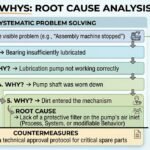
- Apply the “5 Whys” Technique: Do not redesign at the surface level; dig deep until you find the root cause of every inefficiency.
- Foster Collective Intelligence: Ten ideas from ten different people will always outperform the “genius idea” of a single individual.
- Kaikaku is an Infinite Cycle: Radical transformation has no final finish line. Once a new operational peak is reached, it is time to prepare for the next great leap.
Implementation Methodology: The 3P Framework and Phases of Change
According to Shirai et al. (2011), the transition toward a new business model through Kaikaku is a “high-risk, high-reward” endeavor. The success of this transformation hinges on three fundamental pillars:
- Diagnosis and Vision: Developing a precise profile of the current situation versus the target innovation.
- Project Architecture (3S Model): Comprehensively visualizing the Scheme, System, and Service.
- Resource Optimization: Ensuring efficient capital allocation and strategic external collaboration.
The following is the structured guide for executing radical change, integrating the 3P Framework and global best practices:
Phase 1: Preparation and Disruptive Mindset
Before modifying any process, it is imperative to align the organizational culture:
- Senior Management Leadership: Kaikaku must be driven from the top. A core team of specialists and engineers is required to coordinate the change (Walentynowicz, 2023).
- Adoption of the 10 Commandments: The team must reject the status quo. As Hirano proposed, creativity must be prioritized over spending, accepting an immediate 50% implementation over delayed perfection.
- Human Change Management: Resistance is natural. Yamamoto (2017) underscores that the entire organization—not just R&D—must adopt a stance of continuous exploration and training.
Phase 2: Strategic Analysis and Planning (3P Framework)
Planning may take months, but execution must be surgical. According to Alshamary and Ramzi (2024), this phase minimizes uncertainty through data rigor.
- Aggressive Goals: It is vital to establish targets that challenge current limits to achieve critical performance gains (Gåsvaer & von Axelson, 2011).
- Production and Preparation (P1 & P2): Value delivery must be completely rethought, designing new workflows and gathering the necessary logistics to avoid prolonged operational disruptions.
Phase 3: Radical Execution
The core of Kaikaku is rapid disruption, not leisurely evolution.
- Speed and Scale: Projects typically last an average of 120 days. In industrial environments, dramatic transformations can even be executed over a single weekend to minimize downtime.
- The Gradualism Trap: In Agile methodologies or software development, introducing changes piecemeal often extends chaos. It is more effective to implement the new ecosystem comprehensively to reach equilibrium quickly.
- Process (P3): Once the change is executed, new flows must be tested and optimized in real-time to ensure KPI compliance.
Phase 4: Monitoring and Transition to Kaizen
Success is consolidated when innovation becomes the new standard:
- Results Audit: Centralized platforms should be used to verify efficiency leaps of 30% to 50%.
- The Handover to Kaizen: Kaikaku builds the new peak; Kaizen is responsible for inhabiting it. Once the robust new baseline is established, employees are empowered to make the daily adjustments that keep the system in a state of constant improvement.
Benefits and Challenges of Radical Change
Implementing Kaikaku is a “high-risk, high-reward” decision. For management to make informed choices, it is crucial to weigh its spectacular impact against the operational barriers it presents.
Strategic Advantages (Pros)
- Disruptive Performance Leaps: The objective is to achieve productivity increments between 30% and 50%, or even higher (Gåsvaer & von Axelson, 2011). Yamamoto (2017) reports extreme cases with increases of up to 400% and production time reductions to one-twentieth (1/20).
- Agility in the Face of Crisis: Unlike gradual progress, Kaikaku allows for rapid responses to market crises or the promotion of critical initiatives within short periods (Yücel & Oskaloğlu, n.d.).
- Cultural and Motivational Evolution: Beyond metrics, it generates qualitative change. It transforms conservative employees into proactive individuals, fostering a sense of belonging and enhancing management’s innovation skills (Özgünaltay et al., 2025; Yamamoto, 2017).
- Long-Term Competitiveness: By breaking the status quo and introducing new technologies and strategies, organizations achieve structural reforms that modernize their business models (Piyatilake et al., 2022).
Challenges and Barriers (Cons)
- Vulnerability and Investment: It requires a significant capital injection into technology and facility redesign. As a radical bet, there is a real probability of failure if execution is not flawless (Gåsvaer & von Axelson, 2012).
- The Conservatism Paradox: Ironically, a culture deeply rooted in Kaizen (low risk and iterative efficiency) can act as a brake on Kaikaku, restricting the capacity for necessary radical innovation (Gåsvaer & von Axelson, 2011).
- Initial Instability: Jebbouri et al. (2026) warn that radical transformations can destabilize existing systems before showing results, potentially even temporarily amplifying waste such as defects or waiting times.
- Resistance to Change: Given that it is driven top-down, it can generate friction with operational staff if there is a lack of transparent communication.
- Dependence on Kaizen for Sustainability: Kaikaku alone is not self-sufficient. Without a subsequent continuous effort (Kaizen) to stabilize the new standard, the benefits tend to diminish over time (Gåsvaer & von Axelson, 2012).
Impact Summary
| Factor | Kaikaku Impact | Critical Requirement |
| Productivity | 30% to 400% increase | Rigorous KPI measurement |
| Cycle Time | Reduction up to 1/20 | Prior logistical planning |
| Culture | From conservative to proactive | Participatory leadership |
| Risk | High (Systemic disruption) | Data-driven mitigation |
Kaikaku in Action: Practical Examples of Transformation
To understand the power of radical change, it is necessary to contrast its results with the incremental improvements of Kaizen. Below are two scenarios where Kaikaku redefined operational standards.
Case 1: From Assembly Lines to Manufacturing Cells
Imagine an electronic components plant with a production line based on conveyor belts. Work-in-Process (WIP) inventory is critical, and the lead time is 10 days.
- Kaizen Action (Incremental): Reducing the tool changeover time on a machine from 20 to 15 minutes. This is a valuable improvement, but it maintains the current structure.
- Kaikaku Action (Radical): Completely dismantling the conveyor belt line and replacing it with U-shaped manufacturing cells. In this design, workers are multi-skilled, and the product is moved manually between stations.
- The Result: Within just one month of implementation, WIP inventory drops by 80%, and the lead time is drastically reduced from 10 days to 2 days.
Case 2: The 2K5S Framework in the Agricultural Sector
The versatility of Kaikaku transcends the factory floor. Moi and Sing (2021) documented the implementation of the 2K5S operational framework (Kaizen, Kaikaku, and 5S) on a pineapple plantation, achieving an unprecedented synthesis of efficiency.
- The Intervention: Improvements in workflow steps (Kaizen) were combined with the introduction of new cultivation technology that required capital investment (Kaikaku), all under a strict culture of order (5S).
- The Strategic Result: The standard time to complete a planting cycle was reduced by 62.5%.
This case demonstrates that smart investment in technology (Kaikaku), when supported by a foundation of discipline and continuous improvement, generates exponential results even in biological and variable sectors like agriculture.
Why Do Kaikaku Projects Fail?
Despite its high potential, the failure rate is considerable if human and strategic factors are not managed effectively. Kaikaku is a top-down change that demands unwavering leadership.
- Cultural Resistance: This is the primary cause of collapse. If the team is not aligned with the disruptive vision, the inertia of the past will stall execution.
- Intolerance for Initial Chaos: Every radical change generates a learning curve that may temporarily reduce efficiency. If management is unwilling to tolerate two weeks of low productivity in exchange for a year of record gains, Kaikaku will perish before day 30.
- Lack of Post-Implementation Support: As we have analyzed, Kaikaku creates the standard, but Kaizen maintains it. Without a transition plan, results will evaporate.
Warning: The success of Kaikaku depends on the firmness of leadership in the face of initial destabilization and the organization’s ability to sustain the new performance level through daily discipline.
Conclusion: The Future is Hybrid
In the ecosystem of operational excellence, success does not lie in choosing between Kaizen or Kaikaku, but in the mastery of their strategic alternation. Global giants such as Toyota, Amazon, and Tesla have demonstrated that competitiveness is built under a hybrid model: they utilize Kaikaku to execute quantum leaps and conquer new territories of efficiency, subsequently employing Kaizen to “colonize” that standard, ensuring not a single millimeter of ground is ceded to waste (muda).
If your organization is ready to evolve, the premise is clear: Kaizen guarantees stability, but Kaikaku ensures victory. Continuous improvement is the engine of the day-to-day, but radical transformation is the fuel for long-term relevance. In a market that does not wait, the question is not whether change is necessary, but rather: Is your leadership prepared for the first great radical leap?
Kaikaku and Radical Transformation: Frequently Asked Questions (FAQ)
What is the primary difference between Kaizen and Kaikaku?
The difference lies in the magnitude and pace of change. While Kaizen focuses on incremental, steady, and low-risk improvements (small steps), Kaikaku centers on a radical and disruptive reengineering of the system over a short period to achieve productivity leaps of 30% to 50%.
How long does the implementation of a Kaikaku project take?
A standard Kaikaku project has a critical execution window of between 60 and 180 days, with an industrial average of 120 days. However, the physical transformation actions—such as machinery relocation—can occur during intensive events lasting only a few days or a single weekend.
Is it necessary to have a Kaizen culture before applying Kaikaku?
Yes. According to experts such as Gåsvaer and von Axelson, it is fundamental that continuous improvement (Kaizen) routines are already established. Kaikaku creates a new, elevated standard, but the discipline of Kaizen is required to sustain those results and prevent the system from degrading back toward its previous inefficiencies.
Why is Kaikaku considered a “Top-Down” strategy?
Unlike Kaizen, which originates from the operators toward management (Bottom-Up), Kaikaku requires strategic decisions, large investments, and a global vision of the business. Consequently, it must be directly driven and supported by senior leadership to guarantee resources and overcome resistance to change.
What is the 3P Framework in the context of Kaikaku?
The 3P Framework refers to the three pillars of implementation:
– Production: Redesigning how value is created.
– Preparation: Planning the logistics and resources necessary for the transition.
– Process: Testing and optimizing the new system in real-time following execution.
What are the greatest risks of radical change?
The primary risk is cultural collapse. Employee resistance and management’s intolerance of initial operational instability can cause the project to fail within the first 30 days. Furthermore, it requires a significantly higher financial investment than Kaizen.
References
Alshamary, M. H., & Ramzi, A. (2024). Kaizen as a Form of Lean Management to Improve Human Performance in the Organization. South Asian Res J Bus Manag, 6(5), 294-304.
Çelik, H. (2020). Süreç iyileştirmede kaizen ve kaikaku uygulamasi. Avrasya Sosyal ve Ekonomi Araştırmaları Dergisi, 7(4), 245-259.
Gåsvaer, D., & von Axelson, J. (2011). Towards a methodology for Kaikaku realization. In Proceedings of the 4th International Swedish Production Symposium, Lund, Sweden.
Gåsvaer, D., & von Axelson, J. (2012, September). Kaikaku-Radical improvement in production. In International Conference on Operations and Maintenance, Singapore (pp. 37-47).
Helmold, M., Küçük Yılmaz, A., Flouris, T., Winner, T., Cvetkoska, V., Dathe, T. (2022). Kaizen (改善), Kaikaku (改革) and Innovation Management. In: Lean Management, Kaizen, Kata and Keiretsu. Management for Professionals. Springer, Cham. https://doi.org/10.1007/978-3-031-10104-5_2
Jebbouri, H., Chafi, A., & Kammouri Alami, S. (2026). Additive Manufacturing as an Enabler of Lean Construction: A Systematic Literature Review. Buildings, 16(4), 880.
Kostić, M. (2023). UNAPREĐENJE LOGISTIČKOG PROCESA SKLADIŠTENJA PREDUZEĆA 3S INVEST PRIMENOM SAVREMENIH TEHNIKA. Zbornik radova Fakulteta tehničkih nauka u Novom Sadu, 38(02), 223-226.
Moi, W. A., & Sing, S. H. (2021). Application of Toyota way incorporating kaizen, Kaikaku and 5S in agricultural sector. International Journal for Research in Applied Science and Engineering Technology, 9(10), 1565-1579.
Özgünaltay Ertuğrul, G., Aygün, İ., & Urkan, E. (2025). A study examining the potential of the 5S methodology for improving efficiency in agricultural production processes. Turkish Journal of Agriculture – Food Science and Technology, 13(3), 587-593. https://doi.org/10.24925/turjaf.v13i3.587-593.7503
Piyatilake, A., Vitharanage, I. D., Thibbotuwawa, A., & Perera, H. N. (2022). Benefits of supply chain process improvement initiatives: a structured literature review. Journal of South Asian Logistics and Transport, 2(1).
Shirai K., I. Koshijima and T. Umeda. 2011. “Technology and human resource management methodology in “Kaikaku” (corporate innovation) program,” First International Technology Management Conference, San Jose, CA, USA, 2011, pp. 516-521, doi: 10.1109/ITMC.2011.5996021.
Walentynowicz, P. (2023). System i proces Continuous Improvement w przedsiębiorstwie. Zeszyty Naukowe Politechniki Częstochowskiej. Zarządzanie, (52), 133-148. https://doi.org/10.17512/znpcz.2023.4.10
Yamamoto, Y. (2017). Kaikaku in Production in Japan: An Analysis of Kaikaku in Terms of Ambidexterity. In: Backström, T., Fundin, A., Johansson, P. (eds) Innovative Quality Improvements in Operations. International Series in Operations Research & Management Science, vol 255. Springer, Cham. https://doi.org/10.1007/978-3-319-55985-8_5
Yücel, M. M., & Oskaloğlu, E. (s.f.). Süreç i̇yileştirmede deği̇şi̇mi̇n üç yüzü: Kaizen, Kaikaku, Kakushin. Ponencia presentada en la 7th International Mardin Artuklu Scientific Researches Conference.

Editor and founder of “Innovar o Morir” (‘Innovate or Die’). Milthon holds a Master’s degree in Science and Innovation Management from the Polytechnic University of Valencia, with postgraduate diplomas in Business Innovation (UPV) and Market-Oriented Innovation Management (UPCH-Universitat Leipzig). He has practical experience in innovation management, having led the Fisheries Innovation Unit of the National Program for Innovation in Fisheries and Aquaculture (PNIPA) and worked as a consultant on open innovation diagnostics and technology watch. He firmly believes in the power of innovation and creativity as drivers of change and development.