In today’s complex industrial ecosystem—where high-pressure chemical processes, automated systems, and hazardous material handling converge—safety transcends being a mere option to become the fundamental pillar of business continuity. Among the most robust methodologies for ensuring such integrity, the HAZOP (Hazard and Operability Study) stands out.
This systemic and qualitative engineering technique is designed to identify hazards and operability issues within intricate industrial processes. By employing ‘guide words,’ a HAZOP analysis detects deviations in critical variables such as flow, pressure, and temperature, thereby ensuring functional safety and regulatory compliance. As noted by Zhang et al. (2023), this method is a global benchmark in risk analysis, establishing itself as an essential tool for accident prevention in the petrochemical sector (Wang & Gu, 2022).
Due to its capacity for systematically reviewing the causes and consequences of any anomalous deviation within chemical facilities, HAZOP is currently the most widely utilized risk assessment method in the industry (Jung et al., 2025). This technical article delves into its methodology, applications, and differentiation from other systems such as FMEA or LOPA, demonstrating how its correct implementation averts industrial disasters while optimizing operational efficiency.
Key Insights: Everything You Must Know About HAZOP
- Focus on Deviations: Unlike other methodologies, HAZOP does not merely seek component failures; it analyzes the consequences when process variables (pressure, flow, temperature) deviate from their original design intent.
- Mandatory Multidisciplinarity: The study’s success relies on the synergy between design engineers and field operators. Theoretical knowledge must be validated through real-world operational experience.
- The Golden Rule (IEC 61882): For a HAZOP to maintain international validity and comply with OSHA or Seveso regulations, it must adhere to the standardized principles of the IEC 61882 norm.
- Precursor to LOPA Analysis: HAZOP serves as the qualitative starting point. If risks are deemed high, a transition to a LOPA (Layer of Protection Analysis) is required to technically define the SIL (Safety Integrity Level) for electronic protections.
- Digital Evolution and AI: The future of industrial safety lies in “AI-assisted HAZOPs.” Although modern Large Language Models (LLMs) now achieve 86% accuracy in risk identification, human judgment remains the final safety filter.
What is a HAZOP Study? Definition and Corporate Purpose
The acronym HAZOP stands for Hazard and Operability Study. It is defined as a systematic and structured process risk identification technique, designed to examine complex operations with a dual objective: safeguarding the integrity of personnel and the environment, and detecting operability issues that could compromise production continuity.
According to Dunjó et al. (2010), HAZOP consists of the application of a formal and critical examination of engineering intentions in both new and existing facilities. Its purpose is to evaluate the potential for individual equipment malfunctions and the domino effect that such failures could trigger across the entire plant.
The Two Pillars of the Technique: Hazard & Operability
The name of the methodology reflects its comprehensive scope:
- Hazard: Exhaustive identification of any source of potential harm, injury, property damage, or negative environmental impacts.
- Operability: Detection of technical issues that, while not necessarily dangerous, impede efficient process performance (e.g., unscheduled downtime, quality loss, or bottlenecks).
Primary Objectives of the Analysis
Unlike other methods focused solely on component failures, the HAZOP study anticipates “deviations” from the original design intent. It does not merely foresee a valve failure but questions critical scenarios: What happens if the flow exceeds parameters? or What occurs in the event of human error?
In this regard, Rossing et al. (2010) emphasize that the central goal is to validate whether facilities possess sufficient control and safety features to mitigate deviations during startup, normal operation, shutdown, and maintenance. Furthermore, Johnson (2026) highlights that these studies are essential collaborative reviews to determine points of vulnerability and establish corrective actions that reduce risk to As Low As Reasonably Practicable (ALARP) levels.
Fundamentals of HAZOP Analysis
To understand the scope of a HAZOP, it is imperative to break down its essential components:
- The Multidisciplinary Team: This is not an individual task; it requires a facilitator (HAZOP Chair/Leader), a scribe, and experts in process, instrumentation, and maintenance.
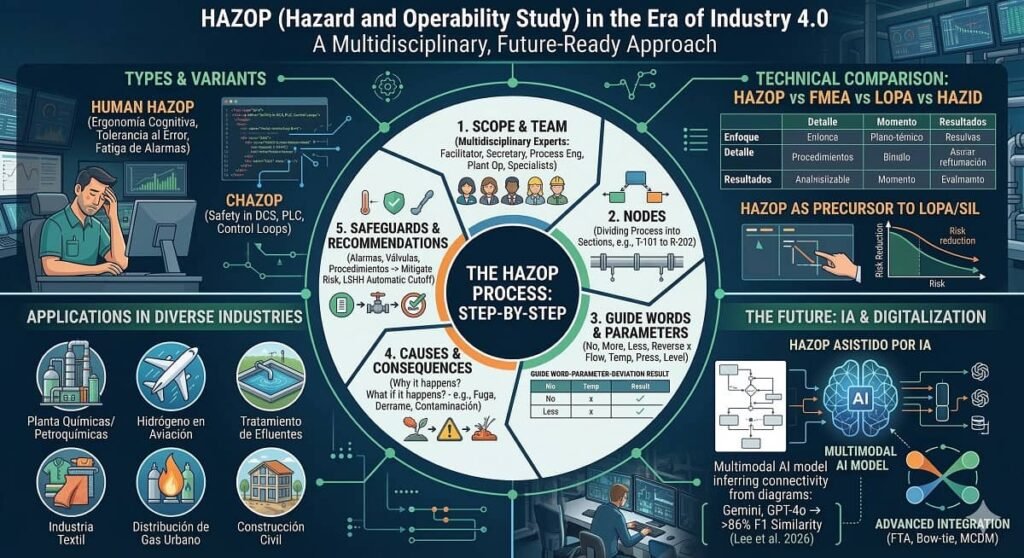
- Study Nodes: The process is segmented into manageable sections or “nodes” (e.g., a pump suction line).
- Guide Words: Terms such as “More,” “Less,” “No,” or “Reverse” act as catalysts to identify potential failures.
Historical Perspective: From ICI to IEC 61882
The technique was developed by the Heavy Organic Chemicals division of Imperial Chemical Industries (ICI) in the United Kingdom during the 1960s. Under the leadership of Dr. Trevor Kletz, what began as a conventional safety review transformed into a formalized discipline. Currently, the practice is governed globally under the IEC 61882 international standard, which dictates the principles and technical application guidelines for modern industry.
HAZOP Methodology: Step-by-Step Process Execution
The HAZOP methodology is distinguished by its rigor, grounded in the directed creativity of a multidisciplinary team. Far from being automated software, it represents a structured group dynamic that has established itself as the “gold standard” in Process Hazard Analysis (PHA).
This process is executed across five critical phases: scope definition, process segmentation, application of guide words, deviation identification, and safeguards evaluation. In this regard, Braarud and Simensen (2025) emphasize that the choice between a rigid or flexible application of the method directly impacts the team’s ability to identify complex risks.
Scope Definition and Team Formation
The study’s success depends on the competence of the working group. A typical HAZOP team must be balanced and include:
- Leader / Facilitator: An expert in the technique whose independence from the original design ensures objectivity.
- Scribe/Secretary: Responsible for real-time technical documentation using matrices or specialized software.
- Process Engineer: Guardian of the technical design and operational intent.
- Plant Operator: Provides a pragmatic “field” perspective, vital for detecting non-theoretical operational risks.
- Additional Specialists: Experts in maintenance, instrumentation, or chemical safety.
As noted by Braarud and Simensen (2025), the analyst’s behavior and team synergy are decisive factors in the technical quality of the results.
Process Segmentation into “Study Nodes”
Due to the magnitude of industrial processes, the system is divided into nodes: specific sections with a defined design intent (e.g., “Ammonia transfer line from tank T-101 to reactor R-202”).
Application of “Guide Words” and Parameters
This is the core of the process. For each node, the team crosses a process parameter with a guide word to generate failure scenarios:
| Guide Word | Parameter | Resulting Deviation | Potential Risk |
| More | Flow | Excess flow | Overpressure or overflow |
| Less | Temperature | Low temperature | Freezing or metal embrittlement |
| Reverse | Flow | Backflow | Contamination or line backflow |
| No | Pressure | Loss of pressure | Total vacuum or seal failure |
Identification of Deviations, Causes, and Consequences
For every detected deviation (e.g., “More Pressure”), the team conducts a causality analysis:
- Causes: Why did it occur? (Valve failure, human error, loss of utilities).
- Consequences: What impact would it have? (Pipe rupture, toxic gas release).
Evaluation of Safeguards and Recommendations
Finally, risks are weighed against existing safeguards (alarms, relief valves, protocols). If the residual risk is deemed unacceptable, the team issues a mandatory technical recommendation to mitigate the hazard and optimize plant safety.
HAZOP Types and Specialized Variants: The Evolution of the Technique
Although the classic HAZOP study originated for continuous chemical processes, the technique has evolved into specialized variants that address the new frontiers of industrial complexity.
Process HAZOP: Continuous vs. Batch
Application varies significantly depending on the operational model:
- Continuous Processes: Common in refineries, where stability allows for linear and constant nodulization.
- Batch Processes: Typical in the pharmaceutical and fine chemical industries. These require a dynamic analysis of sequencing and timing, as risks fluctuate according to the specific stage of the operating cycle.
Human HAZOP: Integrating Cognitive Ergonomics
Human error represents one of the most significant gaps in industrial safety. Human HAZOP focuses on how personnel perceptions, decisions, and actions can induce critical deviations.
Beyond merely assigning responsibility, this variant seeks to determine if the system is “error-tolerant.” It analyzes factors such as fatigue, Human-Machine Interface (HMI) design, and “inattentional blindness.” A key example is alarm fatigue: if an operator constantly deals with irrelevant acoustic signals, they will eventually ignore them. Human HAZOP identifies these scenarios to redesign protocols that reduce the worker’s cognitive load.
CHAZOP (Computer HAZOP): Safety in Control Systems
In the era of Industry 4.0, vulnerabilities are not exclusively mechanical. CHAZOP analyzes Distributed Control Systems (DCS), Programmable Logic Controllers (PLC), and management software. It evaluates critical scenarios, such as the loss of instrumentation signals or control loop failures, ensuring that the digital architecture is as robust as the physical one.
HAZOP in the Project Lifecycle
The timing of the study is a decisive factor in its effectiveness:
- Re-validation HAZOP: Conducted periodically (every 5 years under standards such as OSHA) for existing facilities. Its purpose is to ensure that operational modifications or asset aging have not introduced new or overlooked risks.
- Design HAZOP: Executed during detailed engineering. Its objective is to rectify vulnerabilities prior to construction, optimizing costs and avoiding expensive retrofits later on.
Practical Example of HAZOP Analysis: Real-World Case Study
To illustrate the operability of this methodology, we will analyze a common scenario: a fluid transfer system from a tank truck to an industrial storage tank.
- Node 1: Loading line from external tanker to Storage Tank T-01.
- Design Intent: Controlled transfer at 500 l/min at ambient temperature under leak-tight conditions.
HAZOP Matrix (Technical Abstract)
| Tank T-01 overflow with an imminent risk of spill and environmental contamination. | Potential Causes | Identified Consequences | Existing Safeguards | Proposed Recommendations |
| High Flow | Transfer pump failure; control valve stuck in the open position. | Tank T-01 is overflowing with an imminent risk of spill and environmental contamination. | High-Level Alarm (LAH) on the control panel. | Implement an independent High-High Level Switch (LSHH) for automatic shutdown. |
| No Flow | Physical blockage in the pipeline; operational error due to closed inlet valve. | Critical damage due to pump cavitation and unscheduled production downtime. | Local pressure gauge and manual verification protocols. | Install a flow sensor with dry-run protection for the pump motor. |
| High Temperature | Prolonged exposure of the tanker to solar radiation; fluid out of specification. | Risk of unforeseen exothermic reaction or material degradation within the tank. | Temperature sensor with digital indicator. | Conduct a material compatibility study and evaluate tank thermal insulation. |
This HAZOP example demonstrates the technique’s unique ability to force the identification of critical scenarios that often go unnoticed during conventional design reviews. The methodology does not merely detect the failure; it prescribes the necessary technical solution to ensure operational resilience.
Multidisciplinary Applications of HAZOP in Global Industry
The versatility of the HAZOP study has facilitated its expansion beyond conventional chemical processes, adapting to sectors where operational complexity demands absolute precision. Below are success stories and recent studies validating its effectiveness:
Sustainability and Water Treatment
In Effluent Treatment Plants (ETP), the use of HAZOP has proven fundamental in anticipating operational failures. Siddiqui et al. (2014) emphasize how this technique enables a meticulous review that not only mitigates risks but also optimizes workflows, fostering environmentally sustainable management.
Vanguard in Aviation and Hydrogen
The energy transition in aviation presents critical safety challenges. Research by Dang et al. (2025) on onboard hydrogen systems confirms that the integrated HAZOP-FDBN framework is highly effective for quantifying risks and modeling failure propagation over time. This methodology provides vital support for design optimization, even in scenarios lacking historical failure data.
Synergy in Chemical Plants: HAZOP + JSA
Combining tools is a growing trend to maximize worker protection. Jung et al. (2025) demonstrated that integrating HAZOP with Job Safety Analysis (JSA) identifies risks that technical analysis alone might overlook. In their study, the use of JSA revealed 37 additional recommendations for cleaning operations that were not initially detected by the standard HAZOP process.
Textile Manufacturing and Urban Gas Distribution
- Textile Industry: Susanto et al. (2022) applied the method in spinning departments, successfully categorizing 17 specific hazards into extreme, high, moderate, and low-risk levels, allowing for more targeted risk control.
- Urban Gas Centers: In residential and commercial environments, Tian et al. (2025) validated a HAZOP-based model that identified 65 potential hazards in a restaurant, outperforming traditional inspection methods’ detection capacity by eightfold.
Innovation in the Construction Industry
Even in the lifting processes of prefabricated buildings, HAZOP is used to analyze unsafe behaviors. Zhu et al. (2022) propose this method as an innovative theoretical basis for reducing incidents during hoisting operations, serving as a crucial reference for decision-making in occupational safety policies.
Technical Comparison: HAZOP vs. FMEA vs. HAZID vs. LOPA
In the field of Process Hazard Analysis (PHA), it is common to confuse the available methodologies. Each tool serves a specific purpose depending on the project phase and the nature of the system.
| Feature | HAZOP | FMEA | HAZID |
| Primary Focus | Deviations in variables (Flow, Pressure). | Failure modes of physical components. | External and site-specific hazards. |
| Level of Detail | High: Based on $P\&ID$ diagrams. | Medium/High: Based on specific equipment. | Low: Conceptual and macro level. |
| Application Phase | Detailed engineering or operational plant. | Product, machinery, or IT design. | Feasibility or pre-design phase. |
| Key Output | Comprehensive risk and operability matrix. | List of failures, effects, and criticality. | Hazard Register. |
HAZOP vs. FMEA: Processes versus Components
Both HAZOP and FMEA (Failure Mode and Effects Analysis) are structured, accessible, and resource-efficient methods (Sun et al., 2022). However, their objectives differ:
- HAZOP: Analyzes deviations from design variables. it is the preferred tool for complex systems involving fluid and energy interactions.
- FMEA: Focuses inductively on individual component failure modes (e.g., motor failure). It is the standard in the manufacturing and automotive industries.
According to Sun et al. (2022), these traditional methods are highly effective for identifying hardware failures resulting from deterioration, such as corrosion or digital system overload. Current trends lean toward integrated frameworks: Zincir and Zincir (2026) successfully applied the HAZOP-FTA-FMECA model to high-pressure ammonia supply systems, demonstrating that a multi-method approach provides a much deeper insight into risk.
HAZOP vs. HAZID: Preliminary Identification
Pioneer Trevor Kletz (1999) already distinguished between selective quantitative assessment (Hazan) and preventive qualitative study (Hazop). In this context:
- HAZID (Hazard Identification): A high-level analysis conducted at the project’s onset to identify macro risks, such as climatic threats or geographic location-related hazards.
- HAZOP: The subsequent, much more meticulous step requires finished, detailed engineering to be executed with precision.
The Link to LOPA Analysis and SIL Levels
In modern safety engineering, HAZOP acts as the precursor to LOPA (Layers of Protection Analysis). While HAZOP is qualitative, LOPA is semi-quantitative.
When a HAZOP identifies a severe risk that cannot be mitigated by basic controls, LOPA is employed to determine the required Safety Integrity Level (SIL) for a Safety Instrumented System (SIS). This transition ensures that electronic protection layers are proportional to the magnitude of the identified hazard.
Advantages and Challenges: The True Balance of Implementing a HAZOP
Although the HAZOP study is globally recognized for its effectiveness, its implementation carries a series of strategic benefits and logistical challenges that every organization must weigh.
Benefits for Safety and Business Continuity
- Drastic Reduction in Accident Rates: Anticipating deviations prevents catastrophic events such as leaks, explosions, and fires. According to Choudhuri et al. (2025), HAZOP can even analyze a company’s Dynamic Safety Management System to develop a Safety Culture Index (SCI), revealing strengths and gaps in risk communication and mitigation.
- Guaranteed Regulatory Compliance: It is a legal pillar in international jurisdictions under standards such as OSHA PSM in the U.S. or the Seveso Directives in the European Union.
- Operational Optimization: By identifying bottlenecks and flow issues before they occur, unscheduled downtime is reduced, thereby improving the plant’s financial performance.
Critical Challenges and Methodological Limitations
Despite being the “gold standard” in Process Hazard Analysis (PHA), the method faces significant barriers:
- Resource and Time Intensity: A rigorous study can span several weeks. Li and Zhao (2025) warn that reliance on manual processes makes the analysis laborious and prone to variability, which can affect the quality of the final reports.
- The Human Factor and Expertise: HAZOP’s effectiveness is directly proportional to the team’s expertise. Mocellin et al. (2022) point out that poor time management or a lack of experience can lead to the omission of critical risks. A common pitfall is attempting to redesign the system during the session instead of focusing on recommending mitigating actions.
- The “Illusion of Completeness”: Since it relies on heuristics (brainstorming) rather than deterministic algorithms, HAZOP can generate a false sense of security. As Mocellin et al. (2022) indicate, the method is vulnerable to compound failures or simultaneous deviations that propagate in complex ways throughout the system.
HAZOP remains the most powerful tool for preventing industrial disasters, provided it is executed by an expert team and its limits are acknowledged. Its value lies not only in the documents generated but in the culture of prevention it establishes within the organization.
Software and Emerging Technologies in HAZOP Management
The evolution of HAZOP has transcended traditional spreadsheets toward specialized digital ecosystems. Today, dedicated software is vital for ensuring traceability and the integration of recommendations throughout the project lifecycle.
Market-Leading Tools
- PHA-Pro (Sphera): Widely considered the industry standard; it allows for linking HAZOP with LOPA analysis and managing the recommendation workflow centrally.
- SafetyCulture: A modern and agile platform, ideal for follow-up audits and studies in environments requiring high mobility.
- Open-PHA®: An accessible and powerful alternative for digitizing safety records.
- LEADER PHA: Specifically designed to optimize the facilitator’s experience during live brainstorming sessions.
Editorial Advice: While using spreadsheets is common due to zero initial cost, adopting specialized software reduces documentation time by 30% and minimizes the risk of losing preventive actions over time.
Integration with Advanced Frameworks
To mitigate subjectivity and the static nature of the method, HAZOP is being integrated with both deductive and inductive techniques. According to Mocellin et al. (2022), tools such as Fault Tree Analysis (FTA), Event Tree Analysis (ETA), and Bow-tie analysis are essential for visualizing event chains and mitigation barriers once a hazard is identified. Furthermore, Banu et al. (2026) propose the use of Multi-Criteria Decision Making (MCDM) methods to scientifically prioritize recommendations in high-risk industries.
The Future: Artificial Intelligence and Multimodal Models
The current frontier of HAZOP lies in Artificial Intelligence. Unlike legacy systems based on keyword matching, modern models can infer process connectivity directly from technical diagrams (Yang et al., 2026).
Recent research by Lee et al. (2026) evaluated the performance of Large Language Models (LLMs) such as Gemini and GPT-4o in HAZOP processes, achieving a similarity score exceeding 86% (F1 score) compared to worksheets prepared by human experts. Nevertheless, Elhosary and Moselhi (2025) warn that while the potential is immense, intelligent systems still need improvement in predicting interconnected countermeasures and accurately categorizing risk levels per node.
Conclusion: The Future of Industrial Risk Management
The HAZOP study remains firmly established as the “gold standard” in process safety worldwide. Today, we are witnessing a significant transformation with the emergence of “AI-assisted HAZOPs”—systems capable of inferring causes and consequences by leveraging vast historical databases of global incidents. This predictive capability promises to elevate prevention to unprecedented levels of precision.
However, the critical judgment and technical expertise of the multidisciplinary team remain irreplaceable components. The implementation of a HAZOP must not be perceived as a mere bureaucratic formality, but rather as a strategic investment in the organization’s resilience and operational integrity.
As demonstrated by Almousa et al. (2025), integrating resilience principles—such as error-tolerant design, early detection, plasticity, and recoverability—into the traditional HAZOP workflow substantially raises safety standards. By adopting this evolutionary approach, industries not only protect their assets and personnel but also ensure their long-term sustainability in an increasingly complex and demanding environment.
Frequently Asked Questions (FAQ) regarding HAZOP Studies
What is the primary difference between HAZOP and FMEA?
While HAZOP focuses on deviations in process variables (such as pressure, flow, or temperature) within systems where fluids and energies interact, FMEA centers on the failure modes of individual physical components (such as the mechanical failure of a pump or a motor). Consequently, HAZOP is systemic in nature, whereas FMEA is component-analytical.
How often should a HAZOP study be revalidated?
According to international standards such as OSHA PSM, it is recommended to perform a HAZOP revalidation every five years. However, an immediate update is required if the facility undergoes significant modifications to its original design or operating conditions, ensuring that no new hazards have been inadvertently introduced.
Who should be part of the multidisciplinary HAZOP team?
For the study to be effective, it must comprise:
– An independent Leader or Facilitator (HAZOP Chair).
– A Scribe (Secretary) for real-time documentation.
– Subject matter experts in process, instrumentation, and maintenance.
– A Plant Operator, who provides practical insight into the day-to-day behavior of the equipment.
What are “Guide Words” in a HAZOP analysis?
Guide Words are standardized terms—such as More, Less, No, or Reverse—that are combined with process parameters to compel the team to envision potential failure scenarios. For instance, pairing the guide word ‘More’ with the parameter ‘Pressure’ enables the analysis of an overpressure scenario within a specific study node.
Can Artificial Intelligence replace the human team in a HAZOP study?
Not entirely. According to recent 2026 studies, while Large Language Models (LLMs) such as Gemini or GPT-4o can identify hazards with 86% accuracy, they cannot still grasp site-specific context and intricate safety interconnections. AI acts as a high-speed assistant, but the final technical judgment remains fundamentally human.
How does HAZOP relate to SIL levels and LOPA analysis?
HAZOP is a qualitative technique used to identify hazards. If a risk with severe consequences is detected, a LOPA (Layers of Protection Analysis) is then conducted to quantify the number of protection layers required. The outcome of the LOPA will ultimately determine the Safety Integrity Level (SIL) required for the Safety Instrumented Functions (SIF).
References
Almousa, A. A., Hoseyni, S. M., & Cordiner, J. (2025).Incorporating resilience into HAZOP to enhance process safety in industrial facilities. Journal of Loss Prevention in the Process Industries, 96, 105630. https://doi.org/10.1016/j.jlp.2025.105630
Banu A., S. M. Hoseyni, and J. Cordiner, “Multi-Criteria Decision-Making Methodologies Applied to Hazard and Operability Studies in High-Hazard Industries.” Quality and Reliability Engineering International42, no. 2 (2026): 774–792. https://doi.org/10.1002/qre.70108
Braarud, P. Ø., & Simensen, J. E. (2025). Analyst behaviour and team processes during hazard analysis: The development of an observation protocol and initial results from evaluating HAZOP sessions. Safety Science, 181, 106694. https://doi.org/10.1016/j.ssci.2024.106694
Choudhuri, S., Krishna, O. B., & Maiti, J. (2025). HAZOP for safety culture: a novel safety culture index. International Journal of Injury Control and Safety Promotion, 32(4), 561–569. https://doi.org/10.1080/17457300.2025.2533199 x
Dang, X., Shao, Y., Liu, H., Yang, Z., Zhong, M., Zhao, H., & Deng, W. (2025). Risk Assessment of Hydrogen-Powered Aircraft: An Integrated HAZOP and Fuzzy Dynamic Bayesian Network Framework. Sensors, 25(10), 3075. https://doi.org/10.3390/s25103075
Dunjó, J., Fthenakis, V., Vílchez, J. A., & Arnaldos, J. (2010). Hazard and operability (HAZOP) analysis. A literature review. Journal of Hazardous Materials, 173(1-3), 19-32. https://doi.org/10.1016/j.jhazmat.2009.08.076 x
Elhosary, E., & Moselhi, O. (2025). Utilization of Artificial Intelligence in HAZOP Studies and Reports. In ISARC. Proceedings of the International Symposium on Automation and Robotics in Construction (Vol. 42, pp. 617-624). IAARC Publications.
Johnson, R.W. (2026). HAZOP Studies . In A Guide to the Automation Body of Knowledge (eds N.P. Sands and I. Verhappen). https://doi.org/10.1002/9781394438105.ch22
Jung, S., Kim, H., & Kang, C. (2025). Efficiency Analysis of the Integrated Application of Hazard Operability (HAZOP) and Job Safety Analysis (JSA) Compared to HAZOP Alone for Preventing Fire and Explosions in Chemical Plants. Processes, 13(1), 88. https://doi.org/10.3390/pr13010088
Kletz, T. (1999). Hazop and Hazan: Identifying and assessing process industry hazards (4.ª ed.). Taylor & Francis Group.
Lee, J., Park, S., Oh, S., & Ma, B. (2026). Can large language models automate the HAZOP process without human intervention? Safety Science, 194, 107039. https://doi.org/10.1016/j.ssci.2025.107039
Li, Z., & Zhao, J. (2025). HAZOPCT: A HAZOP analysis completeness tool based on knowledge graph reasoning. Process Safety and Environmental Protection, 197, 107025. https://doi.org/10.1016/j.psep.2025.107025
Mocellin P., J.De Tommaso, C.Vianello, G.Maschio, T.Saulnier-Bellemare, L. D.Virla, G. S.Patience. 2022. Experimental methods in chemical engineering: Hazard and operability analysis—HAZOP. Can. J. Chem. Eng.2022, 100(12), 3450. https://doi.org/10.1002/cjce.24520
Rossing, N. L., Lind, M., Jensen, N., & Jørgensen, S. B. (2010). A functional HAZOP methodology. Computers & Chemical Engineering, 34(2), 244-253. https://doi.org/10.1016/j.compchemeng.2009.06.028
Siddiqui, D. N., Nandan, A., Sharma, M., & Srivastava, A. (2014). Risk management techniques HAZOP and HAZID study. Int J Occup Health Saf, Fire Environ Allied Sci, 1(1), 5-8.
Sun, L., Li, Y. F., & Zio, E. (2022). Comparison of the HAZOP, FMEA, FRAM, and STPA methods for the hazard analysis of automatic emergency brake systems. ASCE-ASME Journal of Risk and Uncertainty in Engineering Systems, Part B: Mechanical Engineering, 8(3), 031104.
Susanto, N., Azzahra, F., & Putra, A. H. (2022, October). Application of Hazard and Operability Study Methods (HAZOP) to asses and control hazard risk in spinning department using at textile industrial. In IOP Conference Series: Earth and Environmental Science (Vol. 1098, No. 1, p. 012006). IOP Publishing.
Tian B, Li H, Cui X, Hu Z, Zhou Z, Shi W (2025) A HAZOP-based hazard identification model for urban gas accidents: Development and empirical validation. PLoS One 20(10): e0333431. https://doi.org/10.1371/journal.pone.0333431
Wang, F., & Gu, W. (2022). Intelligent HAZOP analysis method based on data mining. Journal of Loss Prevention in the Process Industries, 80, 104911. https://doi.org/10.1016/j.jlp.2022.104911
Yang, H., Kareck, T. L., & Wang, Q. (2026). New era of AI in chemical process safety: Foundation models. ACS Chemical Health & Safety. https://doi.org/10.1021/acs.chas.5c00227
Zhang, H., Zhang, B., & Gao, D. (2023). A new approach of integrating industry prior knowledge for HAZOP interaction. Journal of Loss Prevention in the Process Industries, 82, 105005. https://doi.org/10.1016/j.jlp.2023.105005
Zhu, L., Ma, H., Huang, Y., Liu, X., Xu, X., & Shi, Z. (2022). Analyzing Construction Workers’ Unsafe Behaviors in Hoisting Operations of Prefabricated Buildings Using HAZOP. International Journal of Environmental Research and Public Health, 19(22), 15275. https://doi.org/10.3390/ijerph192215275
Zincir, B., & Zincir, B. A. (2026). An integrated HAZOP-FTA-FMECA framework for ammonia leakage in a high-pressure ship fuel supply system. International Journal of Hydrogen Energy, 224, 154447. https://doi.org/10.1016/j.ijhydene.2026.154447

Editor and founder of “Innovar o Morir” (‘Innovate or Die’). Milthon holds a Master’s degree in Science and Innovation Management from the Polytechnic University of Valencia, with postgraduate diplomas in Business Innovation (UPV) and Market-Oriented Innovation Management (UPCH-Universitat Leipzig). He has practical experience in innovation management, having led the Fisheries Innovation Unit of the National Program for Innovation in Fisheries and Aquaculture (PNIPA) and worked as a consultant on open innovation diagnostics and technology watch. He firmly believes in the power of innovation and creativity as drivers of change and development.