Event Tree Analysis (ETA) stands as an inductive modeling methodology designed to evaluate the consequences of an “initiating event” as it interacts with various safety barriers. Unlike the deductive nature of Fault Tree Analysis (FTA), ETA projects chronologically forward to accurately quantify the probabilities of success or failure within highly complex systems.
From an operational standpoint, this technique is fundamental for defining potential accident sequences derived from a specific initiating event or a set of triggering factors (Čepin, 2011). Its implementation enables the transformation of uncertainty into actionable data for industrial and operational safety.
Key Points
- Inductive and Proactive Nature: In contrast to deductive analysis (FTA), ETA starts from an initiating event to chronologically project all possible sequences, allowing for the quantification of success or failure probabilities in complex systems.
- Strategic Synergy (Bow-Tie Model): The maximum efficacy of ETA is achieved by integrating it with Fault Tree Analysis. This union creates the Bow-Tie analysis, where FTA identifies root causes and ETA manages consequences and mitigation barriers.
- Quantification through Binary Logic: The technical value of ETA lies in its ability to transform visual diagrams into numerical data. It utilizes conditional probabilities to calculate the frequency of specific scenarios, facilitating decision-making based on actual risk.
- Multidisciplinary Versatility: Its application is universal, ranging from nuclear and maritime safety to infrastructure protection against climate change and food supply chain management, proving to be an adaptable tool for any critical environment.
- Evolution towards Artificial Intelligence: The future of this methodology is DETA (Dynamic Event Tree Analysis). ETA is moving beyond its static nature to integrate with AI and Big Data algorithms, enabling real-time risk modeling with unprecedented predictive accuracy.
What is Event Tree Analysis (ETA)?
More than a mere flowchart, Event Tree Analysis (ETA) is a robust reliability engineering methodology designed to visualize systemic responses to any operational deviation. Its origins date back to the landmark Reactor Safety Study WASH-1400 (Rasmussen Report), where it established itself as the gold standard for the nuclear industry.
Currently, Mokhtarzadeh et al. (2025) define Event Tree Analysis as a graphical representation that models the progression of events following an initiating incident, facilitating the analysis of potential consequences. For his part, Čepin (2011) maintains that this model describes the logical connection between the successes and failures of safety functions. Similarly, Ferdous et al. (2009) emphasize that ETA is a fundamental risk analysis technique for evaluating accident probabilities within a probabilistic framework.
ETA in the Context of Complex Systems
Within functional safety theory, ETA represents the critical transition from an operational state toward a final consequence, whether it be an accident or system recovery. Its architecture is based on Binary Logic: each node of the tree bifurcates between the success (upper) or failure (lower) of a protection barrier.
This approach allows researchers and designers to precisely identify breaking points within the safety chain (Raiyan et al., 2017). Furthermore, Abad and Naeni (2022) point out that the objective of Event Tree Analysis is to understand the interdependence of events following a change, determining its direct impact on critical variables such as project time, cost, and quality.
Evolution: From the Rasmussen Report to Industry 4.0
The versatility of ETA has allowed for its evolution: while in the 1970s it was limited to mechanical systems, today it is a cornerstone of Industrial Cybersecurity. Currently, “initiating events” incorporate contemporary threats, such as intrusions into SCADA systems, where the event tree models the resilience of firewalls and redundancy protocols against cyberattacks.
Event Tree Analysis (ETA) vs. Fault Tree Analysis (FTA): The Symmetry of Risk
One of the most persistent content gaps in current technical literature is the confusion between ETA (Event Tree Analysis) and FTA (Fault Tree Analysis). For effective risk management, it is imperative to understand their symmetrical and complementary relationship.
Technical Comparison: FTA vs. ETA
| Feature | Fault Tree Analysis (FTA) | Event Tree Analysis (ETA) |
| Logic | Deductive (Backward-looking) | Inductive (Forward-looking) |
| Starting Point | Final failure (Top Event) | Initiating event (Trigger) |
| Objective | Identify root causes of failure | Determine event consequences |
| Operators | Logic Gates (AND / OR) | Binary Probability Nodes |
Engineering Pro-Tip: The integration of both methods gives rise to the Bow-Tie Analysis. In this model, the FTA feeds the causes of the central event, while the ETA projects the consequences and mitigating measures.
In this regard, Purba et al. (2020) report that Probabilistic Safety Assessment (PSA) is a consolidated approach in nuclear power plants, precisely based on the coupled analysis of fault and event trees.
Critical Integration and Operational Synergy
Abad and Naeni (2022) highlight that while FTA is used to investigate the formation of causes, Event Tree Analysis (ETA) allows for the prediction of resulting scenarios following a change. A critical integration noted by these authors is that the FTA output becomes the direct input for the ETA, creating a continuous information flow.
Along these lines, Bouasla et al. (2025) emphasize that ETA enables the examination of outcomes derived from the “top event” (previously identified through FTA). This joint approach evaluates the performance of existing safety measures and identifies critical gaps in system resilience.
Step-by-Step Methodology: How to Construct a Professional ETA
Based on international technical standards, the construction of an Event Tree Analysis (ETA) follows a structured and inductive process to model accident scenarios with precision. The following section details the roadmap for its implementation:
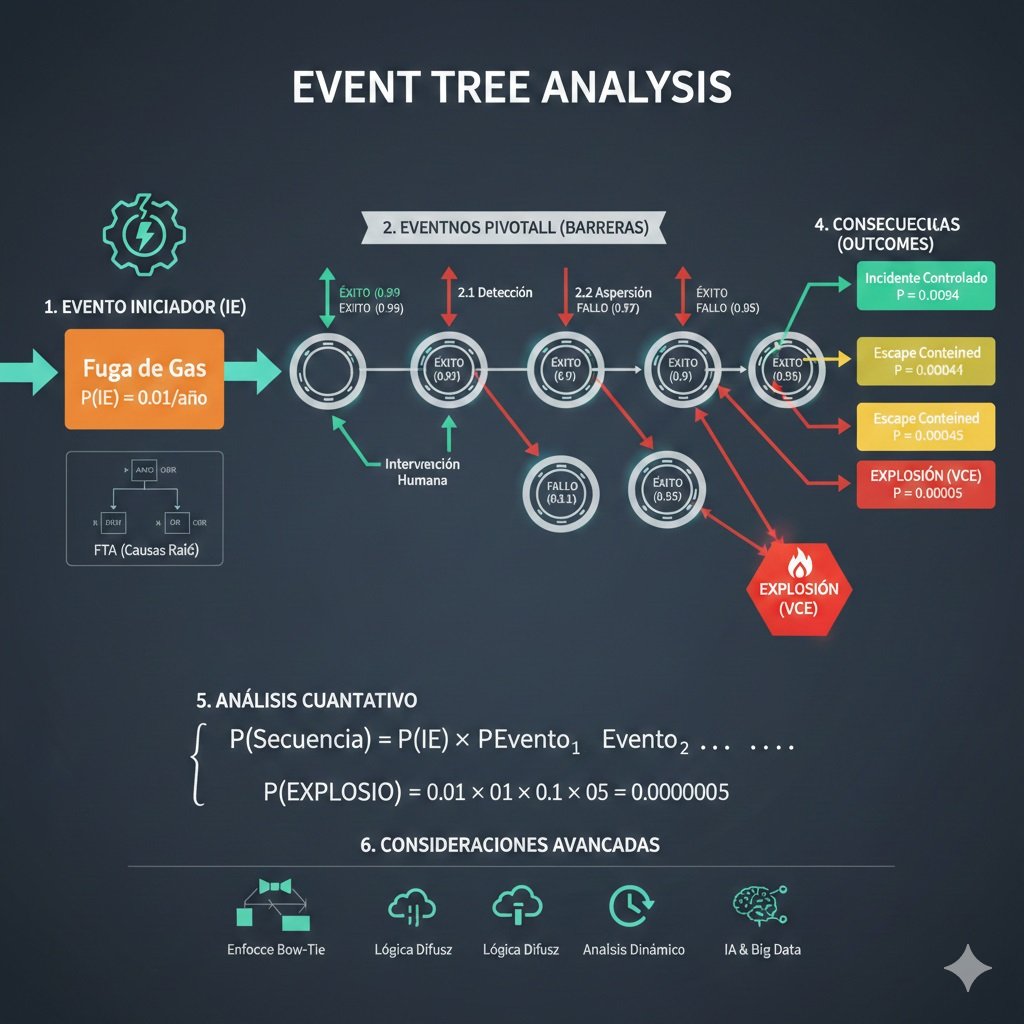
Definition of the Initiating Event (IE)
The process begins by identifying the critical event that destabilizes the system’s equilibrium.
- Selection: It must be categorized as a system failure, human error, or external disturbance (e.g., loss of containment, fire, or power failure).
- Quantification: It is vital to estimate the frequency of occurrence . In advanced hybrid models, this probability is typically derived from a prior Fault Tree Analysis (FTA), linking root causes to the triggering event.
Identification of Pivotal or Intermediate Events
The safety systems, barriers, or protocols designed to respond to the initiating event are determined.
- Chronological Sequence: Events must be ordered according to their actual execution (e.g., ).
- Nature of the Event: These can be automatic safeguards (shut-off valves) or operational actions (evacuation).
Diagram Construction and Binary Logic
The tree is developed from left to right, branching at each pivotal event.
- Bifurcation: Each node typically generates two branches: Success (upper) or Failure (lower).
- Sequence Mapping: Each complete path from the start to the outcome constitutes an “accident sequence” or specific scenario.
Definition of Consequences (Outcomes)
A final result is assigned to each branch of the tree.
- Categorization: Outcomes range from a “Controlled Incident” to catastrophic scenarios such as a Vapor Cloud Explosion (VCE).
- Impact Assessment: In high-level analysis, values for cost, time, or safety are assigned to each result for comprehensive risk management.
Quantitative Analysis and Probability Calculation
To transform the ETA into a decision-making tool, the probabilities of each sequence must be calculated.
- Conditional Probabilities: The sum of success and failure at each node must equal 1 ().
- Sequence Calculation: The probability of a specific outcome is obtained by multiplying the frequency of the initiating event by the conditional probabilities of its path:
Advanced Considerations for Operational Excellence
To elevate the analytical standard, cutting-edge techniques are integrated:
- Bow-Tie Approach: Combines ETA (consequences) with FTA (causes) for a 360° view of risk.
- Fuzzy Logic (Fuzzy ETA): Ideal when historical data is scarce, utilizing expert judgment to estimate probabilities.
- Dynamic Analysis: Overcomes the static nature of traditional ETA by considering variables that change over time or system states.
Quantitative Risk Assessment (QRA) and Probabilistic Modeling
Unlike other superficial analyses, the strategic value of Event Tree Analysis (ETA) lies in its quantification capability through conditional probability. This approach enables the transformation of a graphical representation into an actionable risk metric.
The Fundamental Equation of ETA
To calculate the frequency of a specific accident sequence (), we begin with an initiating event with a given frequency () and a series of protection systems with their respective probabilities of failure on demand (). The formula is defined as follows:
Where the product of the failure probabilities of the barriers determines the magnitude of the residual risk.
Uncertainty Management: Monte Carlo Simulation
In high-criticality projects—such as the standards managed by the U.S. Bureau of Reclamation (USBR)—the use of deterministic or fixed values is insufficient. To avoid the error of underestimating low-frequency but catastrophic events, Monte Carlo Simulation is integrated. This technique allows for modeling failure rates not as static numbers, but as probability distributions (typically Log-Normal or Gamma). By performing thousands of iterations, we obtain a robust Confidence Interval regarding the total risk, providing a much more realistic and secure outlook for financial and operational decision-making.
Comparative Analysis: Potential and Limitations of ETA
To successfully implement Event Tree Analysis, it is crucial to understand both its strategic value and the inherent restrictions of its traditional methodology.
Advantages of Using ETA
- Visualization and Logical Structure: As an inductive and diagrammatic technique, it allows for a clear visualization of how event chains propagate from a specific trigger (Abad & Naeni, 2022). It offers an unparalleled graphical description of failure combinations (Bouasla et al., 2025).
- Barrier and Consequence Evaluation: It is highly effective for modeling impact pathways in extreme events. It enables the auditing of safeguard performance (safety barriers) to determine success or failure (Branstad-Spates et al., 2025), serving as a key tool for justifying new safety investments (Raiyan et al., 2017).
- Probability Quantification: It facilitates the estimation of end-result frequencies by multiplying conditional probabilities along each path of the tree (Bouasla et al., 2025).
- Management and Training: It establishes itself as a valuable tool for decision-making and learning for disaster managers, allowing for the design of realistic training scenarios (Zwęgliński, 2022).
- Communication Clarity: The simplicity of its event chains facilitates risk communication to stakeholders, helping to identify the most significant points of failure (Branstad-Spates et al., 2025).
Critical Disadvantages and Limitations
- Static and Binary Nature: Classical models are often rigid and lack the necessary flexibility to dynamically update probabilities as new evidence emerges (Suzuki and Miller, 2026). Furthermore, its binary approach (success/failure) may oversimplify systems with multiple operational states.
- Dependencies and Common Cause Failures: Traditional Event Tree Analysis (ETA) faces difficulties in integrating multi-state variables and common cause failures (Suzuki & Miller, 2026). It is prone to overlooking subtle system dependencies that could be critical (Raiyan et al., 2017).
- Single Event Restriction: Each analysis is limited to a single initiating event (Branstad-Spates et al., 2025), which hinders the study of scenarios where multiple triggering events interact simultaneously.
- Sensitivity to Data Quality: It requires precise probabilities that are often unavailable in the industry due to incomplete historical data (Abad & Naeni, 2022). Without proper sensitivity analysis, results may be misinterpreted (El-Thalji, 2025).
- Rigidity in Complex Systems: The assumption of statistical independence may not hold true in modern high-complexity environments, potentially leading to conservative or inaccurate safety estimates (Suzuki & Miller, 2026).
Case Studies: Real-World Applications of ETA Across Diverse Industries
The versatility of Event Tree Analysis is demonstrated through its implementation in strategic sectors. The following key examples illustrate its impact:
Maritime Industry Safety
Raiyan et al. (2017) reached a milestone by applying Event Tree Analysis to study maritime accidents in Bangladesh. The study concluded that this methodology is substantially superior to conventional statistical methods. For the first time, it was possible to mathematically identify visibility as the critical factor to be addressed, enabling the prioritization of specific interventions to save lives in the region.
Infrastructure Management and Flood Protection
According to Rosqvist et al. (2013), the area with the greatest potential for Event Tree Analysis is sectoral management. Their findings highlight:
- Key Sectors: It is a vital tool for managing local power grids, residential areas, and stormwater systems.
- Impact Modeling: It is defined as a direct and effective method for projecting impact scenarios in the face of flooding.
- Strategic Framework: Its use facilitates climate change adaptation, providing asset owners and decision-makers with robust data to protect critical infrastructure.
Emergency Response with Liquefied Natural Gas (LNG)
The work of Zwęgliński (2022) validates that event trees, adapted for LNG incidents, are essential tools for training first responders. This approach allows for the evaluation of decision-making under pressure, developing critical technical and operational competencies for hazardous materials management.
Food Safety and Supply Chains
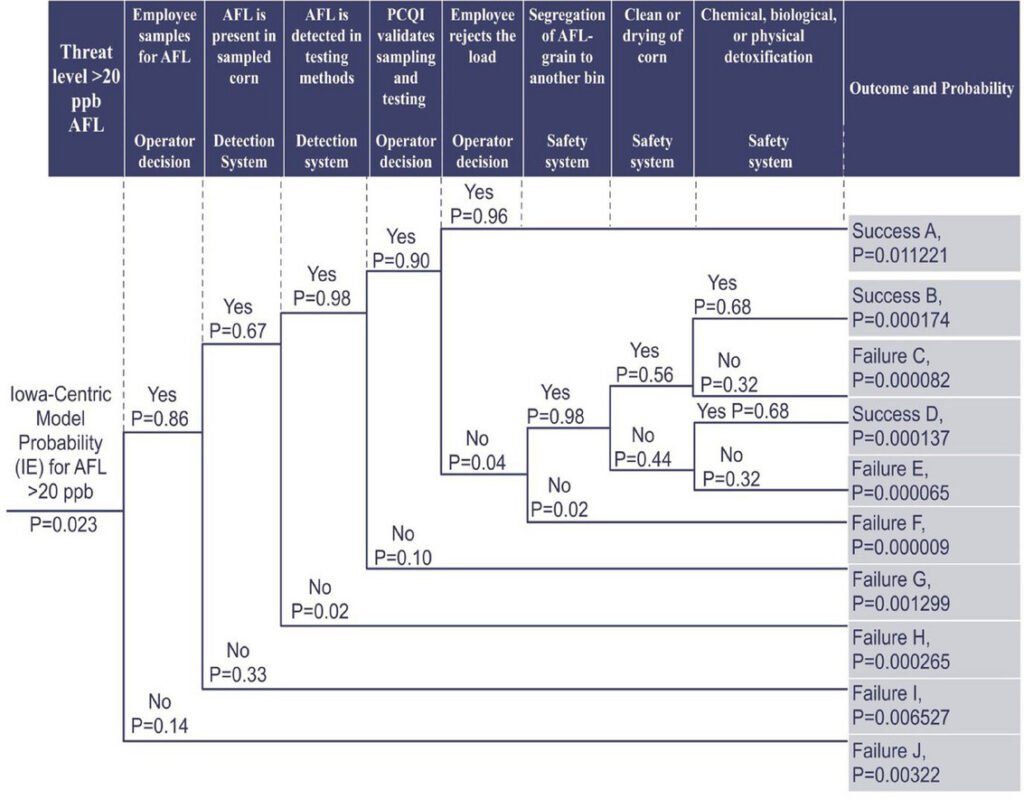
In an innovative application, Branstad-Spates et al. (2025) utilized Event Tree Analysis to model the risk of aflatoxin contamination in corn. The analysis was instrumental in identifying “Single Points of Failure” (SPF), demonstrating that the failure of a single component—such as a deficient sampling protocol—can lead to the total collapse of the food safety system.
The Future of ETA: Digital Transformation and Artificial Intelligence
Contemporary trends in Event Tree Analysis (ETA) point toward a disruptive evolution. The methodology is transitioning from a static tool toward dynamic, hybrid models powered by Big Data and Artificial Intelligence (AI).
Digitalization and Dynamism: From ETA to DETA
Kwon and Heo (2026) propose DETA (Dynamic Event Tree Analysis) as the natural evolution of the traditional method. Unlike the classical approach, DETA allows for:
- Temporal Integration: It explicitly incorporates time dynamics into event sequences.
- Operational Fidelity: It accurately models operator interventions and systemic equipment behavior, significantly enhancing the reliability of safety assessments.
Synergy with Artificial Intelligence
For their part, Thekdi et al. (2025) emphasize that while ETA is a consolidated method, its potential utility multiplies when integrated with AI processing capabilities. This convergence enables the handling of massive data volumes, transforming the analysis into a tool with greater acceptance and trust for complex decision-making.
Toward Real-Time Risk Management
Despite its enduring relevance, authors such as Suzuki and Miller (2026) warn that conventional Event Tree Analysis (ETA) must adapt to survive in highly interconnected systems. They conclude that for real-time risk management, ETA must evolve or integrate with frameworks such as Bayesian Networks, which offer superior flexibility in dynamic environments.
Trend Conclusion: ETA is not disappearing; it is being transformed through digitalization. We have moved from static paper diagrams to dynamic computational models fueled by fuzzy logic and enhanced by AI algorithms, drastically improving predictive capacity in the era of Industry 4.0.
Conclusions: ETA as a Pillar of Operational Resilience
Event Tree Analysis (ETA) reaffirms itself not merely as a modeling technique, but as an indispensable logical framework for modern reliability engineering. Throughout this analysis, we have confirmed that its ability to project inductive sequences of success and failure allows organizations to transform the uncertainty of an “initiating event” into a quantitative roadmap. Its value lies in the transparency with which it exposes critical system dependencies, enabling risk managers to pinpoint exactly where a safety barrier can make the difference between a controlled incident and a catastrophe.
However, the effectiveness of ETA in the 21st century directly depends on its integration capabilities. As previously discussed, the synergy between the deductive approach of Fault Tree Analysis (FTA) and the inductive nature of ETA—materialized in the Bow-Tie model—offers the most comprehensive view of functional safety available today. This duality is what allows industries as diverse as nuclear, maritime, and agrifood not only to react to failures but to design systems that are inherently more robust and resilient against emerging threats.
Finally, the future of ETA is being written in digital terms. The transition toward Dynamic Event Tree Analysis (DETA) and its convergence with Artificial Intelligence and Bayesian Networks marks the end of the era of static diagrams. By incorporating the temporal variable and big data processing, Event Tree Analysis (ETA) is evolving into a real-time predictive management tool. In conclusion, ETA remains the industry’s gold standard, successfully adapting to the complexity of Industry 4.0 to continue ensuring safety and operational continuity in an increasingly interconnected world.
Frequently Asked Questions (FAQ)
What is the difference between an Event Tree and a Flowchart?
Although both are graphical representations, their purposes are fundamentally different. A flowchart describes the standard or ideal sequence of a process; in contrast, Event Tree Analysis (ETA) exclusively models the deviation and failure pathways that emerge following a disruptive event. ETA focuses on the system’s response to anomalies rather than its routine operations.
Can an ETA be performed in Excel?
Yes, it is entirely feasible. Excel allows for the structuring of quantitative analysis through data tables and conditional product formulas to calculate the probability of each sequence. However, the graphical visualization of branching is limited compared to specialized risk engineering software; consequently, it is primarily utilized for the computational phase.
What does “branch dependency” signify in an ETA?
Branch dependency is a critical concept that warns against a common pitfall: assuming that all system failures are mutually independent. A rigorous analysis must account for Common Cause Failures (CCF), where a single event—such as flooding or a power outage—simultaneously disables multiple safety barriers, drastically altering the risk calculation.
In which sectors is Event Tree Analysis (ETA) mandatory?
Implementation is compulsory in high-criticality and heavily regulated industries, such as nuclear power, the chemical industry (SEVESO Directives), aviation, and the oil and gas sector. It is required whenever the risk of loss of life, significant environmental damage, or major economic loss is inherent to the operation.
What fundamental data is required to initiate an Event Tree Analysis (ETA)?
To construct a professional ETA, two pillars of information are required:
1. Historical frequency of the Initiating Event: The probability of the triggering event occurring.
2. Failure rates of protection systems: Generally expressed as the Probability of Failure on Demand (PFD) or through the Mean Time Between Failures (MTBF) of each technical safeguard.
References
Abad, F., & Naeni, L. M. (2022). A hybrid framework to assess the risk of change in construction projects using fuzzy fault tree and fuzzy event tree analysis. International Journal of Construction Management, 22(12), 2385–2397. https://doi.org/10.1080/15623599.2020.1790474
Alfonsi, A., Rabiti, C., Mandelli, D., Cogliati, J., Kinoshita, R. A., & Naviglio, A. (2013). Dynamic Event Tree Analysis Through RAVEN.
Bouasla, S. E. I., Zennir, Y., Mechhoud, E., & Rodriguez, M. (2025). Risk assessment using a structured combined method. International Journal of Safety and Security Engineering, 15(2), 383-396.
Branstad-Spates, E., Mosher, G. A., & Bowers, E. (2025). Risk assessment of aflatoxin in Iowa corn post-harvest using an event tree analysis: A case study. Risk Analysis, 45(1), 253-263. https://doi.org/10.1111/risa.15074
Cepin, M. (2011). Event Tree Analysis. In: Assessment of Power System Reliability. Springer, London. https://doi.org/10.1007/978-0-85729-688-7_6
El-Thalji, I. (2025). Emerging Practices in Risk-Based Maintenance Management Driven by Industrial Transitions: Multi-Case Studies and Reflections. Applied Sciences, 15(3), 1159. https://doi.org/10.3390/app15031159
Ferdous, R., Khan, F., Sadiq, R., Amyotte, P., & Veitch, B. (2009). Handling data uncertainties in event tree analysis. Process Safety and Environmental Protection, 87(5), 283-292. https://doi.org/10.1016/j.psep.2009.07.003
Kwon, D., & Heo, G. (2026). Integration of DICE and MELCOR for dynamic event tree analysis: Case study for RCS failure phenomena. Nuclear Engineering and Technology, 58(5), 104115. https://doi.org/10.1016/j.net.2026.104115
Mokhtarzadeh, M., Rodríguez-Echeverría, J., Semanjski, I. et al. Hybrid intelligence failure analysis for industry 4.0: a literature review and future prospective. J Intell Manuf 36, 2309–2334 (2025). https://doi.org/10.1007/s10845-024-02376-5
Purba, J. H., Sony Tjahyani, D., Widodo, S., & Ekariansyah, A. S. (2020). Fuzzy probability based event tree analysis for calculating core damage frequency in nuclear power plant probabilistic safety assessment. Progress in Nuclear Energy, 125, 103376. https://doi.org/10.1016/j.pnucene.2020.103376 x
Raiyan, A., Das, S., & Islam, M. R. (2017). Event Tree Analysis of Marine Accidents in Bangladesh. Procedia Engineering, 194, 276-283. https://doi.org/10.1016/j.proeng.2017.08.146
Rosqvist, T., Molarius, R., Virta, H., & Perrels, A. (2013). Event tree analysis for flood protection—An exploratory study in Finland. Reliability Engineering & System Safety, 112, 1-7. https://doi.org/10.1016/j.ress.2012.11.013
Suzuki, K., & Miller, R. (2026). Probabilistic reliability analysis of complex engineering systems under uncertainty using Bayesian networks. International Journal of Computational and Biological Sciences, 3(1).
Thekdi, S., Tatar, U., Santos, J., & Chatterjee, S. (2025). On the compatibility of established methods with emerging artificial intelligence and machine learning methods for disaster risk analysis. Risk Analysis, 45(4), 863-877. https://doi.org/10.1111/risa.17640
Zweglinski, T. (2022). Conventional Event Tree Analysis on Emergency Release of Liquefied Natural Gas. International Journal of Environmental Research and Public Health, 19(5), 2961. https://doi.org/10.3390/ijerph19052961

Editor and founder of “Innovar o Morir” (‘Innovate or Die’). Milthon holds a Master’s degree in Science and Innovation Management from the Polytechnic University of Valencia, with postgraduate diplomas in Business Innovation (UPV) and Market-Oriented Innovation Management (UPCH-Universitat Leipzig). He has practical experience in innovation management, having led the Fisheries Innovation Unit of the National Program for Innovation in Fisheries and Aquaculture (PNIPA) and worked as a consultant on open innovation diagnostics and technology watch. He firmly believes in the power of innovation and creativity as drivers of change and development.