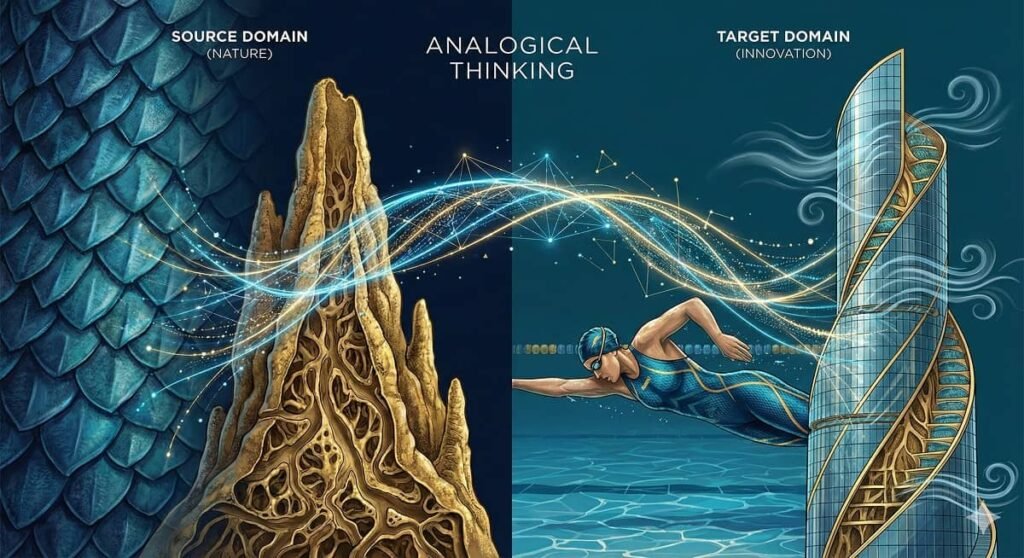
In an environment saturated with data and algorithmic analysis, the human capacity to connect seemingly unconnected concepts has established itself as a critical competitive advantage. Analogical thinking is not merely a rhetorical device; it represents the cognitive engine behind the most significant scientific breakthroughs and the most disruptive business innovations of our era.
The deliberate use of analogical thinking, under appropriate constraints, reliably enhances idea generation and problem-solving. In this sense, it constitutes an accessible pathway to fostering creativity (Callaos and Horne, 2024), an essential competency for addressing the challenges of modern business (Gruner, 2025). In fact, various research studies directly link this cognitive process with the capacity to generate disruptive innovation (Gassmann and Zeschky, 2008).
In this article, we will break down the essence of analogical thinking, its differentiation from other mental models, and the keys to implementing it in the resolution of complex problems.
Key Points
- Competitive Advantage and Creativity: In a world saturated with data, connecting unconnected concepts is a critical advantage that fosters the disruptive innovation necessary for modern business. Analogical thinking acts as a fundamental engine for creative expression at all levels.
- Differentiation Between Thinking and Reasoning: It is vital to distinguish that analogical thinking is a global and intuitive cognitive style, whereas analogical reasoning is the logical and sophisticated procedure that allows one to navigate uncertainty with precision. Thinking tells us “this is like that,” but reasoning validates the “how” and “why.”
- Impact on Innovation and Strategy: In the corporate sphere, originality is not random; it depends on the quantity and type of analogies employed in the design of business models. Cases such as Netflix or the use of “shopping carts” on the web demonstrate how analogies reduce user friction and break established paradigms.
- Risks and Error Mitigation: Not all connections are valid; it is imperative to avoid the false analogy and the fixation effect on old models that no longer explain current technological reality. Analogical success requires a high degree of trial, error, and conscious deliberation.
- Synergy with Artificial Intelligence: The future of analogical thinking lies in a hybrid workflow where humans provide the induction of creative schemas, and AI handles the massive processing of structural data to find solutions in distant domains.
What is Analogical Thinking? Conceptual Framework
Analogical thinking is defined as the mental capacity to identify common patterns between situations, objects, or domains that, at first glance, lack any relationship. It is a process of knowledge transfer from a familiar system (the source) toward a new or unknown system (the target).
As highlighted by Cvjetinović and Pavlović (2024), this thinking acts as a fundamental engine for creativity in various fields. Analogies find application at all levels of expression, from the most mundane personal discoveries to the innovations that transform the course of history.
Etymology and Structure of the Relationship
The word “analogy” derives from the Greek ana (according to) and logos (reason or proportion). Technically, analogical thinking can be summarized as the search for a “proportion of relationships.” The objective is not for the objects to be identical, but for the way their components interact to be equivalent.
Analogical Representation in the Mind
From a psychological perspective, analogical representation is a form of mental coding where the structure preserves the spatial and structural properties of the real world. Unlike a propositional representation (based on phrases or linear logic), the analogical one functions as a dynamic “mental map” that allows for rotating, scaling, and comparing concepts within our psyche to find innovative solutions.
Key Differences: Analogical Thinking vs. Analogical Reasoning
Although often used interchangeably in everyday language, a fundamental technical distinction exists within cognitive sciences and pedagogy. According to Callaos and Horne (2024), the difference between analogical thinking and reasoning lies primarily in their scope, intention, and level of deliberation.
Analogical Thinking: The Cognitive Style
Analogical thinking constitutes the overarching framework or “mindset” that predisposes an individual to establish connections. It is a way of processing reality that prioritizes association over fragmentation, allowing for a more holistic and fluid vision. This process often occurs subconsciously, manifesting as that “spark” of intuition that links two distinct worlds.
Analogical Reasoning: The Structural Process
Conversely, analogical reasoning is the logical and sequential procedure through which these connections are validated. If thinking is the vision, reasoning is the execution. As noted by Douven et al. (2025), this is not a mere vestige of informal logic, but a highly sophisticated information-processing system. Its application enables professionals to navigate uncertainty with precision, drawing well-founded conclusions in the target domain.
Table 01. Technical Comparison: Analogical Thinking vs. Analogical Reasoning.
| Criterion | Analogical Thinking | Analogical Reasoning |
| Nature | Cognitive style and open mindset. | Logical and procedural process. |
| Degree of Awareness | Frequently intuitive and spontaneous. | Deliberate, structured, and conscious. |
| Primary Function | Generating ideas, hypotheses, and visions. | Solving problems and justifying conclusions. |
| Structure | Associative and divergent. | Comparative and convergent ($A:B :: C:D$). |
| Practical Example | Observing an anthill and visualizing a transport network. | Analyzing anthill flows to optimize GPS algorithms. |
In essence, while analogical thinking suggests that “this is like that,” analogical reasoning allows us to conclude that “since this works in A, it must work analogously in B.” It is important to note that while all analogical reasoning stems from prior analogical thinking, not all associative thought succeeds in consolidating into formal reasoning (Callaos and Horne, 2024).
Fundamental Attributes of Analogical Thinking
As noted by Koronis et al. (2023), analogical reasoning is an imperative component for enhancing creativity. To master this faculty, it is essential to understand the intrinsic characteristics that distinguish it from conventional problem-solving methods:
- Relational Abstraction: The ability to filter out superficial “noise” or irrelevant data to identify the underlying logical structure of a phenomenon.
- Mental Flexibility: The skill to transpose concepts between disparate domains (for example, applying principles of organic architecture to user interface design).
- Generative Productivity: A single well-structured analogy can act as a catalyst for multiple solutions to the same challenge.
- Uncertainty Management: It allows for effective operation in ambiguous environments or those without clear rules, using prior knowledge as a strategic compass.
- Multidimensionality: It is not limited exclusively to text; it manifests through images, sounds, spatial models, and physical metaphors.
Analogical Thinking in Education: Building Cognitive Bridges
The integration of analogies in the development of critical thinking is a vital tool for meaningful learning. This process allows students to build “cognitive bridges,” connecting prior knowledge schemas with new and complex concepts. According to Holyoak et al. (2024), tasks that require the generation of relational similarities between dissimilar scenarios—known as far-domain analogies—are fundamental engines for fostering a creative and resilient mindset in the classroom.
Applications of Analogical Reasoning by Discipline
To illustrate its effectiveness, let us observe how analogical reasoning facilitates the comprehension of abstract concepts:
- In Biology: The conceptualization of the cell as a factory. The nucleus acts as the command center or executive office, while the mitochondria function as the power plants driving production.
- In Physics: Understanding electric current through the water flow (hydraulic) analogy. Voltage is associated with water pressure, current with the flow rate, and resistance with the diameter of the pipe.
- In History: The comparative analysis between the fall of the Roman Empire and contemporary geopolitical tensions. This relationship allows students to project possible consequences and understand power cycles.
Verbal Analogical Thinking: Logic and Abstraction
Verbal analogical thinking is one of the most valued competencies in academic aptitude assessments. This skill requires the student to identify the intrinsic logical relationship between word pairs, abstracting the function or category above literal meaning. For example, in the relationship:
Scalpel : Surgeon :: Brush : Painter (Relationship: Tool is to Professional)
Success in these types of exercises does not depend on isolated vocabulary, but on the ability to decipher the “proportion of relationships” mentioned previously.
Analogical Thinking in Business: The Engine of Strategic Innovation
In today’s dynamic corporate environment, analogical thinking has consolidated itself as the cornerstone of disruptive innovation. According to Dahl and Moreau (2002), originality in the creation of new products is not a random phenomenon; on the contrary, it is intrinsically linked to the quality and diversity of the analogies employed. Their findings suggest that success lies in the ability to bypass the limits of pre-existing mental models to explore truly novel solutions.
Complementing this view, Garaus et al. (2025) emphasize that this cognitive faculty is an essential component for creativity in business model design, allowing organizations to redefine their value propositions in saturated markets.
How Do Leaders Implement This Strategy?
The application of analogical reasoning allows for the transposition of proven solutions from one industry to challenges in entirely different sectors:
- Problem Solving: Faced with a user retention crisis, a SaaS (Software as a Service) company may find the solution by analyzing airline loyalty programs. Success lies not in the code, but in replicating the structure of incentives and belonging.
- User Experience (UX) Design: The success of modern interfaces is based on physical analogies. The “shopping cart” in e-commerce is a cognitive bridge that translates a familiar physical action into the digital environment, eliminating friction and facilitating conversion.
- Business Model Disruption: The case of Netflix is emblematic. The company applied the “gym” analogy—a fixed monthly fee for unlimited access—to the consumption of audiovisual content. This model transfer definitively broke the pay-per-unit (rental) scheme that sustained giants like Blockbuster.
Analogical Thinking in Science and Technology: The Engine of Discovery
The evolution of scientific knowledge has been, in essence, a chronicle of transformative analogies. When linear logic reaches its limits, the ability to extrapolate models from one domain to another has allowed for the breaking of historical paradigms:
- Archimedes and Hydrostatics: The Greek scientist used the analogy of water displacement in his own bathtub to solve the dilemma of measuring the volume of a gold crown, laying the foundation for the principle of buoyancy.
- Kekulé and Organic Chemistry: The ring structure of benzene was revealed after a dream where a snake bit its own tail. This visual analogy allowed Kekulé to conceive of a circular structure at a time when only linear chains were considered.
- Bionics as a Discipline: This entire field represents analogical thinking applied to functional design. Examples include high-performance swimwear inspired by shark skin or architectural climate control systems based on the structure of termite mounds.
Overcoming “Intellectual Blockage”
Beyond grand milestones, analogical thinking is a fundamental methodological tool today. Bowie and Quinton (2022) underscore its effectiveness in overcoming mental blocks and resolving complex challenges in academic research, particularly in sectors such as tourism and hospitality.
Their studies indicate that when conventional logical and deductive methods prove insufficient, analogical thinking offers a cognitive escape route. By providing alternative frames of reference, it allows for the unlocking of self-imposed restrictions and the visualization of solutions that were previously invisible under traditional analysis.
Challenges and Fallacies: The Risks of Analogical Reasoning
Despite its undeniable utility, analogical thinking is not infallible. As revealed by the study by Kim and Horii (2016), the effectiveness of this process depends on precise technical execution. Their research identifies two critical error groups: transfer inability (when we fail to apply the logic of one field to another) and recognition failure (when we do not detect a potentially useful analogy).
To mitigate these risks, it is imperative to apply rigorous critical thinking regarding the following biases and fallacies:
The False Analogy Fallacy
This logical error occurs when assuming that because two elements share a common characteristic, they are identical in all other aspects.
Critical Example: “Since alcohol is a legal substance, other substances with more severe psychoactive effects should also be legal.” Here, the similarity in category (“substance”) is ignored, as it does not imply equivalence in social or biological impact.
Availability Bias
This consists of resorting to the first analogy that comes to mind—generally the most recent or emotionally impactful—instead of making the cognitive effort to seek a structurally precise relationship. In business, this can lead to replicating popular success models that do not fit the architecture of one’s own company.
Fixation Effect
This represents stagnation in an old mental model or analogy that, while useful in the past, no longer explains the reality of an emerging market or new technology. Fixation prevents the cognitive restructuring necessary for true innovation.
Practical Guide: Strategies for Developing Analogical Thinking
Science confirms that creativity is not a fortuitous event. Dahl and Moreau (2002) demonstrate a positive and statistically significant correlation between the volume of analogies employed and the originality of the final product. The use of analogies acts as an inexhaustible “wellspring of ideas” that nourishes the entire design and ideation process.
To master this faculty, Lin et al. (2023) suggest that training executive attention is key. This process requires a two-step sequence: first, “disengagement” (clearing mental noise and prior biases) and, second, relational integration (effectively connecting disparate pieces of information).
Far-Domain Innovation
Fostering innovation requires organizations to encourage their teams to explore multiple knowledge bases. According to Gassmann and Zeschky (2008), seeking solutions in divergent domains is infinitely superior to simple benchmarking or the redesign of existing products. For this to be effective, senior management must adopt a strategic intent that includes:
- Active Questioning: A willingness to challenge proprietary technologies, even if it involves cannibalizing successful products.
- External Openness: A receptive attitude toward solutions developed outside the industry of origin.
- Overcoming “Not Invented Here” (NIH) Syndrome: Encouraging the exploration of distant fields to break away from conventional mindsets.
Activities to Strengthen Analogical Thinking
If you wish to boost this skill within your team, implement the following dynamics:
- The “Stranger in the Night” Technique: Present a technical challenge from your company to a professional from an opposing field (an artist, a chef, or a biologist). Their “outsider’s view” and the analogies they use to understand your problem will reveal solutions that traditional technical analysis often overlooks.
- Analogical Dictionary: Use a comparative structure to demystify complex concepts.
| Complex Concept | Everyday Object | Connection Point (Relationship) |
| Cloud Computing | An all-you-can-eat buffet | You pay for access and consume only what you need at the moment. |
| Blockchain | A shared ledger | Everyone has a copy, and no one can erase what has already been written. |
- Analogical Role-Playing: In brainstorming sessions, propose solving the problem from the perspective of another entity: How would NASA handle our customer service? or How would Apple manage our logistics?
Synergy with Artificial Intelligence
Analogical thinking can be scaled through Artificial Intelligence (AI). Kittur et al. (2019) propose a workflow where humans provide schema induction, and AI handles massive data processing. This process is divided into:
- Abstraction: Defining the functional purpose of the problem.
- Search: Using AI to find similar structures in distant domains.
- Application: Transferring findings into a final solution.
Note for Product Designers: According to Koronis et al. (2023), visual stimuli are more effective than textual ones in promoting novelty, as images highlight similarities between unrelated concepts more efficiently.
Cognitive Synergy: Analogical, Analytical, and Critical Thinking
These methodologies are often conflated; however, each serves a specific function within the decision-making architecture. Understanding their boundaries is vital for any professional seeking to optimize their intellectual performance.
Table 02. Comparative Analysis of Thinking Models.
| Feature | Analogical Thinking | Analytical Thinking | Critical Thinking |
| Focus | Connective and associative. | Deconstructed and logical. | Evaluative and reflective. |
| Process | Identifies structural similarities. | Breaks the whole into components. | Questions the validity of premises. |
| Objective | Generate ideas or new perspectives. | Understand technical functionality. | Judge truthfulness or quality. |
| Practical Example | “This software operates like a digital immune system.” | “Let’s deconstruct the code to find the origin of the error.” | “Is this architecture the most ethical and efficient solution?” |
What is the Difference Between Analytical and Critical Thinking?
It is fundamental not to treat them as synonyms. Analytical thinking focuses on how a system works through detailed segmentation. Conversely, critical thinking focuses on why we should validate information, evaluate evidence, and detect biases.
As Kao (2014) points out, analogical thinking acts as a creative bridge between the two: it allows the depth of analysis and the rigor of criticism to unite, generating disruptive solutions that neither method could achieve in isolation.
Conclusion: The Future of Innovation Belongs to the “Connectors”
Ultimately, analogical thinking transcends simple comparison; it constitutes the strategic competency of transposing wisdom from one context to another to solve unprecedented problems. In a labor market in constant metamorphosis, leadership in the next frontier of disruption will not necessarily belong to those with the most data, but to those who master the balance between structural reasoning and creative thinking.
Do not limit yourself merely to processing information; identify the analogies that underlie the data. It is highly probable that the next great revolution in your industry already exists in a completely different field, waiting for a connecting mind to establish the definitive link. Innovation does not always consist of inventing something from scratch, but of possessing the cognitive acuity to see which pieces of someone else’s puzzle fit perfectly into your own.
Frequently Asked Questions
What is analogical thinking? Simple examples included
Analogical thinking is the cognitive capacity to comprehend a novel concept by drawing parallels with a familiar one. For instance, explaining a computer firewall through the analogy of a building’s security guard effectively illustrates its core function: monitoring inbound and outbound traffic to safeguard the system’s integrity.
What is the primary distinction between analogical and analytical thinking?
Analytical thinking is inherently deconstructive, partitioning a whole into its constituent parts to decipher technical functionality from a micro perspective. In contrast, analogical thinking is associative, identifying linkages across diverse systems to synthesize meaning and structural patterns from a macro perspective.
What is the importance of analogical thinking in Artificial Intelligence?
It is regarded as one of the most formidable challenges in the field today. While contemporary AI excels at statistical pattern recognition, the capacity to perform creative ‘analogical leaps’—extrapolating logic to novel contexts absent from its training data—remains a pivotal frontier in the quest for Artificial General Intelligence (AGI).
What are verbal analogical thinking activities?
Verbal analogical thinking activities are exercises specifically engineered to discern logical relationships between disparate concepts. They serve as a cornerstone of academic aptitude assessments, as they foster both expansive vocabulary and relational logic—for instance, the classic analogy: ‘Sun is to day as Moon is to night.
Is analogical thinking the same as lateral thinking?
While distinct, they are inextricably linked. Lateral thinking, pioneered by Edward de Bono, serves as the overarching framework for creative problem-solving, whereas analogical thinking operates as one of the most potent instruments within that paradigm to synthesize novel perspectives.
Why can analogical reasoning fail?
Failure primarily arises from the false analogy fallacy, which occurs when correspondences between two systems are merely superficial. Such errors manifest when the domains lack the structural mapping or internal logic necessary for a valid and accurate cross-domain knowledge transfer.
How can I improve my analogical capacity?
The cornerstone is cognitive diversity: immerse yourself in disciplines outside your own field, observe patterns within the natural world, and engage in the habitual practice of deconstructing technical concepts through everyday metaphors.
References
Bowie, D., & Quinton, S. (2022). A tapestry analogy: Analogical thinking to support academic research. Tourism Management, 91, 104529. https://doi.org/10.1016/j.tourman.2022.104529
Cvjetinović, V. Z., & Pavlović, Z. M. (2024). Analogies as a potential for expressing creativity at different levels. Zbornik radova Filozofskog fakulteta u Prištini, 54(2), 345-370.
Callaos, N., & Horne, J. (2024). Analogical and Logical Thinking: In the Context of Inter- or Trans-disciplinary Communication and Real-Life Problems. International Institute of Informatics and Systemics.
Dahl, D. W., & Moreau, P. (2002). The Influence and Value of Analogical Thinking during New Product Ideation. Journal of Marketing Research. https://doi.org/10.1509/jmkr.39.1.47.18930
Douven, I., Verheyen, S., Elqayam, S. et al. Analogical reasoning: a Carnapian approach. Synthese 205, 185 (2025). https://doi.org/10.1007/s11229-025-04991-y
Garaus, C., Konlechner, S. and Lettl, C. (2025), Problem-Solving Strategies for Creativity in Business Model Design: A Configurational Study. J. Manage. Stud.. https://doi.org/10.1111/joms.13200
Gassmann, O., & Zeschky, M. (2008). Opening up the Solution Space: The Role of Analogical Thinking for Breakthrough Product Innovation. Creativity and Innovation Management, 17(2), 97-106. https://doi.org/10.1111/j.1467-8691.2008.00475.x
Gruner R. 2025. Unlock Creativity Through Analogical Thinking. MIT Sloan Management Review.
Holyoak, K. J., Ichien, N., & Lu, H. (2024). Analogy and the Generation of Ideas. Creativity Research Journal, 36(3), 532–543. https://doi.org/10.1080/10400419.2023.2232673
Kao, C. (2014). Exploring the relationships between analogical, analytical, and creative thinking. Thinking Skills and Creativity, 13, 80-88. https://doi.org/10.1016/j.tsc.2014.03.006
Kim, E., & Horii, H. (2016). Analogical thinking for generation of innovative ideas: An exploratory study of influential factors. Interdisciplinary Journal of Information, Knowledge, and Management, 11, 201-214.
Kittur, A., Yu, L., Hope, T., Chan, J., Lifshitz-Assaf, H., Gilon, K., … & Shahaf, D. (2019). Scaling up analogical innovation with crowds and AI. Proceedings of the National Academy of Sciences, 116(6), 1870-1877.
Koronis, G., Casakin, H., & Silva, A. (2023). An experimental comparison of analogy representation effects on creative outcomes. The Journal of Creative Behavior, 57(4), 711-729.
Lin, Y., Li, Q., & Chen, A. (2023). The causal mechanisms underlying analogical reasoning performance improvement by executive attention intervention. Human Brain Mapping, 44(8), 3241-3253. https://doi.org/10.1002/hbm.26278

Editor and founder of “Innovar o Morir” (‘Innovate or Die’). Milthon holds a Master’s degree in Science and Innovation Management from the Polytechnic University of Valencia, with postgraduate diplomas in Business Innovation (UPV) and Market-Oriented Innovation Management (UPCH-Universitat Leipzig). He has practical experience in innovation management, having led the Fisheries Innovation Unit of the National Program for Innovation in Fisheries and Aquaculture (PNIPA) and worked as a consultant on open innovation diagnostics and technology watch. He firmly believes in the power of innovation and creativity as drivers of change and development.