Artificial Intelligence (AI) has evolved beyond its experimental phase to emerge as a pragmatic utility across virtually every sector. The discipline of Strategic Foresight—critical for organisational resilience and long-term governance—is no exception. Today, AI is radically transforming how organisations detect, interpret, and act upon signals of change.
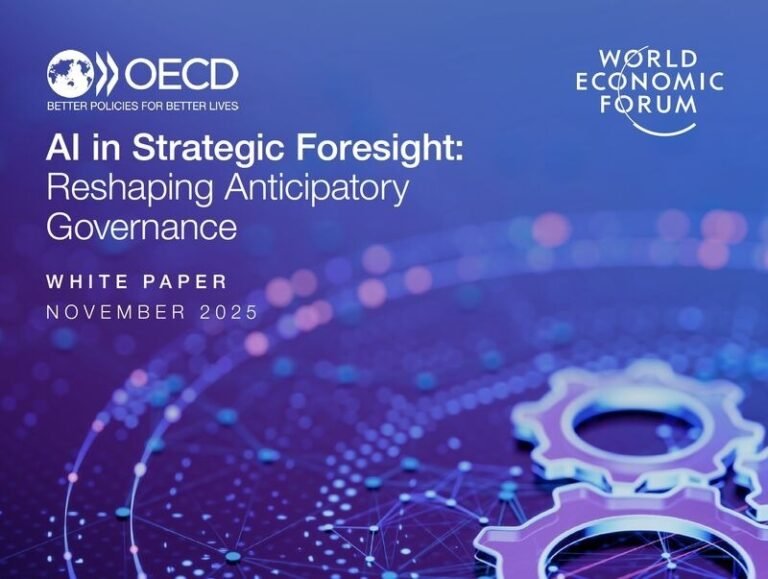
A recent white paper, collaboratively developed by the Organisation for Economic Co-operation and Development (OECD) and the World Economic Forum (WEF), provides a comprehensive landscape analysis of the sector. Based on a survey of 167 experts across 55 countries, the evidence is unequivocal: the discipline is in transition. With two-thirds of respondents already integrating AI into their workflows, the profession stands at a pivotal inflexion point.
Key findings
- A clear consensus prevails: AI is supplementary. Its primary value lies in automating massive data processing and drafting, yet it does not replace human judgment.
- Efficiency and Speed: The most reported benefit (39%) is time savings through the streamlining of repetitive tasks. Furthermore, its capacity to analyse vast datasets (17%)—which would be unmanageable manually—is highly valued.
- The Challenge of Quality and Ethics: The main barriers include a lack of technical expertise and governance dilemmas. Concerns revolve around reliability, model “hallucinations,” and the opacity of algorithms (the “black box” problem).
- The Skills Gap: An alarming disparity is evident. While 93% of the private sector feels competent in AI usage, the public sector (53%), civil society (57%), and academia (59%) report significantly lower confidence levels.
Methodology: A Global Empirical View
The analysis by the OECD and WEF is grounded in data collected in mid-2025. The sample includes experts from high-level networks such as the WEF’s Global Foresight Network, the OECD’s Government Foresight Community, and the Dubai Future Foundation.
This study offers the first empirical assessment of how AI is redefining the methodologies, accessibility, and ecosystem of Anticipatory Governance.
The Technological Ecosystem in Foresight
Most professionals opt for standard commercial tools (off-the-shelf solutions). The usage ranking is led by:
- CoPilot (22%)
- ChatGPT/OpenAI (16%)
- Claude (12%)
- Gemini (12%)
What is AI used for?
Primary functions include Trend Analysis and Clustering (69%), Scenario Development (63%), and Horizon Scanning (60%), which is vital for identifying weak signals of change.
The 3 Levels of Maturity in AI Integration
The survey classifies technology adoption into three evolutionary stages:
- Level 1: AI for Analysis Augmentation (Majority)
Usage is limited to basic research tasks: data synthesis and initial scanning. Tools accelerate workflow by 10-15%, acting as supplements that still require exhaustive human supervision. - Level 2: AI as a Creative “Sparring Partner”
Here, AI acts as an idea generator and a mechanism to stress-test human content. It helps systematise signals and propose scenario structures, generating a tangible boost in productivity and creativity. - Level 3: Integrated and Customised AI (Still Rare)
AI is fused with the entire foresight process. Customised tools are employed for complexity mapping and pattern detection. There is active experimentation with automating signal detection and visualising alternative futures.
Risks: Quality, Bias, and Ethics
Despite the enthusiasm, experts maintain critical reservations regarding the reliability of results:
- Hallucinations and Opacity: The lack of clear logic in some responses necessitates a considerable investment of time in fact-checking.
- Limited Inductive Reasoning: By relying on pre-existing knowledge, AI struggles to identify unknown disruptions or low-probability signals—elements that are the heart of strategic foresight.
- Data Biases: There is concern regarding reliance on historical data, which is predominantly Western and English-centric, potentially restricting truly global analysis.
- The Ethical Gap: Only 27% of experts have formal ethical guidelines within their organisations. Most rely on informal norms, which, combined with data security restrictions in the public sector, hamper deep experimentation with sensitive documents.
The Future of the Profession: Change Management
The final consensus is that AI risks are contextual and depend on governance. To ensure AI acts as a positive catalyst, the report suggests:
- AI Literacy: Closing the skills gap in the public sector through intensive training.
- Fostering Experimentation: Encouraging professionals to move from basic use (Level 1) to creative partnership (Level 2).
- Robust Ethical Frameworks: Developing formal protocols regarding data security, accountability, and intellectual property.
Conclusion
The study marks a watershed moment for foresight. Although AI offers unprecedented analysis speed, its successful integration is not a technical challenge, but a strategic one. Given that AI feeds on the past, the human capacity to imagine extreme scenarios and detect the “invisible” is more critical than ever to ensure resilient anticipatory governance.
Reference (Open Access):
Organisation for Economic Co-operation and Development & World Economic Forum. (2025). AI in Strategic Foresight: Reshaping Anticipatory Governance (White Paper). World Economic Forum. 22 p.

Editor and founder of “Innovar o Morir” (‘Innovate or Die’). Milthon holds a Master’s degree in Science and Innovation Management from the Polytechnic University of Valencia, with postgraduate diplomas in Business Innovation (UPV) and Market-Oriented Innovation Management (UPCH-Universitat Leipzig). He has practical experience in innovation management, having led the Fisheries Innovation Unit of the National Program for Innovation in Fisheries and Aquaculture (PNIPA) and worked as a consultant on open innovation diagnostics and technology watch. He firmly believes in the power of innovation and creativity as drivers of change and development.