The 5 Whys technique is an iterative inquiry method designed to unveil the cause-and-effect relationships underlying a specific problem. Its core objective is to identify the root cause of a failure through the systematic repetition of the question: ‘Why?’.
In fields such as Quality Management and Lean Manufacturing, this tool is distinguished by its pragmatism; rather than relying on complex statistical analysis, it is grounded in rigorous logical reasoning. Operating under the premise that visible incidents are typically symptoms rather than the actual issue, delving through five levels allows for the removal of superficial layers. This approach ensures that the source is addressed, thereby preventing the recurrence of the anomaly.
In this article, we will explore everything from its philosophical foundations to advanced logical validation tactics, providing both a technical and human perspective to transform operational errors into sustainable competitive advantages.
Key Takeaways: Everything You Should Know About the 5 Whys
- Root Cause Identification: The primary purpose is not merely to address visible symptoms—such as stopping a leak—but to delve deeper until the original systemic failure is identified, thereby preventing problem recurrence.
- Methodological Complementarity: This is not a standalone tool. Its maximum efficacy is achieved when integrated with the Ishikawa Diagram (for breadth) and Value Stream Mapping (VSM).
- Reverse Logical Validation: To ensure the analysis is sound, the “Therefore Test” is employed. If the causal chain fails to make sense when read backward, the analysis contains logical “cracks.”
- Iterative Flexibility: The number “5” is a guideline. The inquiry must persist—whether for 3 or 7 levels—until it reaches a process or behavior that the organization has the power to modify or control.
- Limitations in Complex Systems: In high-variability environments, such as healthcare or cybersecurity, the technique can be overly simplistic if it fails to recognize that failures are often multi-causal and non-linear.
- The Vital Human Dimension: The tool’s success hinges on psychological safety. If the team fears retaliation, they will withhold information. The focus must always be to “fix the process, not punish the person.”
What is the 5 Whys Methodology?
The 5 Whys technique is an iterative inquiry method designed to explore the underlying cause-and-effect relationships of a specific problem. Its primary objective is to determine the root cause of a defect by systematically repeating the question: “Why?”. In this process, each response forms the logical foundation for the subsequent inquiry.
Within modern management, this method is established as a fundamental tool of Root Cause Analysis (RCA), sharing an ecosystem with robust methodologies such as the Ishikawa Diagram, Pareto Analysis, Fault Tree Analysis (FTA), and Failure Mode and Effects Analysis (FMEA), among other technical validation frameworks (Pazhayattil & Sharma, 2025).
The Concept: Root Cause vs. Symptom
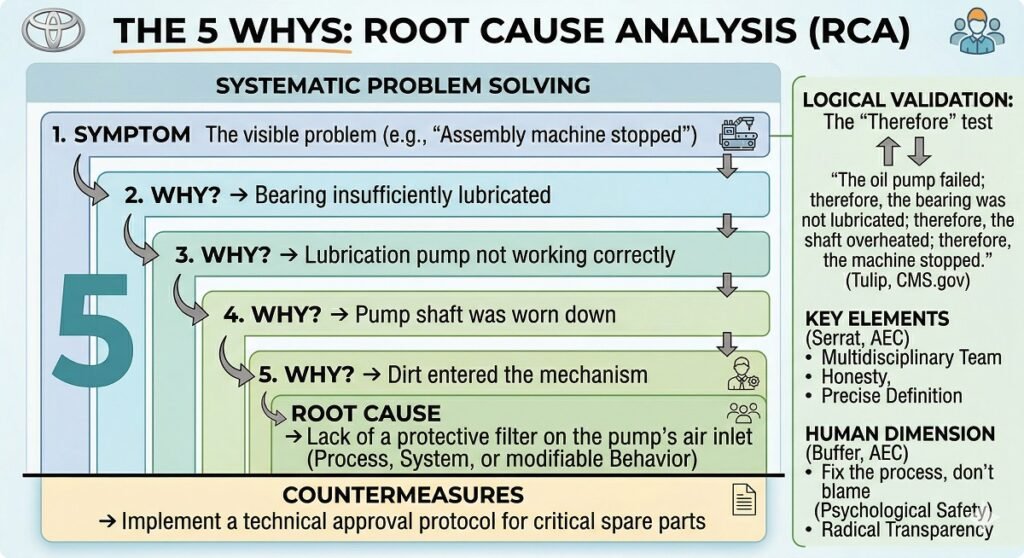
A critical error in problem-solving is limiting action to the symptom. If a machine stops, the downtime is the visible manifestation; restarting it is merely a superficial fix. However, the root cause might be a worn bearing due to a lack of lubrication, which in turn stems from a faulty oil pump. The 5 Whys technique compels the team to transcend the obvious to identify the systemic failure, ensuring the problem does not recur.
- Symptom: The external manifestation of the problem (e.g., “The production line stopped”).
- Root Cause: The fundamental reason for the event (e.g., “Absence of preventive maintenance sensors in the annual budget”).
Historical Origin: The Toyota Legacy and Philosophy
The origin of this tool is typically attributed to the 1930s, specifically to Sakichi Toyoda (Serrat, 2017), founder of Toyota Industries. Toyoda implemented this rule in automatic loom manufacturing so operators could diagnose faults in real-time. Later, Taiichi Ohno, the architect of the Toyota Production System (TPS), popularized it as a pillar of Lean philosophy. Nevertheless, the intellectual genealogy of the “whys” has much deeper roots in classical philosophy:
- Plato and “Meno”: Exploring how knowledge arises from understanding underlying causes.
- Aristotle: Who established that true knowledge involves understanding material, formal, efficient, and final causes.
- Leibniz: Who, as early as 1671, utilized iterative questioning schemes to dissect complex logical problems.
How Does the 5 Whys Technique Work? (A Step-by-Step Guide)
Implementing Root Cause Analysis through the 5 Whys requires more than mere curiosity; it demands facilitator discipline and absolute team honesty. According to Serrat (2017), the effectiveness of this technique lies in systematic resolution and rests upon three pillars:
- Accurate and comprehensive problem statements.
- Total honesty when responding.
- The determination to reach and resolve the origin of the conflict.
Step 1: Form a Multidisciplinary Team
The 5 Whys analysis should never be performed in isolation. A diversity of perspectives is vital to avoid bias. As noted by the Spanish Association for Quality (AEC), “mature groups” are required to prevent the session from devolving into a search for culprits.
- Facilitator: Guides the session, maintains focus, and neutralizes personal conflicts.
- Process Experts: Technical or operational personnel who interact with the problem daily.
- Affected Parties: Representatives from departments suffering the direct consequences.
Key (2019) reaffirms that having trained facilitators significantly elevates resolution efficacy, offering an immediate return on investment by achieving faster consensus.
Step 2: Define the Problem Statement
A poorly defined problem leads to irrelevant root causes. It is imperative to avoid ambiguities:
- Poor Definition: “The system failed.”
- Professional Definition: “The database server overloaded at 10:15 AM, causing 20 minutes of downtime in the Northern Region.”
Jones (2021) warns that personal opinions often cloud judgment. For the tool to work, it is crucial to rely on real data, solid evidence, and continuous experimentation, eliminating all assumptions.
Step 3: Execute the Questioning Sequence
Initiate the sequence by asking why the defined problem occurred. Each answer must be a factual statement:
- Why did the [Problem] occur? Answer A.
- Why did [Answer A] occur? Answer B.
- Why did [Answer B] occur? Answer C… and so forth.
Step 4: Iterate Until the Root Cause is Identified
Although the technique is called “5 Whys,” the actual number may vary between three and seven iterations. You will know you have reached the bottom when the answer points to a process, system, or behavior that is susceptible to being modified or controlled.
Step 5: Implement Countermeasures
The success of the technique lies not in the discovery, but in the execution. Specific countermeasures must be defined to neutralize the root cause and prevent the problem from manifesting again in the future.
Logic Validation: The “Therefore” Method
One of the greatest risks when applying the 5 Whys is constructing a flawed or forced logical chain. To mitigate this bias, experts from Tulip and CMS.gov suggest two essential technical validation methods to ensure the integrity of the analysis:
The Reverse Flow Test
Once the chain of five responses has been established, perform a reading in reverse order by integrating the logical connector “and therefore.” This exercise allows you to verify if the causal relationship is robust and natural.
Example: “The oil pump failed; therefore, the bearing received no lubrication; therefore, the shaft overheated; therefore, the machine stopped.”
If the narrative does not flow coherently in reverse, it is an indicator that the analysis contains logical “cracks” that must be reviewed.
The Validation Question
Upon identifying the purported root cause, subject it to the following critical inquiry: “If I correct this specific element, is it likely that the original problem will recur?”
- If the answer is “Yes”: You have not reached the root cause, but rather a contributing factor. You must continue deepening the inquiry.
- If the answer is “No”: You have successfully identified the origin of the failure and can proceed to implement the countermeasure.
Comparative Analysis: 5 Whys vs. the Ishikawa Diagram
It is common to present the Ishikawa Diagram (Fishbone) and the 5 Whys as mutually exclusive tools; however, in professional practice, they are deeply complementary. Moso and Olanrewaju (2024) emphasize that the 5 Whys operate most effectively when integrated with the Ishikawa diagram—which categorizes the problem to focus the solution—and the analysis of the eight types of waste (Muda).
Furthermore, Al-Rifai (2025) recommends this analytical hybridization to enhance problem-solving capabilities within teams, suggesting that the combination of both tools offers a 360-degree view of any operational failure.
| Feature | 5 Whys | Ishikawa Diagram (Fishbone) |
| Complexity | Simple to moderate problems. | Complex, multi-causal problems. |
| Structure | Linear and vertical (Depth). | Branched and categorized (Breadth). |
| Execution Time | Rapid (15–30 minutes). | Extensive (1–3 hours). |
| Primary Focus | Identifying the Root Cause. | Identifying Contributing Factors. |
Winning Strategy: The Hybrid Approach
To achieve high-impact results, utilize the Ishikawa Diagram to map all possible categories of a deviation (Method, Manpower, Machinery, etc.). Once the 2 or 3 most likely causes have been identified, apply the 5 Whys technique to “drill down” through the surface and find the definitive solution.
Practical Applications and Success Stories of the 5 Whys
Although the 5 Whys technique originated in the industrial sector, its adoption has expanded across various strategic fields due to its effectiveness in revealing systemic failures.
- Education and Society: Francis (2021) reports that this technique accelerates the understanding of social inequalities, allowing students to identify the oppressive structures underpinning injustices beyond visible symptoms.
- Sales Management: Nainggolan and Wiyarni (2024) employed the method as a cornerstone of Root Cause Analysis (RCA) to detect underlying factors in an organization’s revenue decline.
- Healthcare Sector: It is one of the most widely used approaches in patient care (Card, 2017). Recently, Surve et al. (2026) applied it to uncover the root causes of critical incidents during apheresis processes, ensuring safety in platelet collection.
Application Examples in Professional Environments
Industrial Safety: Workplace Accident
- Problem: An operator suffered a fall in the assembly shop.
- Why did it occur? There was an oil slick on the floor.
- Why was there oil? A nearby machine leaked.
- Why did the machine fail? The gasket seal broke due to excessive pressure.
- Why did the seal break? A low-quality material, unsuitable for that specific operation, was used.
- Root Cause: The procurement system prioritizes minimum cost without validating engineering technical specifications.
- Countermeasure: Implement a mandatory technical approval protocol for critical spare parts.
Software Development & IT: Deployment Failure
- Problem: The deployment of the new app version failed in production.
- Why did it fail? An environment variable was not configured.
- Why was it omitted? The lead engineer forgot to upload it manually.
- Why was it manual? The automation script did not support dynamic variables.
- Root Cause: The script architecture is obsolete, and the technical debt backlog is not reviewed during quarterly planning.
Manufacturing: The Classic Case (Paper Production)
As noted by Henny et al. (2023), this technique is a deep diagnostic often applied after Value Stream Mapping (VSM) to eliminate waste.
- Problem: A machine stopped due to an overload.
- Why did it occur? The bearing lacked sufficient lubrication.
- Why did the lubrication fail? The pump was malfunctioning due to wear on its shaft.
- Why did it wear out? Dirt entered the internal mechanism.
- Root Cause: Absence of a protective filter at the pump’s air intake.
Advantages, Challenges, and Criticisms: Is the 5 Whys Technique a Panacea?
As with any management tool, the 5 Whys is not a universal solution. Its effectiveness depends on understanding its scope and, above all, its limitations in high-complexity environments. Maric and Cajner (2025) note that while the technique is excellent for solving single-cause problems in manufacturing, its greatest value lies in the initial project definition phase, where it has a statistically significant impact on overall success.
Competitive Advantages
- Operational Efficiency: It requires no investment in software or external consultancy; it is a “zero-cost” tool.
- Culture of Critical Thinking: It fosters the Lean philosophy, training teams to question the surface level of problems.
- Agility: It enables rapid decision-making based on direct observation (Genchi Genbutsu).
Challenges and Critical Limitations
Despite its prestige, figures such as Teruyuki Minoura (former Toyota executive) and authors like Card (2017) have identified significant methodological flaws:
- Lack of Repeatability: The analysis is subjective. Different teams facing the same problem may reach different root causes depending on their prior knowledge. As Serrat (2017) warns, one cannot ask “why” about something the team does not know.
- The Risk of Linearity: The technique assumes simple causality. In complex adaptive systems—such as healthcare or cybersecurity—failures are typically multi-causal. Card (2017) suggests that focusing on a single causal path can overlook up to 97% of systemic improvement opportunities.
- Confirmation Bias: There is a tendency for facilitators to guide the questioning toward suspected solutions, transforming the exercise into a validation of prejudices rather than genuine discovery.
- Simplism vs. Simplicity: For Shimatani et al. (2024), the direct leap toward a solution and the lack of logical branching can render the tool “simplistic” when applied to education or complex organizational structures.
The Reality in Data (2025 Study)
A critical analysis by Al-Rifai (2025) on the actual implementation of the 5 Whys revealed alarming data:
- 48.4% of the analyses lacked a logical cause-and-effect sequence.
- 22.0% failed to identify the root cause.
- Only 34.1% of cases managed to complete the ideal cycle (clear statement, identification, preventive action, and verification).
Expert Recommendation: To mitigate these risks, the expert consensus is to always verify responses in situ and complement the technique with broader-spectrum tools, avoiding stopping at the fifth “why” if the logic is not yet sound.
The Human Dimension: Psychological Safety and Transparency
A critical aspect that technical manuals often overlook is the emotional impact. Without an environment of trust, failure analysis can be perceived as a punitive interrogation rather than a tool for improvement.
Anxiety Management: The AEC Approach
For the technique to be effective, the leader must guarantee that the goal is to optimize the process, not to punish the individual. According to the guidelines of the Spanish Association for Quality (AEC), if the team feels fear, they will tend to withhold vital information to protect themselves, thereby invalidating the integrity of the entire root cause analysis.
Radical Transparency: The Buffer Success Case
The technology company Buffer has elevated the 5 Whys to a pillar of its organizational culture. Upon concluding an analysis, they share a detailed report with the entire company that includes the problem, the chain of whys, and the implemented solutions. This practice achieves:
- Neutralizing Rumors: It eliminates internal speculation regarding failures.
- Collective Learning: It transforms a specific error into a lesson for the entire structure.
- Resolution Culture: It reinforces that the organization values honesty and problem-solving over non-existent “perfection.”
Resources and Implementation: Tools and Templates
To facilitate the adoption of the 5 Whys into your workflow, several formats are available to suit your operational needs:
- Excel Matrices / Spreadsheets: The ideal option for maintaining a centralized historical record of incidents, allowing for the filtering and analysis of root cause trends.
- PDF Templates or Physical Formats: Analog tools are recommended for in-person brainstorming sessions, where the goal is to eliminate the distraction of digital devices.
- Digital Whiteboards (Miro / Mural): Interactive solutions perfect for remote teams requiring visual and collaborative connection of ideas in real-time.
Conclusion: The 5 Whys technique is, in essence, a bridge between technical logic and human wisdom. Its success does not depend on the sophistication of the software used, but on the team’s ability to delve deep with rigor and honesty in the pursuit of operational excellence.
Conclusion: From Curiosity to Organizational Resilience
The 5 Whys technique transcends its origin as a Toyota operating rule to establish itself as a philosophy of continuous improvement. It is a direct invitation to maintain curiosity in the face of failure and to delve deep into the actual causalities of our processes. By adopting this analytical rigor, organizations cease to be victims of circumstance and transform into architects of resilient and efficient systems.
Regardless of the tool you choose—whether an Excel matrix or a collaborative whiteboard session—remember that success lies not in documenting the “what,” but in unveiling the “why.” Implement this methodology within your structure today and witness how recurring problems give way to a culture of strategic learning and high performance.
Frequently Asked Questions (FAQ) about the 5 Whys Technique
What is the primary objective of the 5 Whys?
The fundamental objective is to identify the root cause of a problem, rather than merely mitigating its superficial symptoms. By asking “why?” iteratively, the goal is to unveil the systemic failure which, once corrected, will prevent the issue from recurring in the future.
Who invented this methodology?
It is historically attributed to Sakichi Toyoda, founder of Toyota Industries, in the 1930s. It was subsequently refined by Taiichi Ohno as a pillar of the Toyota Production System (TPS). Nevertheless, its intellectual roots trace back to the classical philosophy of Plato, Aristotle, and Leibniz.
Is it mandatory to ask exactly five times?
No. The number “5” is merely a guideline. Depending on the complexity of the problem, the root cause may be found at the third “why” or may require seven or more levels. You will know you have reached the end when the response points to a process, system, or behavior that can realistically be modified.
How does it differ from an Ishikawa Diagram?
While the 5 Whys delves linearly into a single causal chain (depth), the Ishikawa Diagram (or Fishbone) explores multiple categories of causes simultaneously (breadth). Both tools are complementary; it is recommended to use Ishikawa to map the problem and the 5 Whys to drill down into the most likely causes.
What is the “Therefore Test”?
It is a logical validation test. It consists of reading the chain of responses in reverse order using the connector “therefore.” If the logic does not flow naturally when read backward, it is likely that the analysis is flawed or contains unjustified logical leaps.
What are the primary criticisms of this method?
The most common criticisms highlighted by experts include:
– Lack of Repeatability: Different teams may arrive at divergent conclusions for the same problem.
– Excessive Linearity: It may overlook the fact that in complex systems, failures are typically multi-causal.
– Facilitator Bias: The analysis is constrained by the existing knowledge and inherent prejudices of the participants.
Can it be applied outside the industrial sector?
Absolutely. The article details successful applications in software development (IT), healthcare, education, and sales management, demonstrating that it is a versatile tool for any discipline seeking continuous improvement.
How does it relate to Six Sigma?
Within Six Sigma, the 5 Whys are utilized during the “Analyze” phase of the DMAIC cycle (Define, Measure, Analyze, Improve, Control) to delve deeper into the critical variables identified.
When should the 5 Whys NOT be used?
Do not use it for extremely complex or chaotic problems (such as a global public relations crisis or a multi-organ system failure). In such cases, more robust systems thinking tools are required.
References
Al-Rifai M (2025), “Unlocking insights: evaluating 5Whys methodology for root cause analysis and employee problem-solving skills in 91 case studies“. International Journal of Lean Six Sigma, Vol. 16 No. 5 pp. 1276–1304, doi: https://doi.org/10.1108/IJLSS-04-2024-0077
Card AJ. 2017. The problem with ‘5 whys’. BMJ Quality & Safety 2017;26:671-677.
Francis, D. M. (2021). Using root cause analysis to help students examine social problems. Teaching Journalism & Mass Communication, 11(1), 61-64.
Henny, H., Alhakim, G. S., Budi, A. H. S., & Aditya, M. (2023). Improving lean manufacturing system using value stream mapping analysis. Journal of Engineering Science and Technology, 18(4), 1949-1956
Jones, G. (2021, febrero). Getting to Know a Lean & Six Sigma Leader. Lean & Six Sigma Review, 20(2), 32.
Key, Barbara A., “Five Whys Root Cause System Effectiveness: A Two Factor Quantitative Review” (2019). Masters Theses & Specialist Projects. Paper 3098. https://digitalcommons.wku.edu/theses/3098
Maric, A., & Cajner, H. (2025). Effects of Personality Type Tools and Problem-Solving Methods on Engineering Company Project Success. Sustainability, 17(24), 11185. https://doi.org/10.3390/su172411185
Moso, M., & Olanrewaju, O. A. (2024). An Application of Lean Techniques to Construct an Integrated Management Systems Preventive Action Model and Evaluation: Kaizen Projects. Processes, 12(6), 1069. https://doi.org/10.3390/pr12061069
Nainggolan, Andreas Maruli Tatar and Wiyarni, Wiyarni (2024) Analyzing Sales Challenges with Root Cause Analysis to Enhance Business Process. Asian Journal of Economics, Business and Accounting, 24 (6). pp. 450-463. ISSN 2456-639X
Pazhayattil, A.B., Sharma, S. (2025). Root Cause Analysis (RCA) Methods. In: Pharmaceutical Manufacturing Deviation and Failure Investigations. AAPS Introductions in the Pharmaceutical Sciences, vol 3. Springer, Cham. https://doi.org/10.1007/978-3-031-86504-6_2
Serrat, O. (2017). The Five Whys Technique. In: Knowledge Solutions. Springer, Singapore. https://doi.org/10.1007/978-981-10-0983-9_32
Shimatani, Y., Nishita, Y., Kano, T., Takahashi, G., Fujii, T., & Dohmoto, M. (2024). Introducing a new framework for implementing a “Five Whys” analysis to deal with issues related to complex structures in Project Design education. Journal of JSEE. (Traducción al inglés de un artículo publicado originalmente en Journal of JSEE, Vol. 72, No. 5, pp. 70-74)
Surve, B., Dewanji, C., Khanna, A., Saha, S., & Ojha, S. 2026. When Technology Falters: Ensuring Donor Safety and System Reliability Amid Apheresis Technical Challenges. Artificial Organs. https://doi.org/10.1111/aor.70097

Editor and founder of “Innovar o Morir” (‘Innovate or Die’). Milthon holds a Master’s degree in Science and Innovation Management from the Polytechnic University of Valencia, with postgraduate diplomas in Business Innovation (UPV) and Market-Oriented Innovation Management (UPCH-Universitat Leipzig). He has practical experience in innovation management, having led the Fisheries Innovation Unit of the National Program for Innovation in Fisheries and Aquaculture (PNIPA) and worked as a consultant on open innovation diagnostics and technology watch. He firmly believes in the power of innovation and creativity as drivers of change and development.